
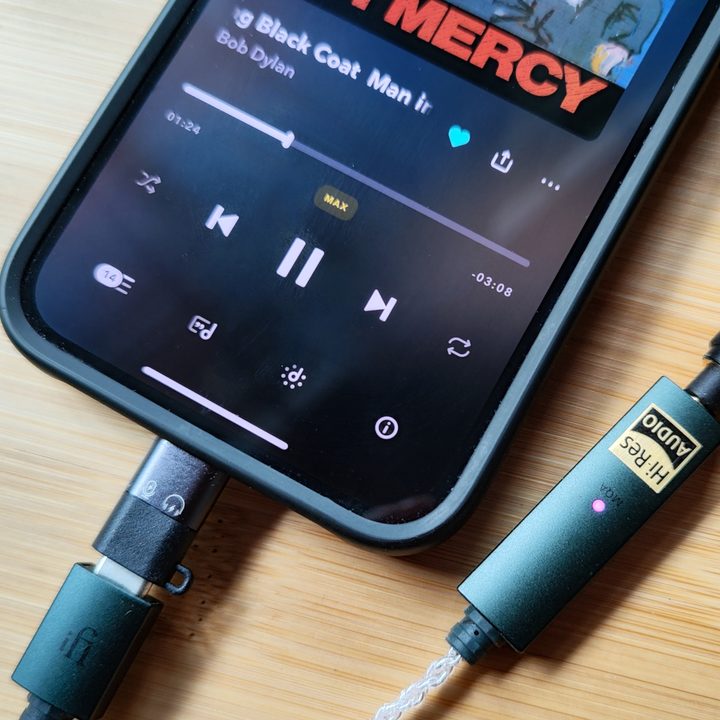
When Tidal CEO Jesse Dorogusker announced in April 2023 that the music service would soon be adding lossless hi-res audio in the open-source FLAC format, a lot of folks cheered the move. And by a lot of folks, I mean audiophiles who have never been happy with Tidal’s decision to use the controversial MQA format as its sole better-than-CD quality option. Right or wrong, it looked like the addition of hi-res FLAC would be the perfect compromise: when available, a listener could hear the FLAC version of their favorite track, and Tidal seemed to indicate that it will be keeping MQA as well, which made this seem like a win for all concerned.
But that’s not what has happened.
I was granted early access to Tidal’s beta app so I could hear the new FLAC tracks for myself, and what I discovered makes no sense at all.
First, a little backstory to help set the stage. Tidal historically has provided three service tiers. There’s a free tier with advertising and really limited audio quality (160kbps max). Then there’s Tidal HiFi, which is what most listeners likely use thanks to its competitive $10-per-month price (increasing to $11 in August) and lossless, CD-quality FLAC streaming. But for really serious listeners, Tidal’s HiFi Plus at $20 per month has always been the star, with access to the full catalog of CD-quality tracks, plus an extended “Master” collection of better-than-CD quality in MQA.


It’s this HiFi Plus tier that has undergone a renovation. The Master designation is now a thing of the past. It’s been replaced with “Max,” a move that I’m guessing is an effort to distance the HiFi Plus tier from its previous reliance on MQA, which by the way, stands for “Master Quality Authenticated.”
Master or Max? Who cares? As long as this label is associated to hi-res FLAC when you want it, it shouldn’t really matter. But therein lies the problem. According to Tidal, “Max” means “you’re getting the best quality version of any song” on the service. That best quality version might be FLAC, or it might be MQA. And there’s no way to know which one you’re streaming without connecting your phone to an external digital-to-analog converter (DAC) that can tell the difference between the two formats.
To be clear: when listening to Max tracks, there is no additional indicator on the playback screen or anywhere else, for that matter, that shows you if the track in question is FLAC or MQA.
To make matters worse, there’s no way to filter Max tracks by your format preference. In the new quality settings for mobile data or Wi-Fi streaming, there are only three choices: Low, High, and Max, with no additional options for FLAC or MQA.
I know what you’re thinking: what happens when a track exists as both a hi-res FLAC and as MQA? Which one wins? According to a Tidal spokesperson, it’s FLAC. Specifically: “If a track exists in both and a user has selected Max, the HiRes FLAC will be prioritized over the MQA version. If a HiRes FLAC version (a FLAC version that is at least 24-bit, 48 kHz) does not exist then the MQA version will be the source file.”
What I can tell you is that every track in my favorites that was previously labeled as “Master” quality still lights up the MQA indicator on my external DAC, even with the new “Max” label. I guess this means that Tidal hasn’t acquired the hi-res FLAC versions (yet).
One exception I found was John Mayer’s 2006 album Continuum. Previously, this was a collection of Master tracks in MQA. But it now exists only as a Max version in FLAC, highlighting once again the problem of not being able to choose formats. Presumably, some Tidal listeners won’t be happy that Continuum is no longer streaming in MQA.
I also asked if this inability to differentiate (or choose) between the the formats would be fixed soon. I was told that there are no plans to do so “at the moment.”
I’m going to give Tidal the benefit of the doubt and say that there’s no way this was an oversight. I don’t believe it’s trying to make it hard to get the content you want. But the cynic in me thinks there’s only one good reason why the company has merged FLAC and MQA into a single tier with no way to choose — it’s planning to eventually migrate its entire catalog over to FLAC, at which point the MQA versions will simply go away. And because you can’t pick the one you’re streaming, it will all happen invisibly. One day, you’ll wake up and the MQA indicator on your DAC won’t light up for any Max tracks.
Tidal clearly hoped that by offering FLAC alongside MQA, it would appease picky audiophiles while maintaining its loyal MQA fanbase (Tidal remains the only major streaming service to support MQA). But this new design seems destined to frustrate and anger both groups. It really is the worst of both worlds, and something Tidal needs to get straight before releasing it to the public.


