

Qualcomm just announced two new Snapdragon chips, one that dramatically increases the performance available to next-generation VR headsets, and another that expands the capabilities of new smart glasses.
The Snapdragon XR2 Gen 2 takes over for the original XR2 chip. Qualcomm launched the XR2 Gen 1 in 2020 and it quickly became the processor of choice for almost every manufacturer of VR and XR headsets with advanced tracking capabilities.
Qualcomm announced the AR2 Gen 1 in 2022, but we haven’t seen them in any glasses yet. Now, we know Qualcomm has been in progress on the chip that will greatly advance the capabilities of affordable smart glasses. When AR2 Gen 1 glasses launch, most likely in 2024, it will bring us closer to the full potential of augmented reality glasses. The new release is the AR1 Gen 1, a less demanding chip that still offers advanced capabilities.
Snapdragon XR2 Gen 2 brings VR power
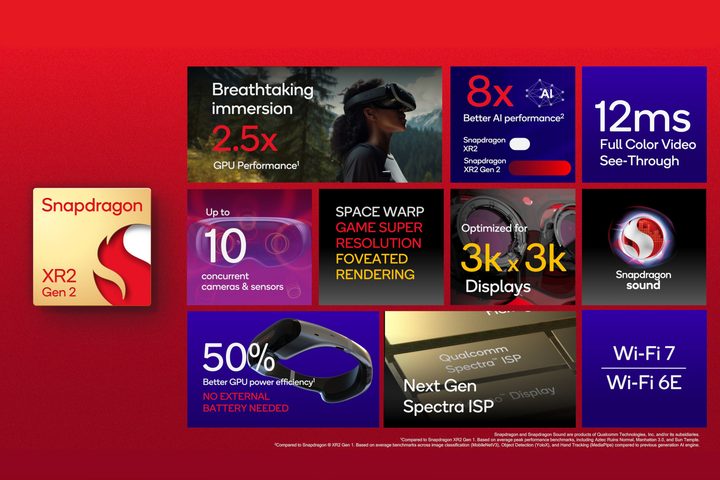
After a three-year gap in updates, it’s not surprising that the Snapdragon XR2 Gen 2 brings remarkable gains in speed and efficiency. Qualcomm says it has 2.5 times the GPU performance of the XR2 Gen 1, while delivering 50% better power efficiency. AI performance is eight times better.
The Snapdragon XR2 Gen 2’s CPU features two performance cores and four efficiency cores, outpacing even the speedy Snapdragon 8 Gen 2, according to Said Bakadir, Qualcomm XR product and business lead. It will also enable VR headsets to run multitask apps and games faster than ever.
That might equate to better image quality, faster frame rates, longer battery life, lighter VR headsets, or more sensors. The mix of those upgrades depends on each manufacturer’s design goals.
The Snapdragon XR2 Gen 2 moves visual analytics from software to silicon for faster and more accurate tracking. Qualcomm’s press briefing included a video of people playing ping pong with actual paddles, table, and ball,– while wearing VR headsets. The latency of about 12 milliseconds lets you move quickly in mixed reality without a big lag.
The new Qualcomm chip will support up to 3K-by-3K resolution, with on-chip super resolution, foveated rendering, and space warp. If you’re unfamiliar with those last three terms, they’re all techniques that improve graphics quality without slowing down frame rates.
The Snapdragon XR2 Gen 2 supports Qualcomm FastConnect and Wi-Fi 6E and 7, providing up to 5.8 Gbps of bandwidth while using 25% less power with 80% lower latency. That should improve the quality and reliability of streaming content and wireless PC VR connections.
Meta’s new Quest 3 VR headset is the first to get the Qualcomm Snapdragon XR2 Gen 2, unlocking more exciting gaming and mixed reality experiences. [link to Meta Quest 3 hands-on]
Since the Snapdragon XR2 Gen 2 brings big performance gains, other standalone VR headset manufacturers will be eager to launch competing solutions. It’s an exciting time for virtual reality.
Snapdragon AR1 Gen 1 make glasses smarter
Qualcomm’s Snapdragon AR1 Gen 1 will make smart glasses more intelligent, adding some AR features we’ve been anticipating.
Until now, smart glasses used low-power chips designed for watches or overpowered VR chips like the XR2 Gen 1. Smartwatch processors limit the capabilities of smart glasses and VR chips aren’t efficient enough for lightweight and long-lasting smart glasses.
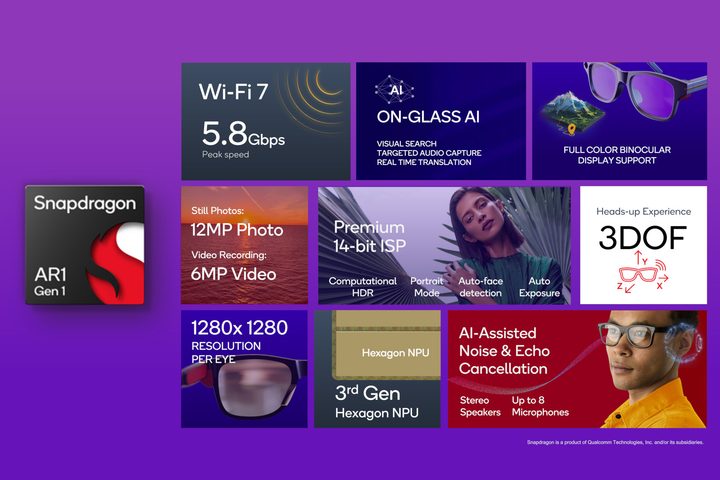
The Snapdragon AR1 Gen 1 should make smart glasses much more useful, adding on-glass AI that manufacturers can use for real-time translations, visual search, and noise cancellation.
Qualcomm claims the image capture of devices with this chip can be as good as those you get with your smartphone. 12MP resolution photos with on-chip HDR should bring a significant improvement in quality.
The Snapdragon AR1 Gen 1’s video resolution is only 6MP, however. You’ll still need to carry your smartphone to get the best videos. The first-person perspective and instant access of smart glasses is a compelling argument for photo- and video-capable glasses.
Qualcomm chips have capabilities that often go untapped. The Snapdragon AR1 Gen 1 supports audio-only, single, and stereo displays. If smart glasses include displays, the chip supports up to 1280-by-1280 resolution per eye.
Tracking supports three degrees of freedom (3DoF) so virtual objects remain fixed in space around you when you turn your head, but travel with you as you walk. The AR2 Gen 1 features more advanced 6DoF tracking that anchors virtual objects when you move.
Wi-Fi 7 and Bluetooth 5.2 and 5.3 support speed connectivity without draining battery life. The chip also supports fitness sensors, opening the door to smart glasses replacing smartwatches.
Qualcomm worked closely with Meta on the Snapdragon AR1 Gen 1, and it’s the processor used in the second-generation Ray-Ban Stories smart glasses.


