  1. Home
  2. Computing
  3. News

Qualcomm and Samsung are teaming up to fight Apple’s Vision Pro

Add as a preferred source on Google

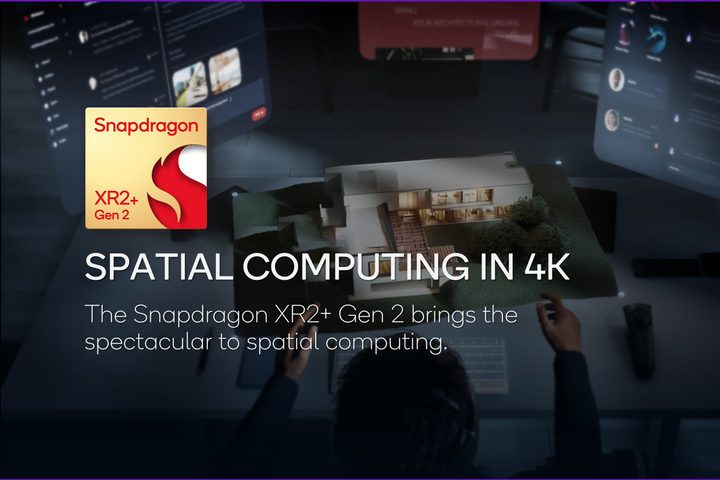
Snapdragon XR2+ Gen 2 is designed for spatial computing.
The Snapdragon XR2+ Gen 2 is designed for spatial computing. Qualcomm

Qualcomm just launched the Snapdragon XR2+ Gen 2, a new spatial computing processor that will power Samsung’s XR headset that will compete with Apple’s Vision Pro. The key features are support for super-sharp displays, multi-camera tracking, and a boost in performance to meet the challenging hardware demands of an immersive workspace.

Recommended Videos

Qualcomm is the leading supplier of XR chips for a variety of manufacturers and led the way with the first mixed reality VR headsets featuring color passthrough, like the Meta Quest Pro, HTC Vive XR Elite, and Pico 4 Enterprise. Moving into spatial computing, however, takes even more processing power.

Compared to the maximum 3K-per-eye resolution of the Snapdragon XR2 Gen 2, the new plus variant (Snapdragon XR2+ Gen 2) supports up to four times as many display pixels at 4.3K-per-eye, which is twice the image sharpness for each eye at 90Hz. That makes a difference when viewing multiple virtual screens with text and detailed, immersive content. The resolution can be tuned for higher frame rates if needed. For example, a 120 Hz refresh rate is possible at 3.7K-per-eye.

The Snapdragon XR2+ Gen 2 can process 12 cameras to accurately track your environment, head, hands, and eyes, and supports multiplexing to handle more if needed. That should allow perfect synchronization of your movements with virtual objects for a convincing mixed reality experience and the ability to identify subtle hand gestures.

To process these hardware challenges, Qualcomm increased the GPU frequency by 15% and boosted the CPU clock by 20%. With improved performance, more than 4K graphics resolution at 90Hz, and support for 12 or more tracking cameras, XR headsets based on this chip have enough processing power to make for compelling spatial computing headsets.
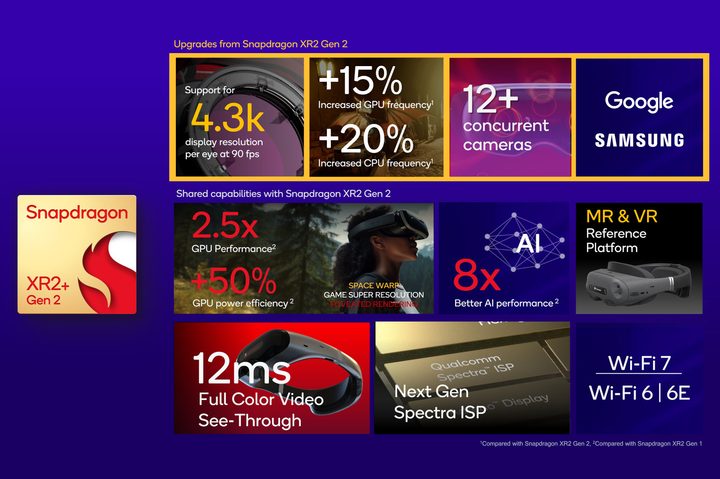
Qualcomm's Snapdragon XR2+ Gen 2 platform summary.
Qualcomm’s Snapdragon XR2+ Gen 2 platform summary. Qualcomm

Qualcomm said more than five manufacturers are working on new headsets with the Snapdragon XR2+ Gen 2. Samsung and Google are partnering on an Apple Vision Pro challenger. HTC and Immersed, a virtual desktop app developer, are also in progress on headsets with the Snapdragon XR2+ Gen 2.

Qualcomm’s latest announcement follows a string of impressive new processors, including the Snapdragon XR2 Gen 2 chip used in Meta’s Quest 3 VR headset, the Snapdragon AR1 Gen1 in the Ray-Ban Meta Smart Glasses, and the Snapdragon X Elite for Windows laptops that combines efficiency and performance to compete well against Apple’s M3 MacBook Pro.

Samsung’s rival to the Vision Pro is still unannounced, but clearly the fight for spatial computing is on, and the Snapdragon XR2+ Gen 2 will play an important role.


Alan Truly
Alan Truly is a Writer at Digital Trends, covering computers, laptops, hardware, software, and accessories that stand out as…
ChatGPT is recommending scam websites that will steal your credit card info
The chatbot is surfacing fraudulent clones of defunct retail brands, and scammers are deliberately engineering sites to game its recommendations.
ChatGPT running on a laptop.

Scammers have found a new way to reach shoppers: getting ChatGPT to do their marketing for them. According to The Guardian, scam-checking service Ask Silver found that OpenAI's chatbot is recommending fraudulent retail websites built to harvest payment details from unsuspecting buyers. The sites mimic real storefronts and use official-looking URLs, making them difficult to spot without scrutiny.

Defunct brands are a prime target

Read more
McDonald’s new AI drive-thru has to prove it can handle hungry people
After its earlier ordering bot became a punchline, McDonald’s is testing a new system that promises fewer human handoffs.
Architecture, Building, Hotel

McDonald’s is bringing AI back to the drive-thru with a new Google-backed system called ArchIQ, also known as Archy. It’s starting in five locations under the company’s broader “> NEXT” technology push, with a franchisee claiming the system has already handled more than 1 million orders.

The bigger number is the one McDonald’s needs people to trust. About 90% of those orders reportedly needed no human intervention. That sounds promising, but this is not a clean reset. Its earlier IBM-backed AI drive-thru experiment ended after viral mistakes turned automated ordering into a public punchline.

Read more
Logitech’s Mobi Fold is a pocketable folding mouse for folks who despise trackpads
Logitech’s Mobi Fold looks like a tiny productivity taco
Logitech Mobi Fold

Laptop trackpads are fine until you get really busy. Editing a spreadsheet in an airport lounge, juggling tabs in a café, or trying to do proper work on a tiny hotel desk can make you miss the convenience of a mouse. Logitech has the answer to this with the new Mobi Fold, its first ultra-portable foldable mouse.

While a small portable mouse is something people carry, many choose to skip the added bulk, simply choosing to bite the bullet with the trackpad. But the Logitech Mobi Fold can simply fold flat, and can later be unfolded when you need to work. This makes it pretty convenient to carry. Logitech even made the mouse to automatically power on when opened and turn off when folded.

Read more