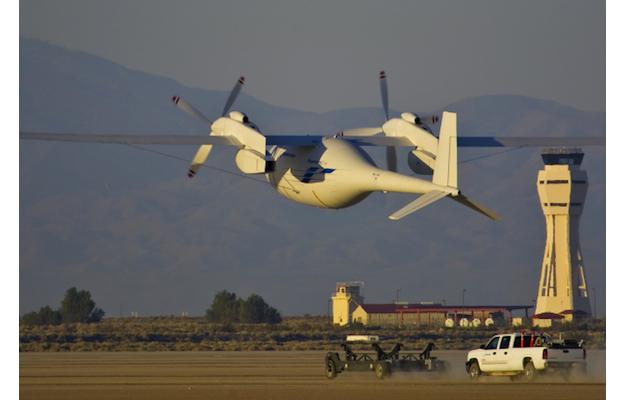
 Boeing’s Phantom Eye unmanned aircraft has completed its maiden flight, which lasted just under half-an-hour and followed a series of initial tests performed in April, and as it’s powered by hydrogen, nothing more harmful than water was emitted during the test.
The Phantom Eye is just one of Boeing’s unmanned airborne systems, or UAS, and is designed to carry out surveillance and intelligence missions. The longer such aircraft can stay in the air, the better, hence the long-range hydrogen propulsion system.
Once the Phantom Eye is operational, Boeing expects it to fly missions lasting up to four days without needing to land, all the while carrying 450-pounds of equipment. As you can see from the picture it’s not a small aircraft, and boasts a wingspan of 150-feet, which is larger than many medium-range passenger jets.
The test flight took place at Edwards Air Base in California on June 1, and the Phantom Eye stayed airborne for 28-minutes, reaching an altitude of 4,080-feet and a speed of 62-knots. In the future, the plane will have a maximum cruising altitude of 65,000-feet.
Of course, keeping an aircraft in continuous use for four days means it needs not only to be very reliable, but also require the minimum of maintenance. When the Phantom Eye was unveiled in 2010, Boeing revealed it would use two 150-horsepower, Ford 2.3-liter, four-cylinder engines, much like those found in Ford’s road cars, just converted for use with hydrogen. Tests of these engines in altitude chambers showed complete reliability for 600 hours, six times that needed for a four-day mission.
Previous Phantom Eye tests have required the plane to be fueled with 1900-pounds of cryogenic hydrogen, a process which takes 12-hours, including priming the fuel system ready for flight. Hydrogen has long been seen as an alternative fuel source for cars, and projects like this help push the technology forward.
Sadly, the Phantom Eye had a bumpy touchdown, as the landing gear dug into the ground and broke, but despite this set back plans are moving forward for the next test flight, where the plane will reach higher altitudes than this week’s early shakedown.