
There’s a lot of promise with the upcoming wave of laptops powered by the Qualcomm Snapdragon X Elite chip. I’ve already seen plenty of benchmarks that prove Qualcomm is onto something huge, with the GPU and NPU performance of the chip being quite powerful. Benchmarks have even shown that it can be double as fast as Intel’s latest Arc graphics in the Core Ultra chips.
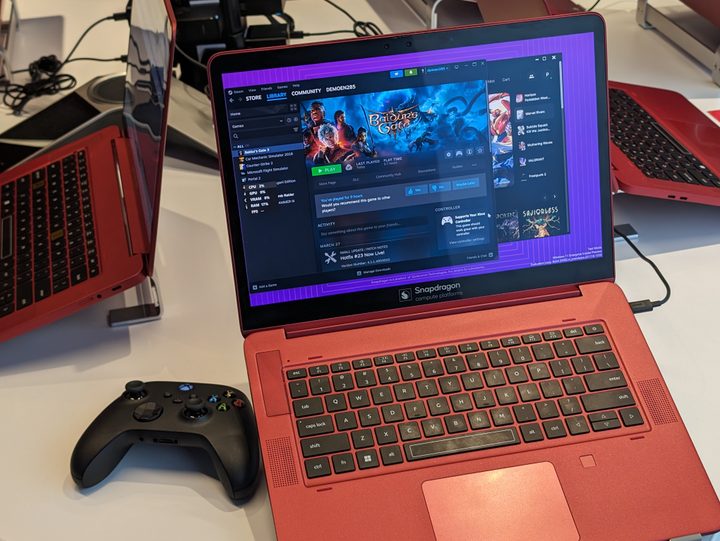
But those are just benchmarks in simulated scenarios. I really wanted to see it to believe it, and recently, at an event in New York, I did just that. I spent some hands-on time with reference laptops running the Snapdragon X Elite.
Along with watching some AI demos done to show the NPU power in Audacity and DaVinci Resolve, I was able to play two PC games and observe someone playing a third game on the same laptop. I came away impressed, and I firmly believe this chip is a big deal.
The hardware

Qualcomm had three demo laptops available for me to try out. Not all the units were for gaming. All three devices had the Snapdragon X Elite under the hood. These reference laptops also had fans onboard, but aren’t final hardware. One unit was paired with 16GB RAM, another with 32GB, and a third with 64GB, especially for AI demos, with the chip. The 16GB and 32GB RAM units were tuned to 3.4 GHZ, and the 64GB RAM unit, a faster 3.8 GHz. All units have 10 CPU cores.
The unit I gamed on was running with 16GB of RAM, was plugged into power, and had Windows set to Balanced Performance. The display on the laptop was set to 2K resolution. All games were running at 1080p, on low to medium settings. All games I demoed were running under emulation.
Qualcomm told me the titles I played are just the start of what’s to come. It has its labs where it tests hundreds of other games to ensure quality experiences.
The games and the results

I played two games on this reference laptop. The first was something a bit simplistic, Redout II. This arcade-style game, which is pretty fast-paced, ran consistently at around 40 frames per second with 17% CPU utilization and 33% RAM usage, according to the Xbox Game Bar widget. Despite my bad racing skills and occasionally running into walls, my lap times were competitive in a single-player race, and I barely noticed any dropped frames.
In the second game, Control, Qualcomm’s reference laptop was able to push out about 35 frames per second. In scenes that got busy, particularly in the “Unknown Caller” chapter, there was some small lag, but it wasn’t anything that ruined gameplay. The Xbox Game Bar showed about 35 fps and 25% RAM usage in my gameplay.

I was in an event space, so I wasn’t able to complete gameplay on my own, but Qualcomm also Balder’s Gate 3 running at 30 frames per second. I observed as other media members played around with the game, and it was pretty impressive. No dropped frames, and RAM and CPU usage were pretty even with my own experiences with the previous titles.
The only issue I noticed was the fans kicking in during gameplay. This is to be presumed with a laptop without a GPU, but it could also be because these devices were running in a showroom scenario, where they are under high stress.
Qualcomm provided some benchmark claims that can show why my experience was so good. It claims that the GPU onboard the Snapdragon X Elite is 36% faster than the Arc graphics on Intel’s Core Ultra 155H chip when running at 20W of power. It also claimed the chip consumes 50% less power, one of the hallmarks of Arm-based chips.
The competition

A lot changed since Qualcomm first announced the Snapdragon X Elite. Apple launched the M3 chip, and Intel its Core Ultra chips. Qualcomm is ready, though, and brought some new benchmarks to the table to show how powerful its chip can be.
You can see a sample of these in the graphic above, but I wanted to highlight some numbers. Note this benchmark you’re seeing came from the maxed-out Snapdragon X Elite-powered laptop with 64GB RAM and a boost to 3.8 GHz.
Against the Apple M3 chip, Qualcomm is claiming that its Snapdragon X Elite chip can score 15,610 in Geekbench 6 multi-core testing. That’s above the 12,154 that the Apple M3 scores.
When mentioning the Intel Core Ultra 7 155H, meanwhile, Qualcomm claims that the X Elite can be up to 54% faster and use up to 65% less power in Geekbench 6 Single-Thread testing at a similar power level. Multi-thread testing is also better, coming in at 52% faster, with 60% less power.
Qualcomm went as far as to highlight the Core Ultra 9 185H and lay down the claim that when running at 30W of power, the Snapdragon X Elite can be up to 41% faster in Multi-Thread performance and use 58% less power. Single-Thread performance is 51% faster and uses 65% less power.
The future is bright
Now that I have had some quality time with Qualcomm’s reference laptops, I’m even more of a believer than I was before. It’s incredible to see the gaming performance on these devices, even if the settings have to be tuned down. I own a ThinkPad X13s, featuring the older Snapdragon 8cx Gen 3, and I wish my current laptop was as fast as these.
Of course, there’s a lot we still don’t know about this upcoming wave of laptops. The chip inside might be impressive, but that’s nothing if they aren’t packaged, marketed, and priced in the right way. We’ll have to wait and see, but as for now, I’m excited about how these chips could transform the future of Windows laptops.


