
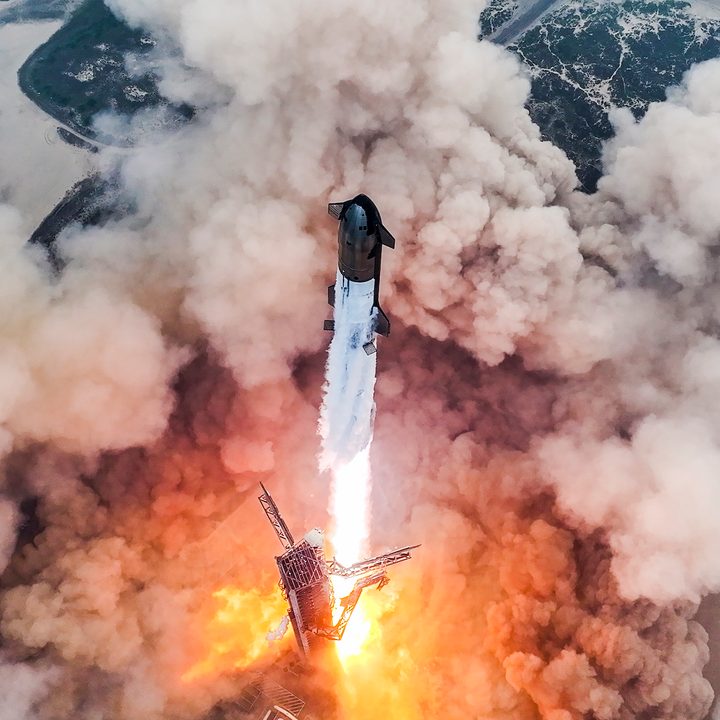
SpaceX achieved its most successful Starship flight yet on Thursday in a test that launched from its Starbase site in Boca Chica, Texas.
The world’s most powerful rocket created a colossal 17 million pounds of thrust as it roared away from the launchpad. SpaceX later shared some incredible slow-motion footage showing the vehicle — comprising the first-stage Super Heavy booster and upper-stage Starship spacecraft — climbing toward orbit.
Slow motion liftoff of Starship on Flight 4 pic.twitter.com/9itFbrfxW7
— SpaceX (@SpaceX) June 6, 2024
Thursday’s mission was a far cry from the first two test flights of the 120-meter-tall rocket, both of which ended in explosions just minutes after leaving the launchpad. The third test flight in March made significantly more progress, but this latest mission surpassed even that, achieving most of the objectives set by the SpaceX team.
“The Super Heavy booster lifted off successfully and completed a full-duration ascent burn,” SpaceX said in a post-mission report. “Starship executed another successful hot-stage separation, powering down all but three of Super Heavy’s Raptor engines and successfully igniting the six second stage Raptor engines before separating the vehicles.”
It said that following separation, the Super Heavy booster “successfully completed its flip maneuver [and] boostback burn to send it towards the splashdown zone, and jettison of the hot-stage adapter.” The Super Heavy booster flight finished with its first-ever landing burn and soft splashdown in the Gulf of Mexico 7 minutes and 24 seconds after leaving the launchpad.
Meanwhile, the Starship’s six second-stage Raptor engines powered the spacecraft to orbit where it coasted for a while before making a controlled reentry for the first time. The Starship successfully handled the various phases of peak heating and maximum aerodynamic pressure while descending through the atmosphere at hypersonic speeds, with the flaps controlling its path toward open water.
Starship then ignited its three center Raptor engines to execute its first flip maneuver and landing burn since the start of the rocket’s suborbital campaign, followed by a soft splashdown in the Indian Ocean 1 hour and 6 minutes after departing Starbase.
The successful reentries of both vehicles is a big step forward for SpaceX as it seeks to make the Starship fully reusable by landing both sections upright — instead of in the ocean — so that they can be used for multiple flights.
The ultimate plan is to use the Starship for crew and cargo missions to the moon, and possibly even Mars.


