  1. Home
  2. Space
  3. News

See a stunning 3D visualization of astronomy’s most beautiful object

Add as a preferred source on Google

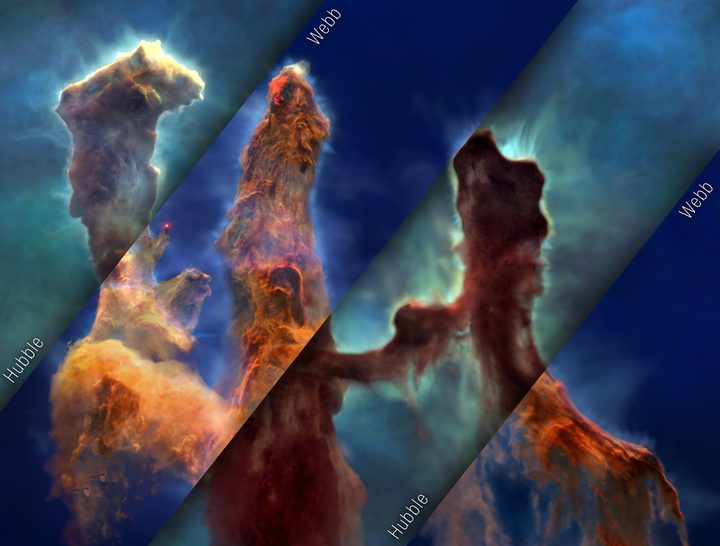
This image is a mosaic of visible-light and infrared-light views of the same frame from the Pillars of Creation visualization. The three-dimensional model of the pillars created for the visualization sequence is alternately shown in the Hubble Space Telescope version (visible light) and the Webb Space Telescope version (infrared light).
This image is a mosaic of visible-light and infrared-light views of the same frame from the Pillars of Creation visualization. The three-dimensional model of the pillars created for the visualization sequence is alternately shown in the Hubble Space Telescope version (visible light) and the Webb Space Telescope version (infrared light). Greg Bacon (STScI), Ralf Crawford (STScI), Joseph DePasquale (STScI), Leah Hustak (STScI), Christian Nieves (STScI), Joseph Olmsted (STScI), Alyssa Pagan (STScI), Frank Summers (STScI), NASA's Universe of Learning

The Pillars of Creation are perhaps the most famous object in all of astronomy. Part of the Eagle Nebula, this vista was first captured by the Hubble Space Telescope in 1995, and has captivated the public ever since with its dramatic rising pillars of dust and gas that stretch several light-years high. The nebula has been imaged often since then, including again by Hubble in 2014 and more recently by the James Webb Space Telescope in 2022.

Recommended Videos

Now, scientists working with the Hubble and Webb telescopes have released a striking visualization, comparing the different views of the pillars taken by the two different space telescopes. If you’re wondering why scientists would bother taking many images of the same object with different telescopes, it’s sometimes because technology and processing has improved so much that it offers a better view (as was the case with the 1995 and 2014 Hubble images), and sometimes because different telescopes operate in different wavelengths of light so they can get different views of the object (as is the case with the Hubble and Webb images).
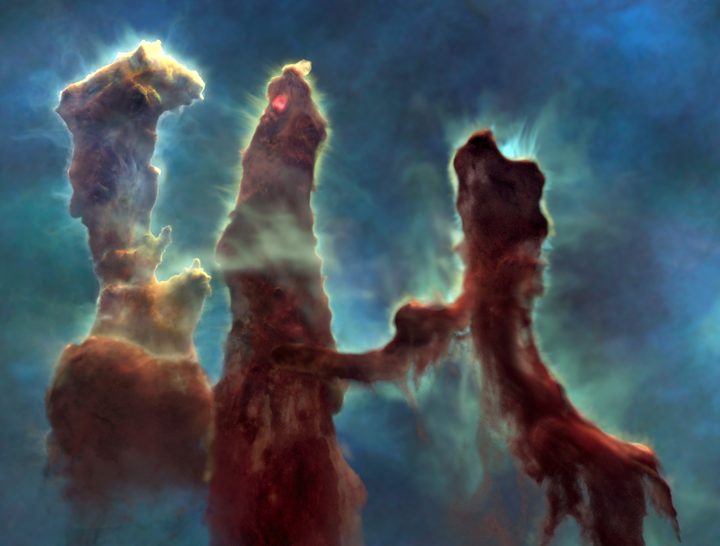
The Pillars of Creation imaged by Hubble.
The Pillars of Creation imaged by Hubble. Greg Bacon (STScI), Ralf Crawford (STScI), Joseph DePasquale (STScI), Leah Hustak (STScI), Christian Nieves (STScI), Joseph Olmsted (STScI), Alyssa Pagan (STScI), Frank Summers (STScI), NASA's Universe of Learning

“When we combine observations from NASA’s space telescopes across different wavelengths of light, we broaden our understanding of the universe,” said Mark Clampin, Astrophysics Division director at NASA, in a statement. “The Pillars of Creation region continues to offer us new insights that hone our understanding of how stars form. Now, with this new visualization, everyone can experience this rich, captivating landscape in a new way.”
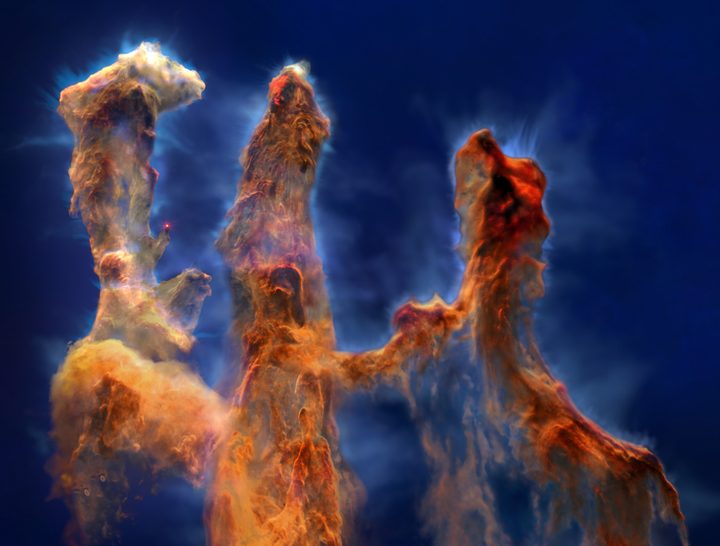
The Pillars of Creation imaged by Webb.
The Pillars of Creation imaged by Webb. Greg Bacon (STScI), Ralf Crawford (STScI), Joseph DePasquale (STScI), Leah Hustak (STScI), Christian Nieves (STScI), Joseph Olmsted (STScI), Alyssa Pagan (STScI), Frank Summers (STScI), NASA's Universe of Learning

As well as comparing the images, the team from NASA has also created a 3D visualization of the pillars, showing what they look like from different angles.

“By flying past and amongst the pillars, viewers experience their three-dimensional structure and see how they look different in the Hubble visible-light view versus the Webb infrared-light view,” explained principal visualization scientist Frank Summers of the Space Telescope Science Institute (STScI) in Baltimore, who led the movie development team for NASA’s Universe of Learning. “The contrast helps them understand why we have more than one space telescope to observe different aspects of the same object.”

The Pillars of Creation: A 3D Multiwavelength Exploration

“The Pillars of Creation were always on our minds to create in 3D. Webb data in combination with Hubble data allowed us to see the Pillars in more complete detail,” said production lead Greg Bacon of STScI. “Understanding the science and how to best represent it allowed our small, talented team to meet the challenge of visualizing this iconic structure.”

NASA has even created a 3D printable model of the pillars for those who want to make their own model at home.

Georgina Torbet
Georgina has been the space writer at Digital Trends space writer for six years, covering human space exploration, planetary…
Scientists have found a hidden galaxy inside the Milky Way, and they’re calling it Loki
A lost dwarf galaxy may be hiding inside the Milky Way.
milky-way-hidden-galaxy-loki

Our home galaxy has a secret buried inside. A new study published in the Monthly Notices of the Royal Astronomical Society suggests that the Milky Way swallowed an ancient dwarf galaxy billions of years ago, and its stellar remains are still embedded within ours.

Researchers have named this lost galaxy Loki, after the Norse trickster god, and the name is quite fitting because it remained hidden in plain sight for a very long time.

Read more
NASA aims September launch for Roman space telescope and it’s going to be a huge shift
An earlier target for Roman means one of NASA’s most ambitious observatories is getting close, with the potential to open a huge new era in space discovery
Machine, Wheel, Astronomy

NASA is now aiming to launch the Nancy Grace Roman Space Telescope as soon as early September 2026, a faster timeline than its earlier commitment to fly no later than May 2027. That alone makes this one of the agency’s most important missions to watch over the next few months.

The reason is simple, Roman is built to scan vast parts of the sky with sharp infrared vision.

Read more
Blue Origin successfully re-uses a New Glenn rocket for the first time ever
Blue Origin achieves first New Glenn reflight despite payload setback
Blue Origin

Blue Origin has achieved a major milestone in its spaceflight ambitions by successfully reusing a booster from its heavy-lift New Glenn rocket for the first time. The historic launch, conducted on April 19, marks a significant step forward for Jeff Bezos’ space company as it seeks to compete with rivals like SpaceX in the rapidly evolving commercial launch market.

A Milestone With A Mixed Outcome

Read more