The Core Ultra series is graduating to Series 2 as Intel finally launched its next-gen Lunar Lake mobile CPUs. These new chips made their first appearance at Computex 2024, and are said to offer improved performance paired with a substantial reduction in power consumption compared to Meteor Lake. In fact, the new Core Ultra 200V series is now claimed to be the most efficient family of x86 processors ever.
As per Intel, these new chips offer up to 50% lower power consumption thanks to the revamped architecture. The entire lineup comes with four Skymont efficient (E) cores and four Lion Cove performance (P) cores. However, instead of delegating low-power tasks to the E-cores, most tasks now run on the E-cores with Lunar Lake. Essentially the P-cores are only used when a boost of performance is required.
By disabling Hyperthreading, Intel has managed to further optimize the P-cores for better Power, Performance and Area (PPA). According to the company, Hyperthreading duplicates certain tasks, sharing or dividing up others between the threads. This can lead to mixed results depending on what kind of work your CPU is handling and may require more transistors, which can lead to more power consumption. There’s a new low-latency fabric within the chipset that reduces latency between all the cores, as well as DRAM.
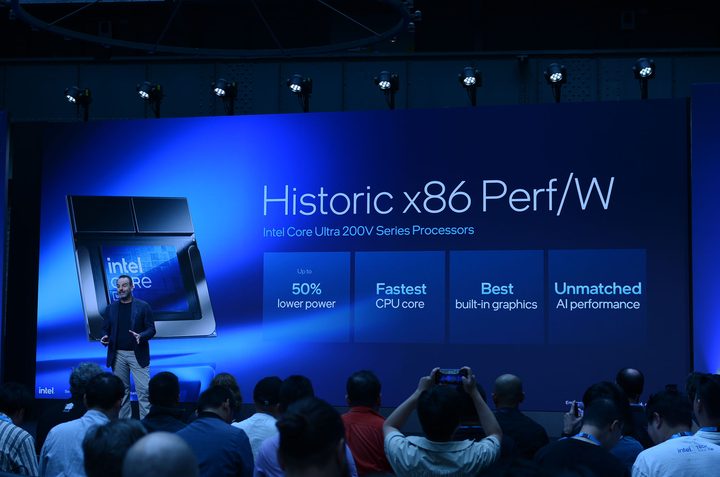
The Intel Core Ultra 200V series processors can deliver up to 120 total platform tera operations per second (TOPS) across the CPU, GPU, and NPU, making it a lot more powerful than Qualcomm’s Snapdragon X Elite and AMD’s new Ryzen AI 300 series processors. The fourth-generation NPU is said to deliver a performance boost of up to 4x over its predecessor, and excels in handling sustained AI workloads while maintaining energy efficiency. These processors are also claimed to offer up to 3x the performance per thread, an 80% peak performance increase, and up to 20 hours of battery life in productivity scenarios.
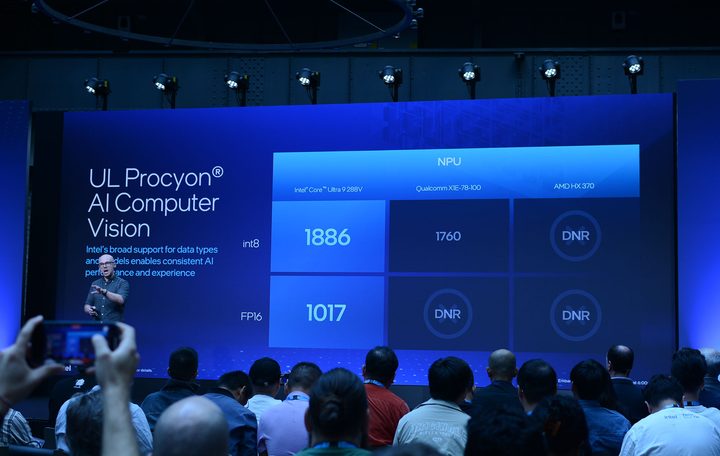
Comparing its new chips with Qualcomm and AMD, Intel came prepared and pointed out how it offers a more powerful and capable neural processing unit (NPU). Not only does it outperform the two in a variety of AI-focused workloads, but a handful of applications are still not supported on the Snapdragon X Elite and Ryzen AI 300 chips.
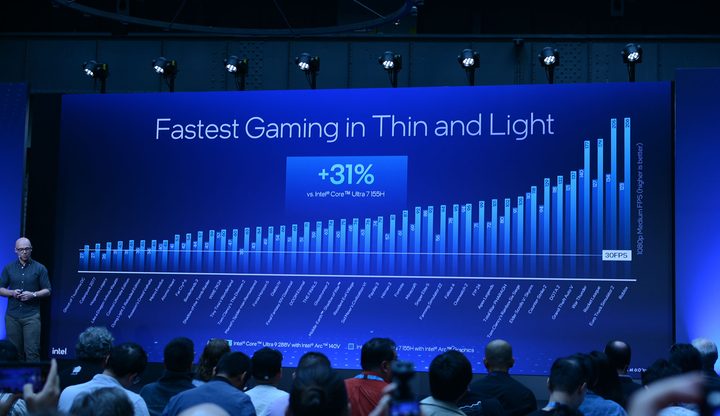
The Core Ultra 200V series also introduces Intel’s Xe2 graphics microarchitecture, offering a substantial 30% improvement in mobile graphics performance. The integrated Intel Arc GPU features up to eight new 2nd Gen Xe-cores, eight enhanced ray tracing units, and support for up to three 4K monitors. It also includes Intel Xe Matrix Extensions (XMX) AI engines, delivering up to 67 TOPS to enhance creative applications as well as gaming performance through advanced XeSS kernels.
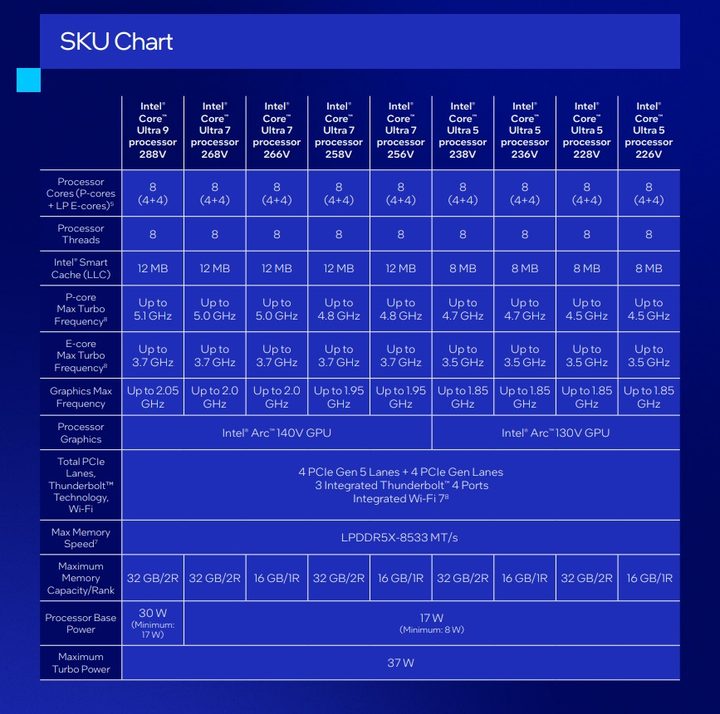
There are a total of nine models, led by the Core Ultra 9 288V. The entire range shares a similar core and thread count with a maximum TDP range of 33 watts. Since the memory module is integrated into the chipset package itself, there are only two options including 16GB and 32GB of LPDDR5x RAM clocked at 8533MT/s.
Intel also announced that most laptops featuring the Intel Core Ultra 200V series will be part of the Intel Evo Edition, which are co-engineered with partners to deliver an optimal AI-driven PC experience. These laptops are expected to offer reduced lag with minimized distractions and extended battery life. New Evo laptops must also meet new standards for cooler, quieter operation. Key features of the Intel Ultra 200V Evo Edition include long battery life, built-in Intel Arc graphics, Wi-Fi 7 support, Thunderbolt connectivity, instant wake, fast charging, and EPEAT Gold certification for sustainability.
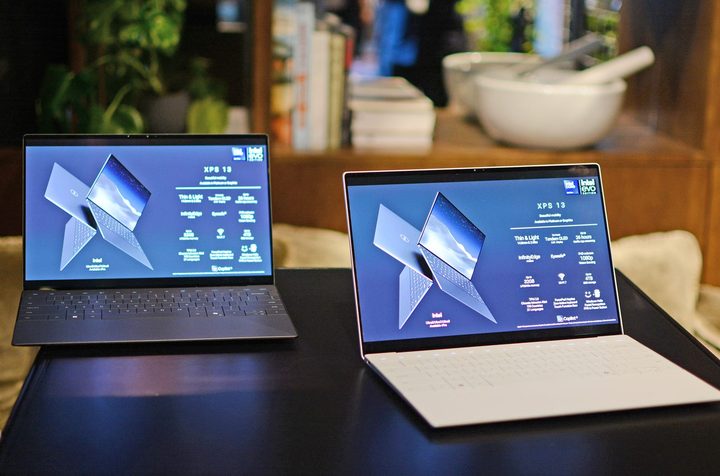
The new Core Ultra Series 2 lineup will be available on a range of mobile products from popular manufacturers including Acer, Asus, Dell, HP, Lenovo, MSI, and Samsung. Expect them to be available starting September 24 with pre-order starting today in select regions. All products featuring Intel Core Ultra 200V series processors will be receiving Copilot+ PC features via a Windows update in November.