  1. Home
  2. Space
  3. News

See the stunning Rosette Nebula in all its glorious colors

Add as a preferred source on Google
Rosette Nebula Captured with DECam
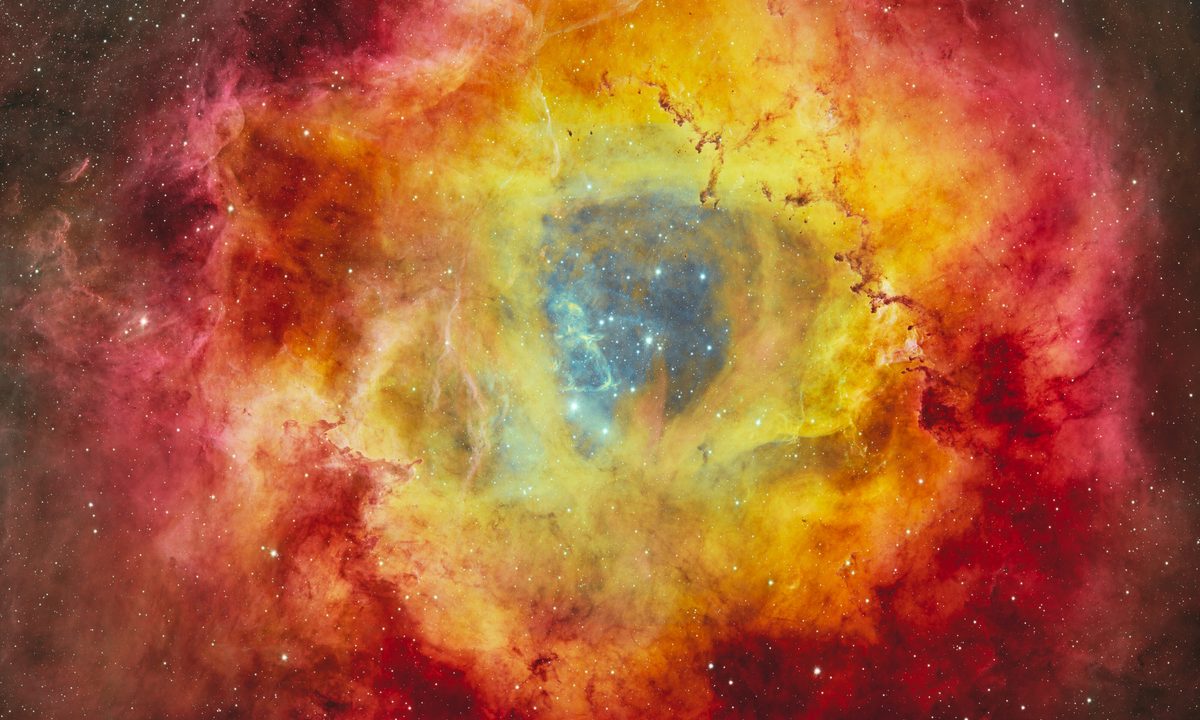
Cradled within the fiery petals of the Rosette Nebula is NGC 2244, the young star cluster which it nurtured. The cluster’s stars light up the nebula in vibrant hues of red, gold and purple, and opaque towers of dust rise from the billowing clouds around its excavated core. This image, captured by 570-megapixel Department of Energy-fabricated Dark Energy Camera (DECam), mounted on the U.S. National Science Foundation Víctor M. Blanco 4-meter Telescope at Cerro Tololo Inter-American Observatory, a Program of NSF NOIRLab, is being released in celebration of NOIRLab’s fifth anniversary. CTIO/NOIRLab/DOE/NSF/AURA Image Processing: T.A. Rector (University of Alaska Anchorage/NSF NOIRLab), D. de Martin & M. Zamani (NSF NOIRLab)

This gorgeous image shows a fiery stunner called the Rosette Nebula that’s located 5,000 light-years away from Earth. Imaged by the Dark Energy Camera (DECam) instrument on the Víctor M. Blanco 4-meter Telescope in Chile, this cloud of dust and gas acts as a stellar nursery and houses a young star cluster at its center.

Unlike other telescopes, such as the James Webb Space Telescope, which looks in the infrared wavelength, the DECam looks in the optical wavelength, so it sees similar colors to what the human eye would perceive. The colors in this image are so bright and vivid due to the starlight from the massive young stars in the cluster, which give off large amounts of ultraviolet radiation, thereby ionizing nearby hydrogen gas. The ionized gas glows brightly, giving the nebular its striking appearance.

Recommended Videos

“The billowing red clouds are regions of H-alpha emission, resulting from highly energized hydrogen atoms emitting red light,” NOIRLab explains. “Along the walls of the central cavity, closer to the massive central stars, the radiation is energetic enough to ionize a heavier atom like oxygen, which glows in shades of gold and yellow. Finally, along the edges of the flower’s petals are wispy tendrils of deep pink glowing from the light emitted by ionized silicon.”

The nebula is huge, at 130 light-years across, but you can see there is a hollow area at its center where there is a lack of red or yellow, indicating the presence of gas. This central region has been hollowed out by the process of star formation, as the dust and gas has formed into clumps that have gradually attracted more and more matter through gravity until these clumps collapse into a core that forms the basis of a new star.

These stars formed a cluster named NGC 2244 around 2 million years ago, and as the stars, evolve they produce stellar winds that blow away nearby dust and gas and prevent more stars from forming nearby.

These winds carved out the hollow at the center of the nebula and, eventually, they will bring about the end of the nebula as well. In around 10 million years’ time, the radiation from these stars will have pushed away so much of the dust and gas that the nebula will disappear, leaving just the stars remaining without their rose-shaped cloud around them.

Georgina Torbet
Georgina has been the space writer at Digital Trends space writer for six years, covering human space exploration, planetary…
Getting to Mars may require a pit stop in orbit, and NASA just tested the nozzle to make that happen
A gas pump nozzle for spacecraft sounds simple. It is not, and that's what makes this test worth paying attention to.
Architecture, Building, Factory

Getting a spacecraft to Mars or beyond requires an enormous amount of fuel, most of which has to be hauled from Earth, adding to the overall cost and weight of the spacecraft. NASA has been working on a different approach, one that could be more efficient and effective.

It wants to refuel a spacecraft in orbit before heading out for the mission. What’s even more interesting is that the space agency just finished testing a component that could make that possible: a cryocoupler.

Read more
Elon Musk’ Starlink could soon offer mobile services as a US carrier
Showcase of T-Mobile Starlink service on an iPhone.

Elon Musk’s Starlink has already changed how millions of people access the internet, especially in places where traditional broadband struggles to reach. Now, the satellite internet service could be preparing for an even bigger leap — becoming your mobile carrier.

According to a Financial Times report, SpaceX has told investors it’s considering launching a retail Starlink mobile service in the US. Instead of simply partnering with wireless carriers, the company could begin selling mobile plans directly to consumers, putting it in direct competition with Verizon, AT&T, and T-Mobile.

Read more
Lightsails have hit another speed bump on the road to interstellar travel
The coolest interstellar travel idea may get betrayed by the light pushing it
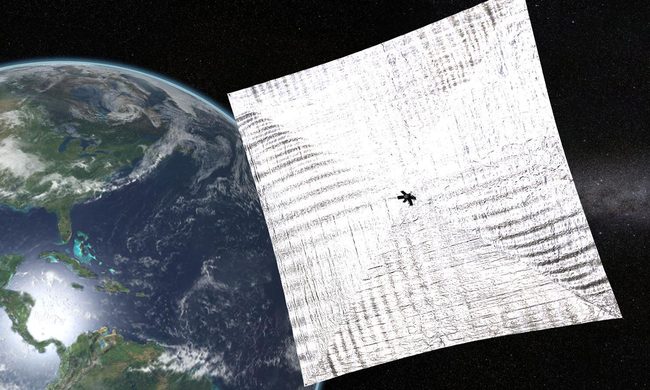
LightSail in Earth orbit

Laser-powered lightsails are one of the coolest answers to spaceflight. It might not be as sci-fi-sounding as a warp drive, but now, its practicality has also come under question. Using lightsails, a spacecraft could unfurl an ultra-thin reflective sail and let a powerful laser push it toward another star, without relying on fuel.

The tech was simple and elegant--except it's also more complicated than it sounds. A new preprint from researchers Chao Shen and Jiaze Li of the Harbin Institute of Technology suggests that relativistic lightsails may run into a hidden propulsion problem once they start moving extremely fast.

Read more