
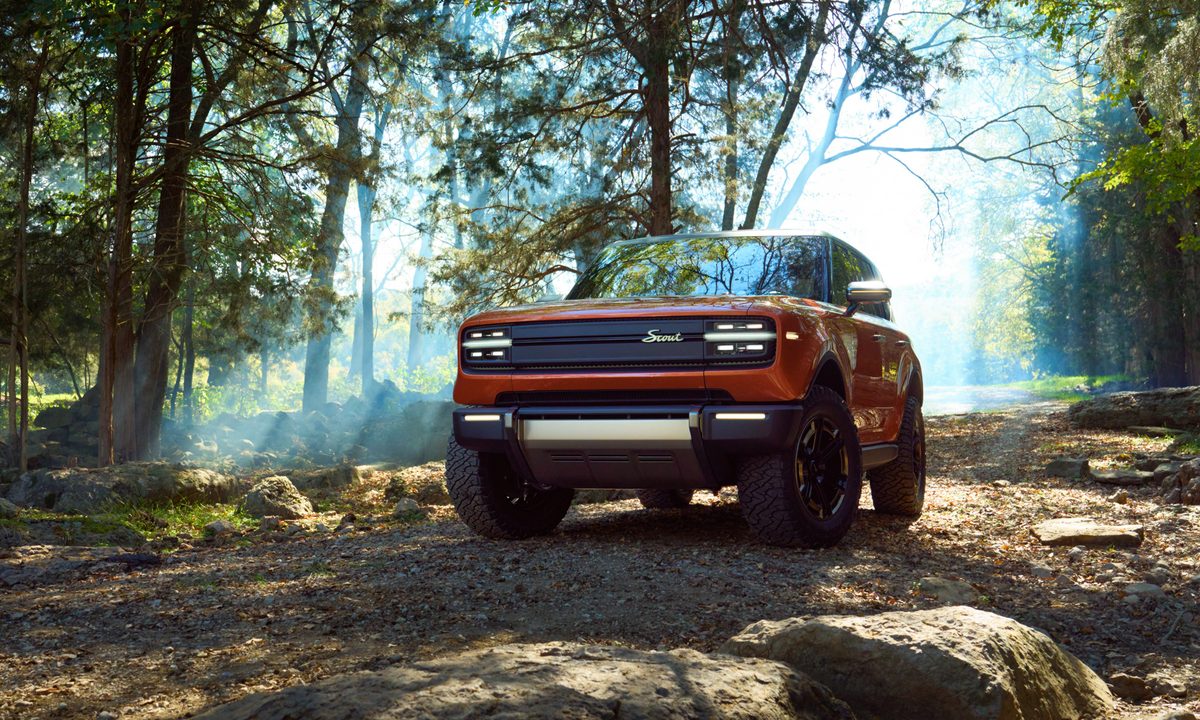
Scout Motors has made a big comeback, now under the guidance of Volkswagen Group. Not only is the Scout brand being reinvigorated but it has already announced two new models in the form of the Scout Terra truck and the Scout Traveler SUV. The Scout Traveler SUV in particular is an interesting vehicle, but it has an uphill battle ahead of it thanks to competition from the likes of Rivian.
The Rivian R1S is often considered to be the best electric SUV out there right now, and while it’s not cheap, it offers an excellent set of tech features, a long range, and more. So how does the Scout Traveler SUV compare with the R1S? We put the two vehicles head to head to find out.
Design
The exterior designs of the Scout Traveler and the Rivian R1S are similar in many ways, though there are some major differences. Both vehicles offer a relatively blocky shape characteristic of a traditional SUV. The Traveler is a little more traditional than the Rivian in that it has a spare tire on the back, which is both practical and gives it a rugged vibe.

Both the Traveler SUV and the Rivian R1S offer unique fronts, with the R1S offering Rivian’s now iconic oval headlights and the Traveler SUV having the slim LED lights. Both look great, but while the R1S takes a more modern approach, the Traveler has a slightly more retro vibe.
Both the Scout Traveler SUV and Rivian R1S look great, and this choice is largely down to personal preference. As such, it’s a tie.
Winner: Tie
Interior and tech
The interiors of these two vehicles are slightly different too, but again there are some similarities. Both vehicles offer premium interior designs with high-end materials, and their overall interior vibe actually looks pretty similar, especially when it comes to the seat designs and the rugged yet modern look.
Both vehicles offer two displays at the front, made up of one instrument display for the driver and one infotainment display in the middle of the dashboard. The R1S’ infotainment display looks slightly larger than the Traveler’s, but we don’t yet know exactly how large the screens will be in the Traveler. We also don’t yet know exactly what the software will be like, though hopefully it’ll be as good as Rivian’s, which is considered to be among the best.

There is one major difference between the interiors of these two vehicles though, and that comes down to how many seats they have. The Rivian R1S has three rows of seating that can accommodate up to seven people in total, including the driver. The Traveler SUV only has two rows of seating. However, that doesn’t necessarily mean you’re limited to only five people. While the base model of the Traveler SUV has a typical seating arrangement with two front seats and three rear seats, there’s an option for a front bench seat that will accommodate three people, bringing the total to six occupants. It’s another way that Scout is embracing a retro approach for the Traveler SUV; however, taking advantage of that option will mean doing away with much of the internal storage.
Interior design is down to personal preference, and not everyone will need more than five seats. This one’s a tie as well.
Winner: Tie
Performance
The Rivian R1S and Scout Traveler SUV take a slightly different approach to performance too, though thankfully both vehicles perform quite well.
That said, there’s still a lot we don’t know about the performance of the Traveler SUV. Scout has said that the electric powertrain in the Traveler will offer 1,000 pound-feet of torque and get the vehicle from 0 to 60mph in 3.5 seconds. That’s pretty quick. It’s entirely possible that other powertrain options will be available, either offering faster or slower speeds depending on the general approach that Scout takes to the lineup.

The Rivian R1S is available in a number of different powertrain options. However, all of them are relatively premium. With the R1S, there are options for a dual-motor, tri-motor, or quad-motor setup. However, the quad-motor R1S isn’t available just yet. Not only that but some of these powertrains have an optional performance upgrade, which makes them faster and higher performing. Essentially there are tons of different variables, but the slowest R1S is the dual-motor model, which offers 533hp and can get from 0 to 60 mph in 4.5 seconds. The fastest model is the quad-motor variant which, as mentioned, isn’t available just yet, but Rivian says it will be able to accelerate from 0 to 60 mph in only 2.6 seconds.
While the Traveler SUV that Scout has announced so far is more powerful than the base R1S, the R1S has options to get more powerful at an additional cost, making it the winner of this category.
Winner: Rivian R1S
Range and charging
The vehicles take a different approach to range and charging too. The Scout Traveler SUV, according to Scout, will offer a 350-mile all-electric range, which is quite good. That said, perhaps the most interesting thing about the vehicle is the fact that it will have an option to be upgraded to an extended range EV, or EREV. This basically means that you’ll be able to get it with a small gasoline generator that’s used exclusively to charge the battery, and Scout says that it will extend the range of the vehicle to 500 miles. Scout says that the vehicle will support fast charging at up to 350kW, which means it will be able to take advantage of the fastest EV chargers available right now.

The Rivian R1S certainly isn’t low on range either. The base model of the R1S leaves a little to be desired, offering a 270-mile range. That said, the vehicle can be upgraded to offer Rivian’s Max battery pack, which gives it 410 miles of range on the dual motor variant. Other models are somewhere in between. The R1S currently offers a charging speed of 200kW, which doesn’t quite reach the heights of what Scout is hoping for. That said, Rivian says that its vehicles will charge at 300kW in the future, so by the time the Traveler SUV is available, it’s possible that Rivian vehicles will close the gap a little.
All that said, the base Traveler has a much better range than the base R1S, and with the EREV option, it’s able to offer a better range than the longest-range R1S, albeit through using gasoline. Not only that but the Scout will charge faster. All that makes it the winner of this category.
Winner: Scout Traveler
Price and availability
This category is a little easy because there’s only one vehicle that’s actually available right now: the Rivian R1S. The R1S has been available in different forms for some time now — however, Rivian gave it a bit of a refresh for the 2025 model, which is what it sells as of the time of this writing. The Rivian R1S starts at $75,900.

Scout says that it will begin production of the Traveler starting in 2027, so it’s entirely possible that the vehicle won’t be available until late 2027 or early 2028. That said, when it is available, Scout says that it will cost under $60,000 for its starting price, which will make it a little more compelling than the R1S for those who want something a little more affordable.
Still, despite Scout’s promises, the fact that the Rivian is the only vehicle currently available makes it the winner of this category.
Winner: Rivian R1S
Overall winner: Rivian R1S
The Rivian R1S is the winner of this comparison, but largely because it’s the only vehicle that’s currently available. If you’re looking for an electric SUV right now, the R1S is considered by many to be the best one you can get, but the Scout Traveler could give it a bit of a run for its money, especially if the Traveler is able to come in at a lower price point. If the R1S is similar in 2028 to what it is now, the Traveler will offer options for a longer range, faster charging speed, and more. That said, those who want three rows of seating will still need to stick with the Rivian.


