
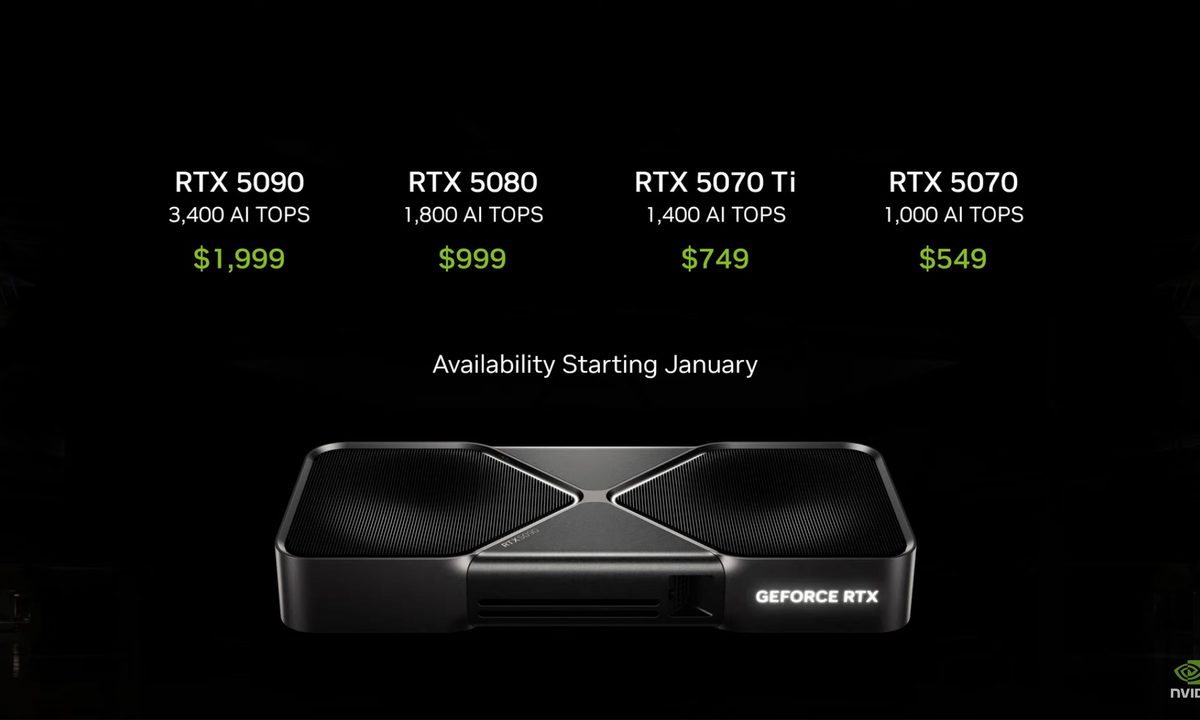

Nvidia just revealed its range of RTX 50-series GPUs at CES 2025, and made some big performance claims. The company says that the flagship RTX 5090 is twice as fast as last gen’s RTX 4090, and it’s not alone. Across all of the benchmarks Nvidia shared, from the RTX 5090 down to the RTX 5070, Nvidia says the new GPUs are twice as fast as their last-gen counterparts.
We normally don’t see that kind of generational uplift. Did Nvidia put some sort of magical GPU dust into its new graphics cards? If you look closely at the benchmarks, it becomes clear that, yes, Nvidia did exactly that. And that magical GPU dust is called DLSS 4.
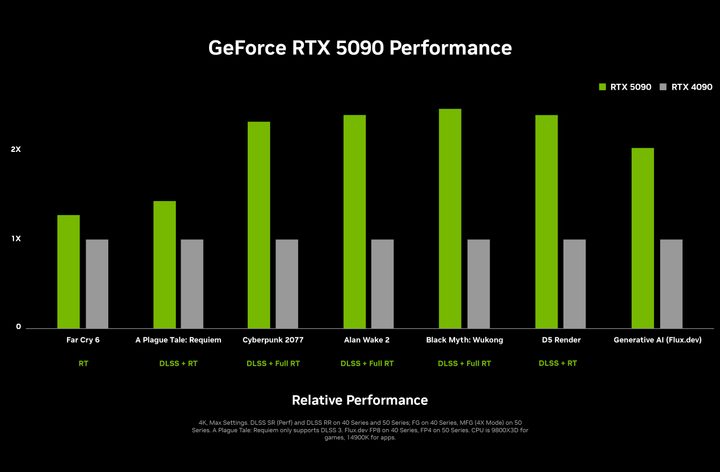
You can see what I mean from the chart above. In the footnotes, Nvidia notes that it used DLSS 3 for the RTX 4090 and DLSS 4 for the RTX 5090. DLSS 4 supports multi-frame generation — in short, it can generate multiple frames in between each “real” frame. Nvidia is providing more than twice the performance of the RTX 4090 with the new RTX 5090, but that largely comes on the back of multi-frame generation in DLSS 4.
That becomes clear when you look at Far Cry 6 and A Plague Tale: Requiem. The comparative numbers in these games are much less impressive, with Nvidia showing somewhere around a 1.5x improvement in performance. A Plague Tale: Requiem only supports DLSS 3, so the RTX 5090 doesn’t have the multi-frame generation advantage. And Far Cry 6 doesn’t support DLSS at all, and it’s the weakest of the games Nvidia showed off.
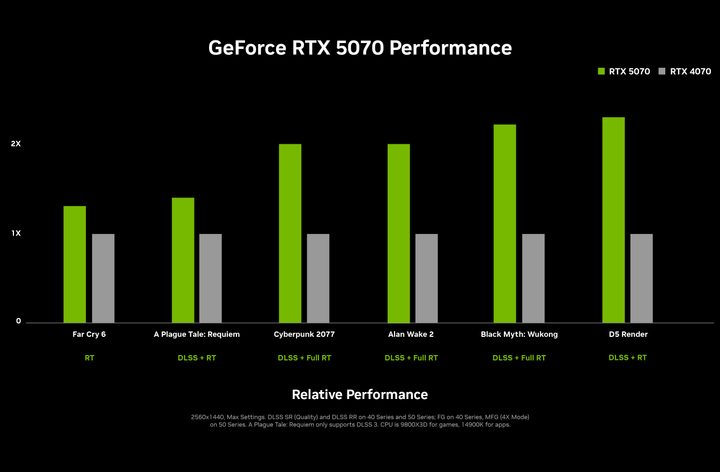
This is true across all of the benchmarks. You can see the results for the RTX 5070 above, which is expected to arrive in February. During Nvidia’s presentation, CEO Jensen Huang boldly declared that the $550 RTX 5070 delivers performance on par with the RTX 4090, but again, that claim comes largely on the back of multi-frame generation in DLSS 4.
There’s a problem with multi-frame generation, and that’s latency. As is already the case with DLSS 3, you’re essentially playing on a delay with frame generation. It’s a slight delay, but the graphics card has to render two frames in order to perform the frame interpolation to “generate” the frames in between. This isn’t a problem at high frame rates, but DLSS 3 runs into issues if you’re running at a low base frame rate.
That issue becomes exaggerated when generating multiple frames, which is something I saw when looking at Lossless Scaling, which supports 4x frame generation like DLSS 4. You may be able to go from 30 frames per second (fps) to 120 fps with DLSS 4, but you’ll still get the responsiveness of 30 fps.
Now, I haven’t used DLSS 4 — no one outside of Nvidia has. Based on previous DLSS updates, I’m sure it will be much better than what Lossless Scaling is able to deliver, especially with the new Reflex 2 latency reduction feature running at full clip. And in fairness to Nvidia, it’s still showing a solid generational uplift in games like Far Cry 6 and a Plague Tale Requiem. It’s just not twice the performance of the previous generation.
It shouldn’t be long until I have Nvidia’s new GPUs in hand and I’m able to test them myself and see how well DLSS 4 actually holds up. Regardless, it’s clear that the claims of twice the performance as the previous generation don’t tell the full story about Nvidia’s new graphics cards.


