1. Home
  2. Space
  3. News

Dark energy turns out to be even weirder than we thought

Add as a preferred source on Google
The U.S. National Science Foundation Nicholas U. Mayall 4-meter Telescope at Kitt Peak National Observatory (KPNO), a Program of NSF NOIRLab, beneath streaking star trails, created by long-exposure photography.
The U.S. National Science Foundation Nicholas U. Mayall 4-meter Telescope at Kitt Peak National Observatory (KPNO), a Program of NSF NOIRLab, beneath streaking star trails, created by long-exposure photography. DESI Collaboration/DOE/KPNO/NOIRLab/NSF/AURA/L. Tyas

The universe is a strange place: just 5% of the mass of everything that exists is made up of regular matter. The rest is made up of 25% dark matter and 70% dark energy. Dark matter is already a mysterious phenomenon, being made of presumably particles that don’t interact with light, but dark energy is perhaps even more puzzling. Scientists know that it must exist, but it keeps getting stranger.

Dark energy must exist because we can see the way that it affects the expansion of the universe. We know that the universe is expanding, and that this expansion is speeding up over time, based on measurements of distant objects with a fixed and known brightness. Dark energy is the theoretical force that is driving this expansion faster.

Recommended Videos

However, there are some wrinkles in this theory to be worked out. One weird finding is that the force dark energy has exerted on the universe over time seems to have changed, as it appeared to have more of an effect in the early universe than it does now — but many people assumed this was some kind of error in the measurements, as theories of dark energy generally suggested it should be constant through time.

Now, though, new evidence from a three-year project called the Dark Energy Survey suggests that dark energy really is changing over time; a finding which could upend the current physical models of the universe.
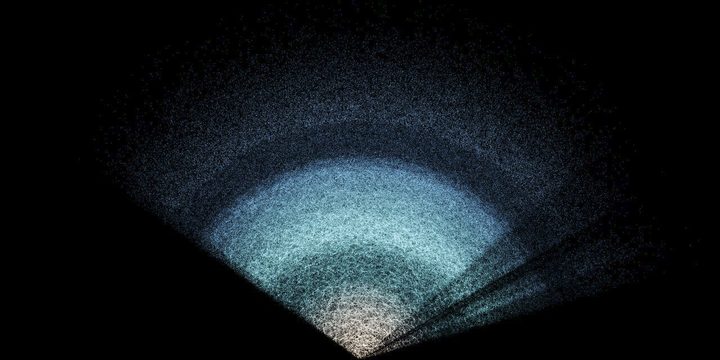
This shows a small fraction of the total DESI year-3 data in which the structure created by gravity is visible. This is the largest 3D map of the Universe ever made.
This shows a small fraction of the total DESI year-3 data in which the structure created by gravity is visible. This is the largest 3D map of the Universe ever made. DESI Collaboration/DOE/KPNO/NOIRLab/NSF/AURA/R. Proctor

The project used data from a special instrument called the Dark Energy Camera, mounted on the Víctor M. Blanco 4-meter Telescope in Chile, and the Dark Energy Spectroscopic Instrument (DESI), mounted on the Nicholas U. Mayall 4-meter Telescope in Arizona. A coalition of hundreds of researchers from around the world worked on the data, including creating a 3D map of the universe that shows the structures created by gravity — seen above.

The findings suggest that dark energy is dynamic and changes over time, and that it used to be stronger in the early stages of the universe but is weaker now. That’s particularly odd because most models consider dark energy to be a fixed force, comparable to gravity. But perhaps that isn’t the case.

“This result is intriguing because it hints at physics beyond the standard model of cosmology,” said Juan Mena-Fernández of the Subatomic Physics and Cosmology Laboratory in Grenoble, France. “If further data support these findings, we may be on the brink of a scientific revolution.”

Scientists aren’t quite ready to throw out the book of standard cosmology just yet, but using tools like DESI which can gather light from thousands of distant galaxies simultaneously, they are refining their understanding of dark energy over time. More data and more theoretical work will help refine the understanding of this strange force.

“Our results are fertile ground for our theory colleagues as they look at new and existing models, and we’re excited to see what they come up with,” said Michael Levi, DESI director and a scientist at Berkeley Lab. “Whatever the nature of dark energy is, it will shape the future of our Universe. It’s pretty remarkable that we can look up at the sky with our telescopes and try to answer one of the biggest questions that humanity has ever asked.”

Georgina Torbet
Georgina has been the space writer at Digital Trends space writer for six years, covering human space exploration, planetary…
Getting to Mars may require a pit stop in orbit, and NASA just tested the nozzle to make that happen
A gas pump nozzle for spacecraft sounds simple. It is not, and that's what makes this test worth paying attention to.
Architecture, Building, Factory

Getting a spacecraft to Mars or beyond requires an enormous amount of fuel, most of which has to be hauled from Earth, adding to the overall cost and weight of the spacecraft. NASA has been working on a different approach, one that could be more efficient and effective.

It wants to refuel a spacecraft in orbit before heading out for the mission. What’s even more interesting is that the space agency just finished testing a component that could make that possible: a cryocoupler.

Read more
Elon Musk’ Starlink could soon offer mobile services as a US carrier
Showcase of T-Mobile Starlink service on an iPhone.

Elon Musk’s Starlink has already changed how millions of people access the internet, especially in places where traditional broadband struggles to reach. Now, the satellite internet service could be preparing for an even bigger leap — becoming your mobile carrier.

According to a Financial Times report, SpaceX has told investors it’s considering launching a retail Starlink mobile service in the US. Instead of simply partnering with wireless carriers, the company could begin selling mobile plans directly to consumers, putting it in direct competition with Verizon, AT&T, and T-Mobile.

Read more
Lightsails have hit another speed bump on the road to interstellar travel
The coolest interstellar travel idea may get betrayed by the light pushing it
LightSail in Earth orbit

Laser-powered lightsails are one of the coolest answers to spaceflight. It might not be as sci-fi-sounding as a warp drive, but now, its practicality has also come under question. Using lightsails, a spacecraft could unfurl an ultra-thin reflective sail and let a powerful laser push it toward another star, without relying on fuel.

The tech was simple and elegant--except it's also more complicated than it sounds. A new preprint from researchers Chao Shen and Jiaze Li of the Harbin Institute of Technology suggests that relativistic lightsails may run into a hidden propulsion problem once they start moving extremely fast.

Read more