  1. Home
  2. Space
  3. Photography
  4. News

After Starship’s 9th test, astronaut shares unique view of earlier flights

Add as a preferred source on Google
SpaceX's Starship on its sixth flight, as seen from the space station.
Don Pettit/NASA

SpaceX’s massive Starship rocket roared skyward for the ninth time on Tuesday, with the test flight delivering mixed results.

The upper-stage Starship spacecraft coasted for around 40 minutes before breaking up on reentry, a performance that beat the seventh and eighth tests when the vehicles broke up soon after stage separation. The first-stage Super Heavy booster, meanwhile, exploded on its descent, though SpaceX had said beforehand that this could happen as it was trying out a new system for the return flight that put extra pressure on the booster.

Recommended Videos

Tuesday’s test flight inspired NASA astronaut Don Pettit to share his two favorite shots of earlier Starship launches, captured from the unique perspective of the International Space Station (ISS) as it passed close to the launch site at an altitude of around 250 miles.

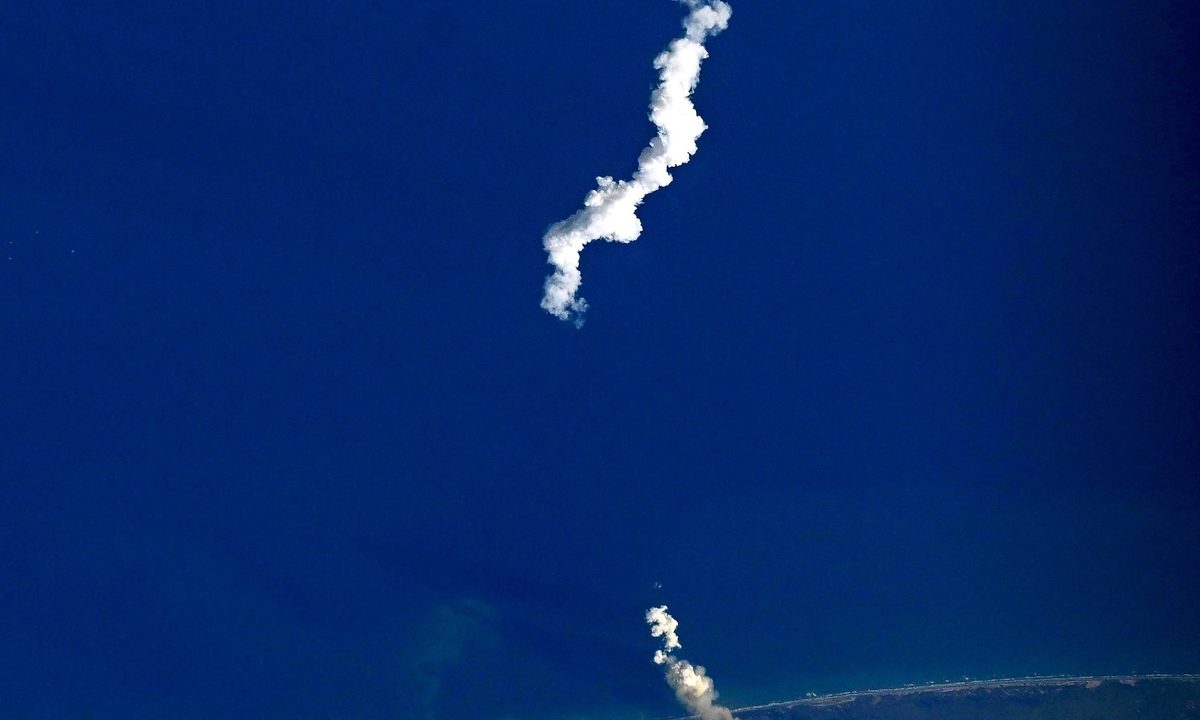
“My two best Starship photos from space station,” Pettit, whose most recent ISS stay lasted just over seven months before ending last month, wrote in a message on X. “Left shows flight 6 launch over Starbase. Right is the flight 8 exhaust trail and debris field after breakup in orbit.”

My two best Starship photos from space station.

Left shows flight 6 launch over Starbase. Right is the flight 8 exhaust trail and debris field after breakup in orbit. pic.twitter.com/ivqYcfCrjZ

— Don Pettit (@astro_Pettit) May 27, 2025

Commenting back in December about his photo of the sixth Starship launch, Pettit put it down to “dumb luck” for being in the right place at the right time, adding that if the launch had been delayed by 20 minutes, the ISS would have traveled far enough that he wouldn’t have been able to see the rocket lift off.

He said that once he realized that the ISS was going to be flying over SpaceX’s Starbase launch site, it was “just a question of knowing how to use your your photography equipment, which lens to use, what kind of shutter speeds, exposures, ISO, that kind of stuff.” 

During his time in orbit, Pettit shared some amazing images, including this absolute stunner of the Betsiboka River estuary in Madagascar, and another showing Earth as you’ve never seen it before.

Want to see more of Pettit’s space-based work? Then check out this collection of his best images from his most recent ISS mission.  

Trevor Mogg
Contributing Editor
Not so many moons ago, Trevor moved from one tea-loving island nation that drives on the left (Britain) to another (Japan)…
Getting to Mars may require a pit stop in orbit, and NASA just tested the nozzle to make that happen
A gas pump nozzle for spacecraft sounds simple. It is not, and that's what makes this test worth paying attention to.
Architecture, Building, Factory

Getting a spacecraft to Mars or beyond requires an enormous amount of fuel, most of which has to be hauled from Earth, adding to the overall cost and weight of the spacecraft. NASA has been working on a different approach, one that could be more efficient and effective.

It wants to refuel a spacecraft in orbit before heading out for the mission. What’s even more interesting is that the space agency just finished testing a component that could make that possible: a cryocoupler.

Read more
Elon Musk’ Starlink could soon offer mobile services as a US carrier
Showcase of T-Mobile Starlink service on an iPhone.

Elon Musk’s Starlink has already changed how millions of people access the internet, especially in places where traditional broadband struggles to reach. Now, the satellite internet service could be preparing for an even bigger leap — becoming your mobile carrier.

According to a Financial Times report, SpaceX has told investors it’s considering launching a retail Starlink mobile service in the US. Instead of simply partnering with wireless carriers, the company could begin selling mobile plans directly to consumers, putting it in direct competition with Verizon, AT&T, and T-Mobile.

Read more
Lightsails have hit another speed bump on the road to interstellar travel
The coolest interstellar travel idea may get betrayed by the light pushing it
LightSail in Earth orbit

Laser-powered lightsails are one of the coolest answers to spaceflight. It might not be as sci-fi-sounding as a warp drive, but now, its practicality has also come under question. Using lightsails, a spacecraft could unfurl an ultra-thin reflective sail and let a powerful laser push it toward another star, without relying on fuel.

The tech was simple and elegant--except it's also more complicated than it sounds. A new preprint from researchers Chao Shen and Jiaze Li of the Harbin Institute of Technology suggests that relativistic lightsails may run into a hidden propulsion problem once they start moving extremely fast.

Read more