  1. Home
  2. Computing
  3. News

Engineers take drastic action to prove humanoid robot is real

It walked so naturally that some people thought there was a human inside.

Add as a preferred source on Google
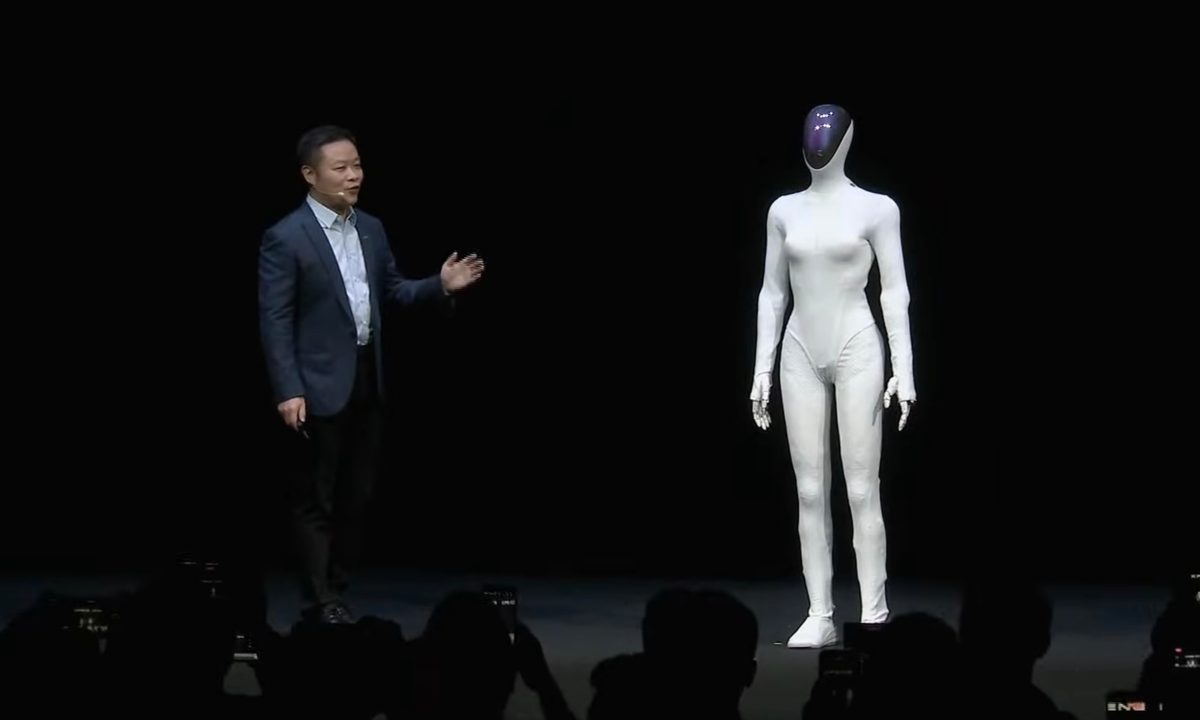
XPeng's CEO beside the company's Iron humanoid robot.
XPeng's CEO beside the company's Iron humanoid robot. XPeng

XPeng held a special event at its headquarters in Guangzhou, China, this week, showcasing its transformation from an electric vehicle maker to something much more ambitious involving humanoid robots, robotaxis, and flying cars — all powered by its advanced AI model and proprietary chips. 

Highlighting its new focus on integrating AI with real-world mobility and robotics, the company unveiled the latest version of its humanoid robot, called Iron. 

And that’s where things got interesting.

Recommended Videos

Iron’s ability to walk just like a human had many in the audience, as well as those watching a livestream of the event at home, wondering if it was actually a human inside. After all, many of you will recall that when Tesla chief Elon Musk unveiled the automaker’s Optimus robot in 2021, it was actually someone wearing a tight-fitting bodysuit.

And so, keen to dispel any rumors that XPeng was trying to pull a fast one in the style of Tesla, CEO He Xiaopeng brought Iron back onto the stage to show that Iron was indeed a humanoid robot and not a person in a bodysuit. 

They did this by getting an engineer to carefully cut away the fabric and padding materials surrounding Iron’s left leg, eventually revealing a robotic leg.

Once again, with its metal innards exposed, Iron walked across the stage in a very human-like way. It’s an extraordinary sight, and anyone with a nervous disposition may shudder at the spectacle of the bipedal bot strolling along in such a realistic way.

XPENG’s next-gen IRON robot effectively crossed the uncanny valley, leading many to believe it was a human in a suit.

In a follow-up event to prove it was a robot, He Xiaopeng had its leg skin cut open in front of a live audience. The robot then walked off the stage. pic.twitter.com/CNF5loZyaf

— The Humanoid Hub (@TheHumanoidHub) November 6, 2025

XPeng is competing with a slew of other makers of humanoid robots, which could eventually be deployed in the workplace and even in home settings.

According to XPeng, Iron could one day find itself helping visitors in museums, car showrooms, shopping centers, and of course XPeng’s own retail stores. Placement in factories for inspection roles is also on the cards. 

The company says it’s targeting mass production of Iron by the end of next year.

Trevor Mogg
Contributing Editor
Not so many moons ago, Trevor moved from one tea-loving island nation that drives on the left (Britain) to another (Japan)…
Pope says AI must be disarmed and shouldn’t dominate humanity. We’re going the opposite way.
The Pope just dropped his first encyclical, and AI companies should probably read it.
Pope Leo XIV signing his first encyclical

Pope Leo XIV signed his first encyclical on May 15, the 135th anniversary of Pope Leo XIII's Rerum novarum. The document, Magnifica humanitas, was published on May 25 and addresses one of the defining challenges of our time: artificial intelligence and its impact on humanity.

The core message isn't anti-technology. The Pope is clear that technology is neither a threat nor inherently evil. However, he does say that technology is never neutral, because it takes on the values of those who build, fund, and control it. That's where things get interesting.

Read more
I built an offline Grammarly alternative and turned it into a Mac app without any coding
It lives in a browser tab. It's a Chrome extension. It's also a Mac app. Claude built it for me in all three flavors.
Grammarly alternative built using Claude.

I wrote this entire article while seated on an airplane experiencing unusually high turbulence. The software I used to spell-check and grammatically sanitize the draft was built at an airport. The language engine is running entirely on my Mac, fully offline, fixing all my typos and removing the double spaces while I mash the keyboard and sip a sugar-bomb coffee. 

Also, I don't know how to code. I didn't write a single line of code, and yet, the Mac software I am using right now looks classier and feels snappier than Grammarly ever did. Grammarly, if you don't know, is one of the most popular apps for spelling and grammar checking on the planet. So, how did I do it? I asked Claude. I narrated my wish, it asked my preferences, and in less than 30 minutes, I built myself a no-internet Grammarly replacement while also avoiding the "yet-another-subscription" curse.

Read more
China will put a unique ID code on humanoid robots, just like citizen ID for us humans
China is treating its humanoid robots like citizens. assigning each one a unique ID code from birth to recycling.
Robot with four arms

China has launched a national programme that will assign every humanoid robot manufactured in the country a unique digital identity code, effectively a citizen ID, but for bipedal machines (those that can balance and walk/run on two legs). 

The initiative, called the Humanoid Full Lifecycle Management Service Platform, was announced on Friday. It is led by the Humanoid Robotics and Embodied Intelligence Standardization committee, which is under China's Ministry of Industry and Information Technology (via South China Morning Post).

Read more