  1. Home
  2. Space
  3. News

Stunning close-up footage shows NASA’s moon rocket roaring to space

On its first crewed flight, NASA's lunar rocket displays its awesome power.

Add as a preferred source on Google
NASA's SLS rocket roars skyward at the start of the Artemis II mission on April 1, 2026.
NASA's SLS rocket roars skyward at the start of the Artemis II mission on April 1, 2026. NASA

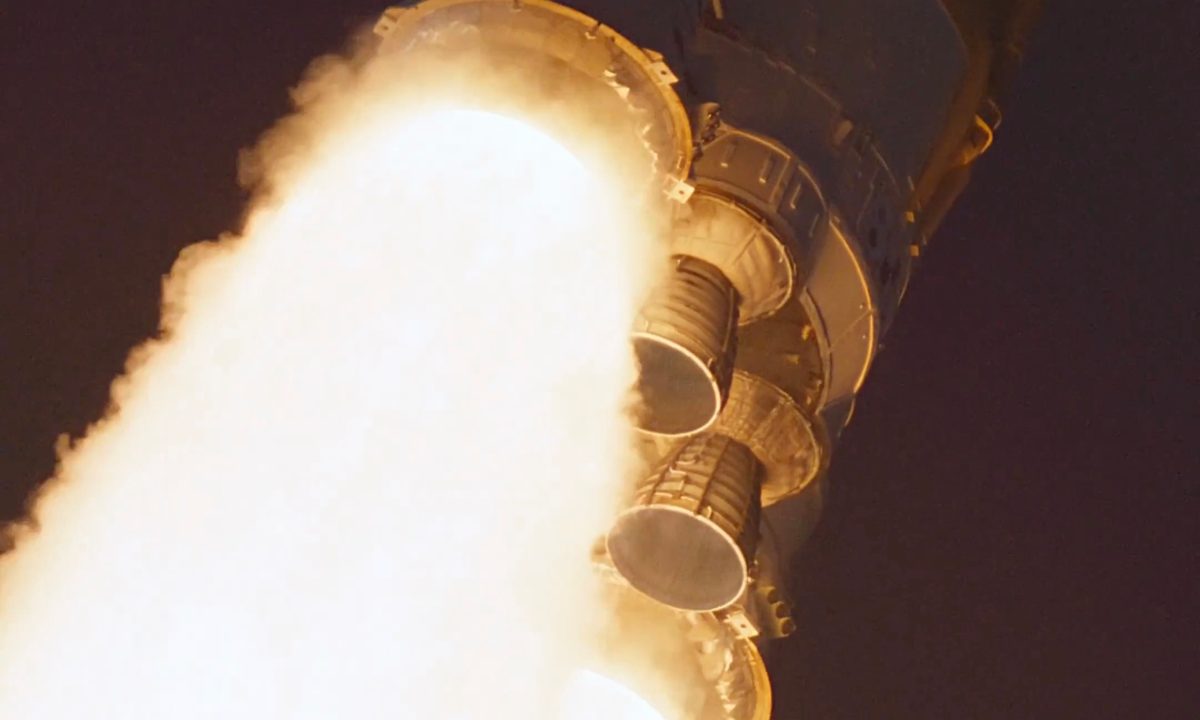
As NASA’s Artemis II astronauts journey back to Earth following their breathtaking close encounter with the moon earlier this week, the space agency has just shared some stunning footage (below) of the rocket launch that sent the crew on its way on April 1.

The close-up tracking shot shows the awesome power of the Space Launch System (SLS) rocket’s four core RS-25 engines together and its two solid rocket boosters as the 98-meter-tall vehicle roars away from the launchpad at the Kennedy Space Center in Florida.

@NASA has just released some EXTRAORDINARY tracking footage from Artemis II’s launch just one week ago.

Mesmerizing exhaust flow interaction between all four RS-25’s & twin SRB’s. pic.twitter.com/Q49oZh5RrB

— Max Evans (@_MaxQ_) April 8, 2026

The SLS creates a colossal 8.8 million pounds of thrust at launch, about 1.2 million pounds of thrust more than the Saturn V rocket of the Apollo era five decades ago, and about half that of SpaceX’s in-development Starship rocket, which itself is expected to one day fly to the moon.

Recommended Videos

NASA’s rocket is powered by a mix of high-performance engines across its stages. Its core stage uses four RS-25 liquid-fueled engines, which burn liquid hydrogen and oxygen to produce extremely efficient thrust. Notably, these core stage boosters are actually repurposed hardware from the Space Shuttle, which NASA retired in 2011.

The vehicle also uses two massive solid rocket boosters that provide the majority of liftoff power to get the massive vehicle and the Orion spacecraft containing the crew to space.

Orion carried the crew farther from Earth than anyone has ever traveled as the spacecraft looped around the moon earlier this week.

Besides gathering new data about the moon, the mission is also testing the spacecraft for human operations ahead of future Artemis missions that will endeavor to return humans to the lunar surface, possibly as early as 2028.

After eight days in space, the four Artemis II astronauts now have Earth clearly in their sights and are preparing to splash down in the ocean off the coast of California on Friday in what promises to be a memorable homecoming.

For more details on how to watch the final moments of the Artemis II mission unfold, Digital Trends has you covered.

Trevor Mogg
Contributing Editor
Not so many moons ago, Trevor moved from one tea-loving island nation that drives on the left (Britain) to another (Japan)…
Scientists have found a hidden galaxy inside the Milky Way, and they’re calling it Loki
A lost dwarf galaxy may be hiding inside the Milky Way.
milky-way-hidden-galaxy-loki

Our home galaxy has a secret buried inside. A new study published in the Monthly Notices of the Royal Astronomical Society suggests that the Milky Way swallowed an ancient dwarf galaxy billions of years ago, and its stellar remains are still embedded within ours.

Researchers have named this lost galaxy Loki, after the Norse trickster god, and the name is quite fitting because it remained hidden in plain sight for a very long time.

Read more
NASA aims September launch for Roman space telescope and it’s going to be a huge shift
An earlier target for Roman means one of NASA’s most ambitious observatories is getting close, with the potential to open a huge new era in space discovery
Machine, Wheel, Astronomy

NASA is now aiming to launch the Nancy Grace Roman Space Telescope as soon as early September 2026, a faster timeline than its earlier commitment to fly no later than May 2027. That alone makes this one of the agency’s most important missions to watch over the next few months.

The reason is simple, Roman is built to scan vast parts of the sky with sharp infrared vision.

Read more
Blue Origin successfully re-uses a New Glenn rocket for the first time ever
Blue Origin achieves first New Glenn reflight despite payload setback
Blue Origin

Blue Origin has achieved a major milestone in its spaceflight ambitions by successfully reusing a booster from its heavy-lift New Glenn rocket for the first time. The historic launch, conducted on April 19, marks a significant step forward for Jeff Bezos’ space company as it seeks to compete with rivals like SpaceX in the rapidly evolving commercial launch market.

A Milestone With A Mixed Outcome

Read more