  1. Home
  2. Phones
  3. News

Apple could bring curved displays back in vogue with the 20th anniversary iPhone

Apple's 2027 anniversary iPhone isn't just a milestone device; it could be the first iPhone that looks nothing like any iPhone before it.

Add as a preferred source on Google
Siri running on iPhone
Rachit Agarwal / Digital Trends

Apple doesn’t do anniversaries quietly, and we’ve seen that with the iPhone X in 2017. As 2027 approaches, marking 20 years since the first iPhone launched, fresh supply chain rumors suggest the company is planning something that isn’t just a spec bump. 

The 20th anniversary iPhone, as it seems, may be accompanied by the most radical design overhaul ever. 

What kind of display is Apple actually planning?

According to information from Chinese tipster Digital Chat Station (via Weibo), the Cupertino giant is working with Samsung on a custom “micro-curved” OLED panel, one that curves around all four edges of the device. 

Recommended Videos

Unlike the traditional “waterfall” edges we’ve seen on Samsung phones (on the popular S Edge series), Apple wants something that’s deliberately more subtle, just enough to soften the feel in the hand but make the device look like no other iPhone ever launched. 

While the subtler edges would make the design feel more natural, it would also prevent on-screen content from distorting at the sides. The display could also drop the polarizer layer entirely and instead use a Samsung technology called Color Filter on Encapsulation (COE), which, as the name suggests, applies the color filter directly onto the encapsulation layer. 
This technique reduces the overall display thickness while allowing more light to pass through, improving brightness and reducing power draw. At the same time, Apple has also incorporated a crated-shaped light diffusion layer to keep the brightness uniform across the entire panel. 

Will the front camera and Face ID finally go under the display?

They could, possibly, but it’s complicated. While display analyst Ross Young has previously said that an under-display Face ID won’t be ready for a 2027 iPhone, other leakers claim that the engineering achievement remains pretty much on the table for the next year. 

The company is still actively testing an under-display front camera module, implying that the 20th anniversary iPhone could feature a bezel and hole-punch-free screen, or something that is just short of it. Either way, the company wants an all-glass iPhone without any visible cutouts on the display. 

While I’m not doubting Apple and Samsung’s collective design and engineering prowess — the companies can surely achieve an all-display smartphone — I’m more concerned about its durability and how it would handle every wear-and-tear. 

Shikhar Mehrotra
For more than five years, Shikhar has consistently simplified developments in the field of consumer tech and presented them…
The next iPhone moment might come from an AI company, not Samsung or Apple
OpenAI is done playing nice with Android and iOS.
agentic smartphone representation

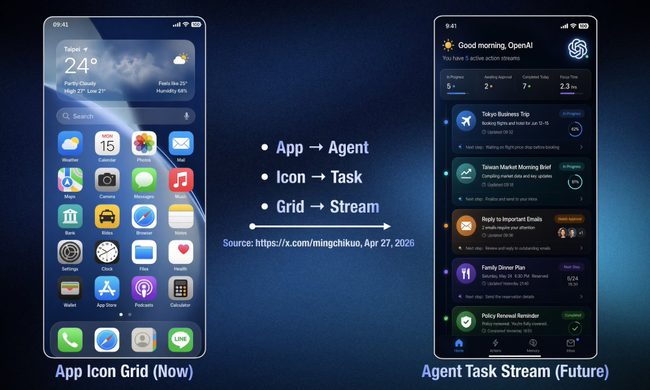
Your smartphone has a pile of apps. OpenAI wants to replace all of them with one AI agent that just gets things done. That's the vision behind the company's plans to build its own smartphone, complete with a custom processor co-developed with MediaTek and Qualcomm, as first reported by analyst Ming-Chi Kuo on X.

And Sam Altman seems to agree. In a post on X, the OpenAI CEO wrote, "feels like a good time to seriously rethink how operating systems and user interfaces are designed." That is not a subtle hint.

Read more
Samsung leak shows its upcoming wide foldable will be unmissable in a sea of phones
Samsung's wider Galaxy Fold dummy has leaked, and the Qi2 magnets have us more excited than the design itself.
Samsung galaxy fold dummy units

Samsung is developing a wider Galaxy Fold, and if you've been keeping up with recent tech news, this won't come as a surprise. While its arrival was already expected, newly leaked dummy units have now given us our first confirmed look at the design, and there's plenty to be excited about.

The design looks like nothing else in your pocket

Read more
The iPhone 17 won me over, but I’d still recommend the iPhone 16 to most people
The iPhone 16 shares its design, software, AI features, and primary camera with its successor, all at a lower price.
Electronics, Mobile Phone, Phone

I was using the iPhone 17 when I picked up my iPhone 16 to look at an older video, and it led to an epiphany: nothing about the iPhone 16 felt any worse than its successor. It wasn’t any slower, the design didn’t feel dramatically different, and nothing about it screamed “old” or “outdated.” That feeling stuck with me for a few days.

Over the years, the smartphone industry has trained us to treat one year of upgrades (no matter how incremental) as something that should feel significant, but upon switching back to the iPhone 16 after using the iPhone 17 for over six months, I realized that wasn’t the case. We’re so stuck in finding the smallest changes in the spec sheet that we forget that a company’s product cycle isn’t a measure of obsolescence.

Read more