  1. Home
  2. Computing
  3. News

OpenAI is bringing in the mighty Codex tool to the ChatGPT app on your phone

The ChatGPT mobile app now has Codex so you can manage coding tasks anywhere.

Add as a preferred source on Google
openai-codex-chatgpt-app-remote-monitoring-feature
OpenAI

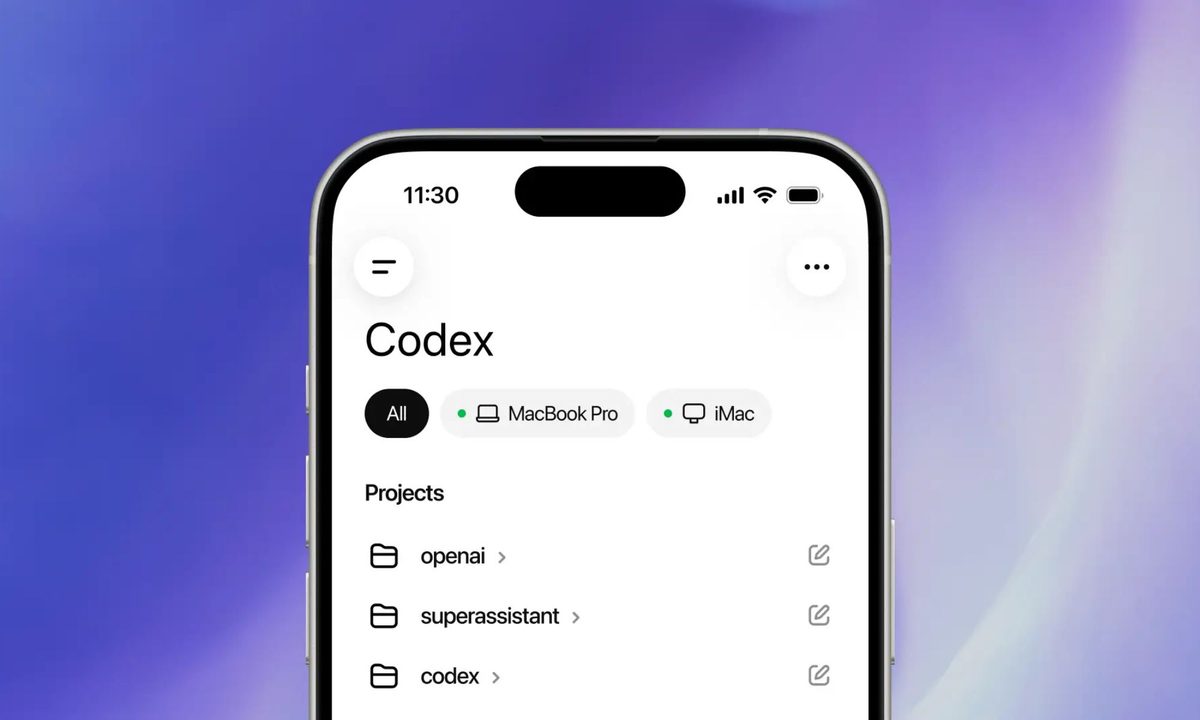
If you have ever wanted Codex to work through your bugs and pull requests while you grab coffee or commute, OpenAI just made that possible. Codex, the company’s AI-powered coding agent, is now available in the ChatGPT mobile app on iOS and Android.

The feature is currently rolling out in preview across all plans, including Free and Go, in all supported regions. For now, mobile support works with the macOS Codex app. Windows support is coming soon.

What can Codex actually do from your phone?

The mobile version is not about writing entire apps on a tiny touchscreen. Think of it more like a remote control for AI-powered coding sessions already running on your computer.

Recommended Videos

When you connect your phone to any machine where Codex is running, whether that is your laptop, a dedicated Mac mini, or a remote development environment, the app pulls in the live state from that setup.

From there, you can review active threads, approve commands, switch models, check terminal output, look at test results, and inspect diffs, all without being anywhere near your desk.

Your files, credentials, and local setup stay on the machine doing the work, while real-time updates flow back to your phone as Codex makes progress.

OpenAI uses a secure relay layer to keep your trusted machines reachable across devices without exposing them to the public internet.

OpenAI clearly sees Codex as a huge deal

The ChatGPT maker has been reshaping its products around Codex with confirmed plans to combine ChatGPT, Codex, and its Atlas browser into one larger AI “superapp.”

The company recently brought Codex into Chrome, putting its coding agent directly inside your browser. It even introduced quirky “Codex Pets” that show live progress updates while AI coding tasks run in the background.

The competition is heating up with rivals like Anthropic’s Claude Code which gained a remote monitoring feature, back in February. OpenAI is now making its own push, and clearly does not want to fall behind.


Manisha Priyadarshini
Manisha Priyadarshini is a tech and entertainment writer with over nine years of editorial experience.
Your next free Google account might only come with 5GB of storage
Google's free storage has been a competitive advantage over Apple's 5GB iCloud limit for years, but that’s changing.
Electronics, Mobile Phone, Phone

Google has quietly altered one of the most reliable promises in consumer tech: 15GB of free cloud storage. For years, signing up for a Google account meant getting 15GB of free storage, shared across Gmail, Drive, and Photos. However, that’s changed. 

New accounts are now defaulting to 5GB (same as iCloud), with the full 15GB available only if you have entered your phone number during setup. The prompt users are seeing reads: “Your account includes 5GB of storage. Now get even more storage space with your phone number.”

Read more
Sony shows off AI-touched Xperia 1 VIII camera samples. It’s an epic self-own that I can’t digest
Sony built the Xperia 1 series for people who know what a histogram looks like. Xperia Intelligence appears to have been built for everyone else, and the sample images make that tension impossible to ignore.
Sony aggressive AI photography featured.

Sony has a camera legacy that most brands, regardless of whether they make cameras or smartphones, dream of. The company rewrote what full-frame sensors could do with its Alpha series. 

That particular rendering of skin tones, that restraint with saturation, the commitment to accurate white balance; the company’s color science is precisely why cinematographers, videographers, and photographers like me, in the consumer tech space, swear by its color science and camera hardware. 

Read more
Razer’s new Blade 18 gets Arrow Lake refresh and a modest $3,999.99 starting price
For $3,999.99, you get the base model with Nvidia RTX 5070 Ti. A 5090 variant is available, too.
Razer Blade 18.

Razer has officially unveiled the 2026 Blade 18 today, and at the heart of all three configurations is an Intel Arrow Lake processor. 

I’m talking about the Core Ultra 9 290HX Plus, which features 24 cores, up to 5.5GHz clock speed (with boost), 36MB cache, and an onboard NPU that delivers up to 13 TOPS of compute power. 

Read more