  1. Home
  2. Wearables
  3. News

Your earbuds may soon identify you by your heartbeat

Add as a preferred source on Google
Earbuds
Unsplash

Biometric authentication is no longer limited to fingerprints and face unlock. Researchers are now exploring whether your earbuds can recognize you simply by listening to the tiny vibrations created by your heartbeat.

A new study published on the arXiv preprint server introduces “AccLock,” a passive authentication system that uses standard earphone hardware to verify a user’s identity. Instead of relying on microphones or voice prompts, the system works through built-in accelerometers already found in many modern earbuds.

Your heartbeat may become your next password

The technology captures heartbeat-induced vibrations inside the ear canal, known as ballistocardiography (BCG) signals. These signals travel through bones and tissues, creating patterns unique to each person. That uniqueness is what makes the system interesting. Once the earbuds register a user’s BCG signal, they can continuously check whether the same person is still wearing them. If another user puts on the earbuds, the authentication fails automatically.
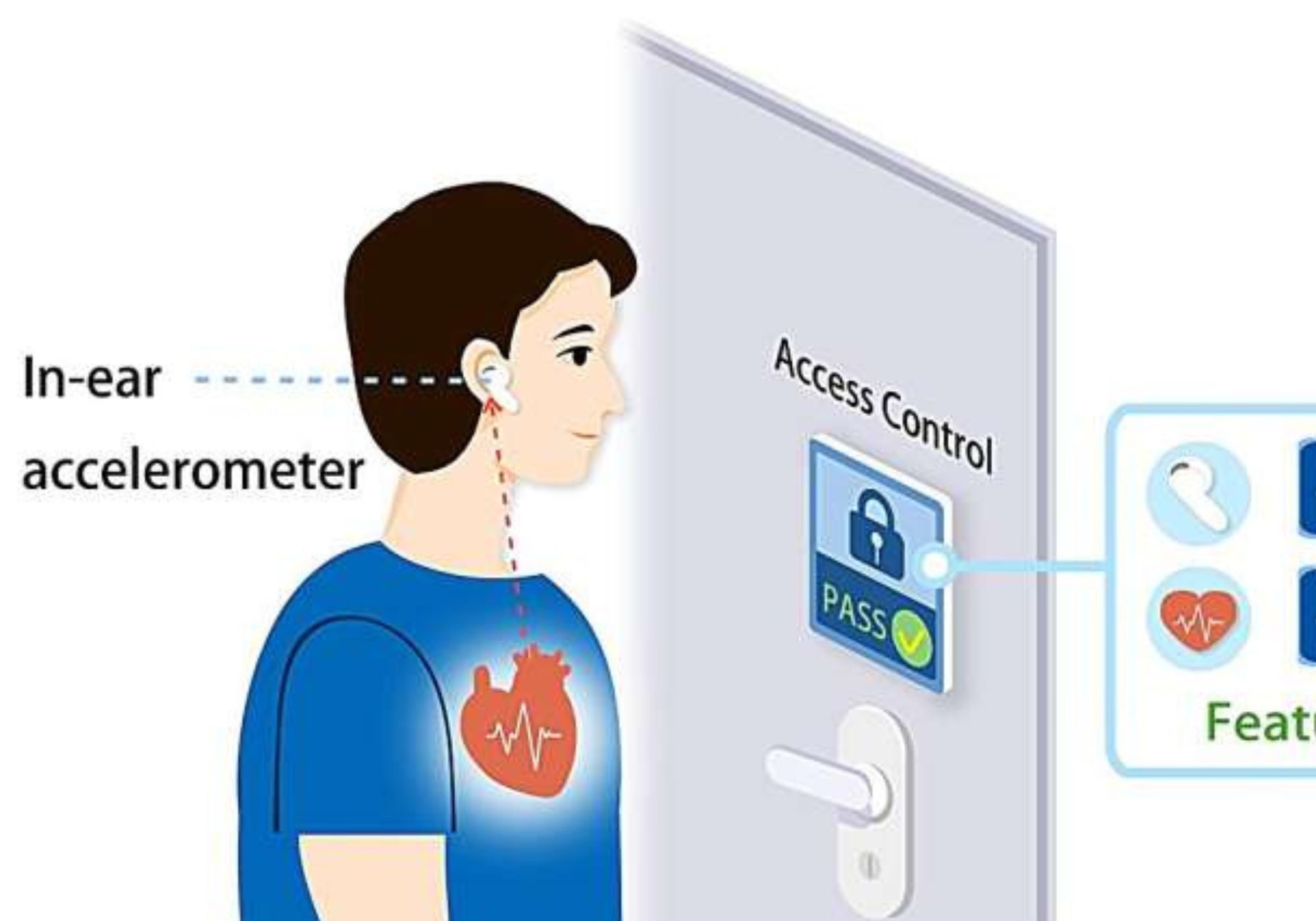
Unlike older earphone-based authentication systems, AccLock does not require users to actively interact with the device. The entire process runs quietly in the background, which could eventually make tasks like unlocking devices, approving payments, or entering smart homes feel almost invisible.

It works well — until too much movement is involved

To improve reliability, the researchers used a deep learning model and a multi-stage denoising system to separate user-specific heartbeat patterns from environmental noise and general body movement. In tests involving 33 participants, the system achieved false acceptance and false rejection rates of 3.13% and 2.99%, respectively, which is fairly promising for an experimental prototype.

However, heavy movement remains a major problem. Walking, talking, or shaking the head significantly increased error rates, showing that the system still struggles in real-world conditions. The researchers also tested the technology on Apple AirPods and found that it remained functional despite hardware limitations. While AccLock is far from becoming a commercial feature today, it offers a glimpse of a future where your earbuds quietly recognize you before you even unlock your phone.

Shimul Sood
Shimul is a contributor at Digital Trends, with over five years of experience in the tech space.
Google Health 5.0 is rolling out with its best feature up front and its worst problems buried
Google Health 5.0 puts its cleanest feature on the home screen and hopes you don't look too closely at what's changed.
Fitbit app AI health coach screenshots.

Google Health 5.0 is rolling out now as a mandatory update for the Fitbit app users, and the timing is deliberate. 

The new Fitbit Air, Google’s most direct competitor to the Whoop fitness tracking band, launches next week, and, if you haven’t already guessed it, Health 5.0 is required to set it up. 

Read more
Samsung is prepping open-ear Galaxy Buds Able earbuds and I’m pretty excited
Samsung is entering the fastest-growing segment in wireless audio with a clip-on open-ear earbud, and the market timing couldn't be more competitive.
Face, Head, Person

Open-ear earbuds have grown quite popular in recent years, and Samsung has finally decided it wants a piece of the market. The Korean outlet ETNews, citing industry sources, claims that the company is gearing up to launch the Galaxy Buds Able. 

They are believed to be clip-type, open-ear earbuds that hook onto the ear without blocking the canal, and I genuinely believe they could be one of the most interesting audio launches of the year. 

Read more
Google and Xreal’s Project Aura smart glasses will ship later this year
Xreal Project Aura smart glasses come with built-in display units and run Android apps.
Front view of Xreal Project Aura smart glasses.

Google is working on a whole bunch of smart glasses. The first one running on the Android XR platform developed by Samsung is expected to arrive close to July. The slate, it seems, will get crowded pretty soon. Earlier today at the I/O 2026 Developers Conference, Google also showed off a new class of audio glasses that have been designed in partnership with Warby Parker and Gentle Monster.

But the most interesting of the bunch is the Xreal Project Aura smart glasses, which support full hand gesture support as well as mixed reality view for Android apps available through the Play Store. These smart glasses were first showcased in December 2025, but Xreal confirmed earlier today that the Project Aura smart glasses will hit the shelves in 2026. 

Read more