In a true testament to the power of the people, an unlikely mechanism has emerged as a key tool in tracking and detecting earthquakes. While high-tech sensors can’t be placed everywhere in the world, people already are, and people use Twitter — over 316 million of them per month, to be exact.
Now the U.S. Geological Survey (USGS) has begun relying on Twitter and tweets to track and detect earthquakes with surprising accuracy and efficiency. In fact, thanks to Twitter, the USGS can be alerted to tremors in less than 30 seconds. How’s that for having eyes and ears everywhere?
While the USGS maintains around 2,000 realtime earthquake sensors, most of which are located in the U.S., this number pales in comparison to the number of Twitter users who are able to react and respond instantaneously when the earth moves beneath their feet. In its blog post, Twitter noted, “At first, the USGS staff was a bit skeptical that Twitter could be used as a detection system for earthquakes — but when they looked into it, they were surprised at the effectiveness of Twitter data for detection.”
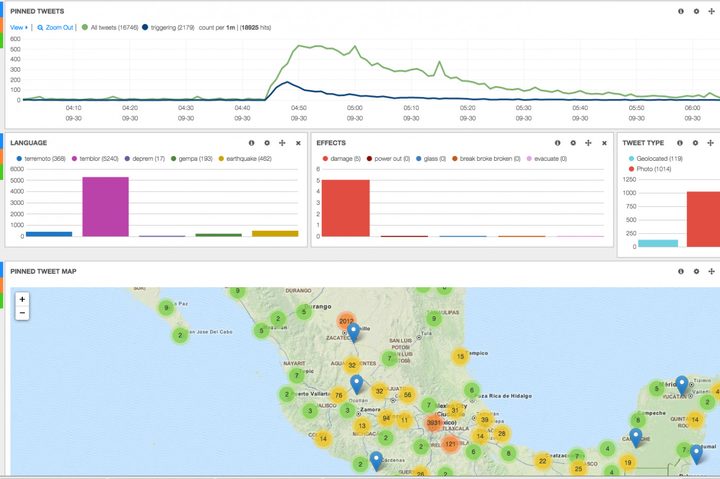
In order to really leverage the platform to its advantage, the USGS asked staffers Paul Earle, a seismologist, and Michelle Guy, a software developer, to take a closer look at Twitter’s Public API. While still employing the same “time series event” detection techniques the USGS uses when detecting earthquakes, the team wanted to take things a step further and examine how people actually talked about earthquakes as they happened. Unsurprisingly, Earle and Guy found that in the event of an earthquake, people who tweeted about it kept their Tweets short — sometimes just one word: “earthquake?”

After noticing this trend, the USGS team decided to only examine tweets comprised of seven or fewer words. Moreover, the Twitter blog notes, “They also recognized that people sharing links or the size of the earthquake were significantly less likely to be offering firsthand reports, so they filtered out any Tweets sharing a link or a number.” After applying these parameters, the USGS found that “this filtered stream proved to be very significant at determining when earthquakes occurred globally.”
While this isn’t necessarily an earth-shattering innovation, having yet another tool in the USGS arsenal helps keep people safer and more aware of potentially dangerous situations. “It’s not a revolutionary change in what we do,” Earle told CNN, “but it just gives us that extra minute to start on our response.” And sometimes, it’s that minute that makes all the difference in the world.