Cars are rapidly evolving, and it seems like just about everything about them is going digital. Of course, for the most part, that’s a good thing. It allows for more remote control over your car, a cleaner look to your car’s dashboard, and more.
Unfortunately, it also seems like car companies are going a little … too far. It’s one thing for things like audio playback controls, mood lighting controls, and others to be pushed into a screen. But for some reason, it feels like another thing entirely for climate controls, for example, to be controlled exclusively digitally.
But digital controls can be done well — and recently driving the Lucid Air proved that to me.
Car companies are software companies?
There’s one simple explanation for why digital controls in cars can be, and often are, bad. They’re unsafe. When you’re supposed to be watching the road, it’s simply dangerous to be hunting around an interface just because you’re a little cold.
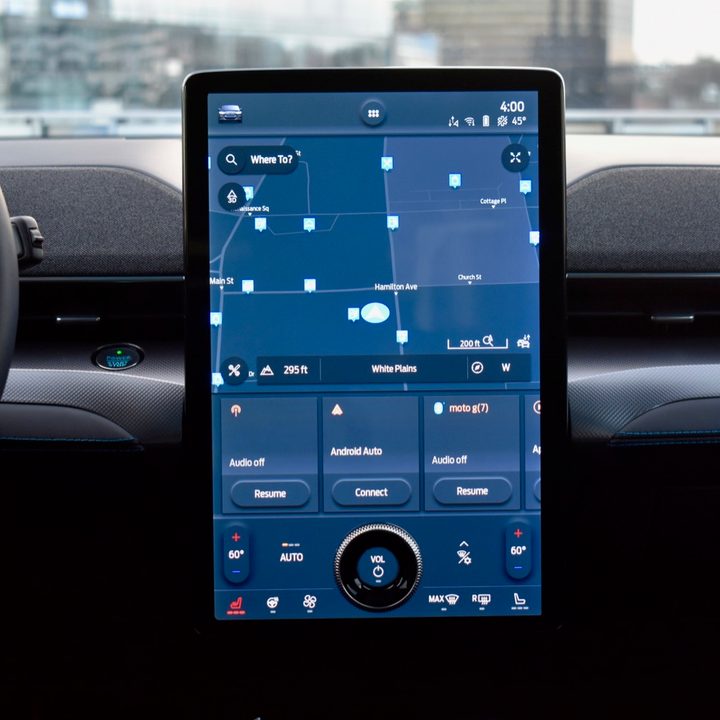
The simple truth is that car companies want your attention on their interface — not CarPlay or Android Auto. Sure, they include those interfaces because customers demand them, but there’s a war going on in that screen of yours. If car companies can convince you to stick within their interfaces, they could eventually convince you to subscribe to more features, pay for things in their software, and so on.
The result of all this? Car companies are software companies now. Well, they’re aspiring software companies. Car companies have been building software for years, but for the most part, it’s been inconsequential — bad software with few ramifications. The likes of Apple and Google, however, have been forced to develop easy-to-use software for the better part of two decades now. And companies like Tesla and Lucid have benefitted from their work, not only poaching many of the employees that refined those software systems but taking the lessons learned too.
For the most part, traditional car companies are starting to clue into this, but they clearly have a long way to go. Most of the major automakers have placed a heavy emphasis on their software over the past few years, but even the big ones, like Ford, still struggle. I don’t mind the overall interface on the Mach-E, for example, but it’s dogged by sub-par processing power which means it takes precious seconds for button presses to actually do anything, and in a fast-paced situation like driving, those precious seconds can be very important.
It can be done well, but rarely is
All of this takes me to the Lucid Air experience, which should serve as an example to the rest. In the Lucid Air, it’s actually very easy to tweak climate controls straight from the software. There’s a whole tab dedicated to climate controls, and to even navigate to that tab you’ll get a giant button that I actually got used to tapping without seeing within a week of driving the car (our car review loans are usually a week). From that tab you can turn up and down both temperature and fan speed with ease.
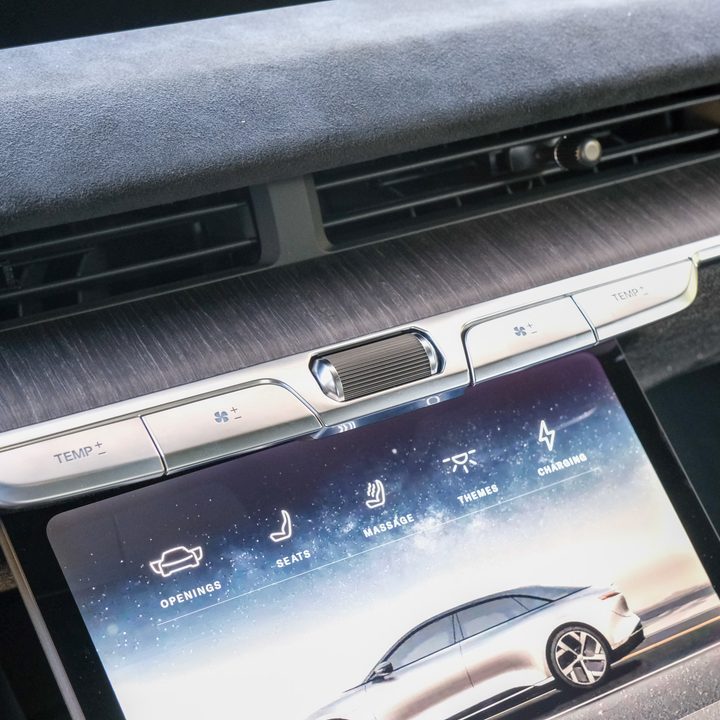
But Lucid has another trick up its sleeve. Despite being one of those fancy tech-heavy new car companies, Lucid has enough awareness to know that physical controls are important. Both the driver and the passenger have their own physical fan speed and temperature controls that are tactile and easy to use with no more than a split-second glance.
It’s not as if Lucid actually needed to do this. As mentioned, its software controls actually aren’t bad. And even if they weren’t the best, car companies have started adopting better tactile feedback, as smartphone manufacturers have been doing for years, ensuring that drivers know that their pressing a button without having to actually look at the screen.
Safety is key
The Lucid Air proves that there really can be a good balance between physical and digital controls, and other companies should take note.

Here are the rules, explicitly laid out. Settings that you would control every time you drive, like audio playback and climate settings, should be immediately accessible from whatever screen you’re on in the software interface. If there are controls of this kind that don’t have corresponding physical controls, feedback of some kind should be included (whether it’s haptic or audio), so that drivers know they’re pressing buttons when they tap the screen.
And, it goes without saying that button presses should be instantaneous. Your car should have enough processing power to handle the software both as it is from the factory, and as it will be years from now. Otherwise, you shouldn’t claim that your car will offer OTA updates, and yes, that means you’ll lag behind the competition.
This is really the bare minimum. Car companies that want to pretend to be software companies should at least prioritize safety — and that means ensuring that drivers don’t have to stare at a screen to avoid being freezing cold in the middle of winter. After all, any time spent not watching the road puts drivers at risk. Until car companies can build fully self-driving cars (not faking full self-driving like Tesla), they should do better.