


While electric vehicles now face more obstacles in the United States thanks to a hostile political situation, the EV future is still happening in Europe. Held in Munich this year, the IAA Mobility show is Germany’s largest auto show, and the major German automakers had several major EV announcements at their home show. From next-generation battery tech to wireless charging, here are the highlights.
Audi moves forward by looking back

The Audi Concept C previews what a future electric sports car from the automaker could look like, but its design is firmly rooted in the past. Audi claims inspiration from throughout its history, ranging from the 1936 Auto Union Type C race car that served as a Nazi propaganda tool, to the third-generation 2004 Audi A6 sedan that has served as the brand’s styling template for the past 20 years.
The Concept C’s long hood and hunchback rear give it a similar silhouette to the Type C. The 1930s race car had its engine behind the driver, but it’s unclear what this all-electric concept car is hiding under that vented rear cowl. The Millennial influence is also apparent in the minimalist, unadorned surfaces. Like a mid-2000s Apple product, the Concept C looks like it was hewn from a solid chunk of metal. The minimalist theme continues inside, where a 10.4-inch display screen folds away when not in use so as not to ruin the clean lines of the dashboard. Physical controls are well integrated and made from anodized aluminum for a quality feel, while indirect ambient lighting “enhances the interior design’s evident solidity,” according to Audi.
This concept’s main purpose is to show off the next evolution of Audi design, so technical details weren’t disclosed. Audi did say that the Concept C previews a future production model, which could be paired with the expected EV replacements for the Porsche 718 Boxster and 718 Cayman sports cars.
BMW goes back to school
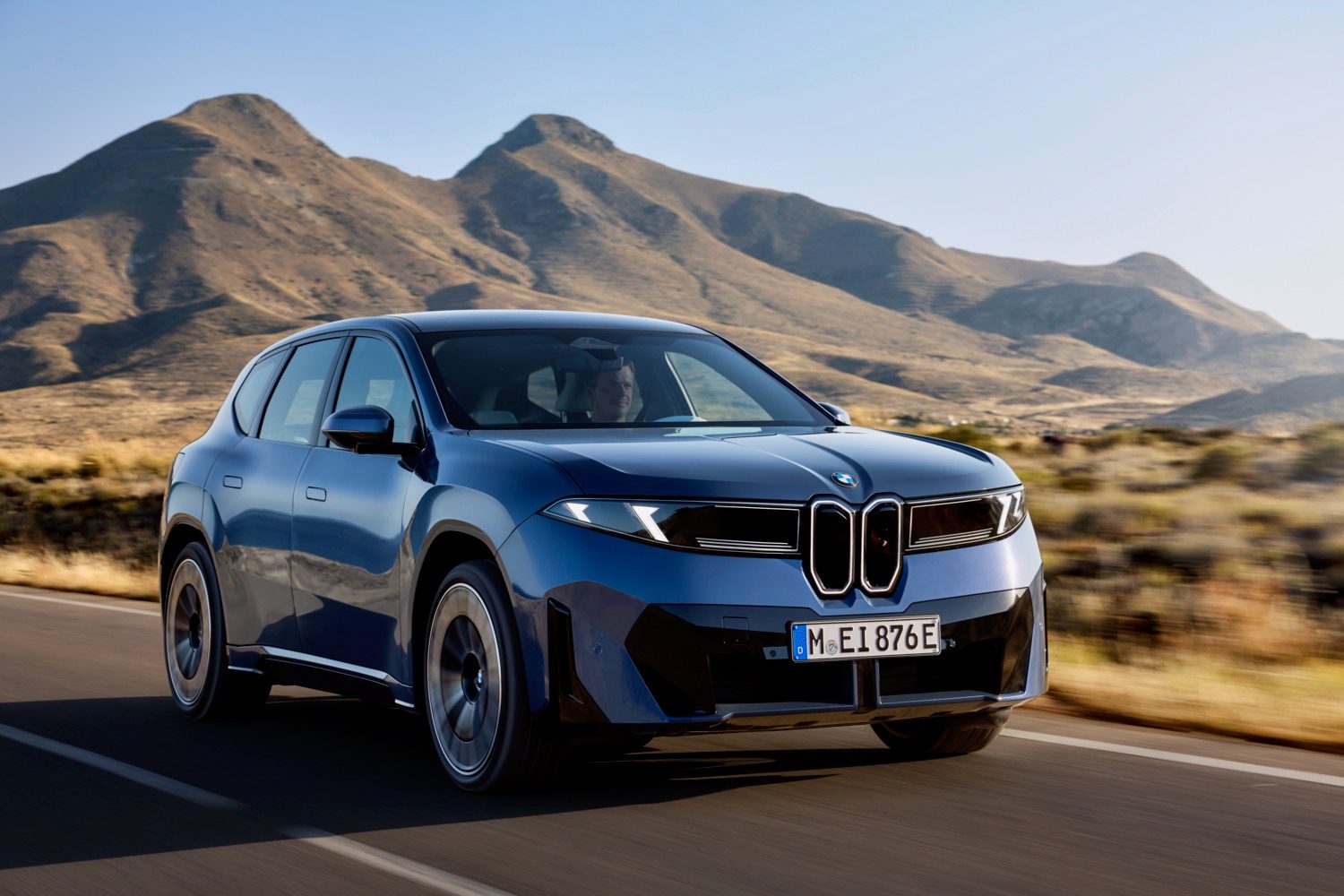
BMW unveiled the first of its next-generation “Neue Klasse” EVs at its hometown show, and SUV called the iX3 that’s close in size to the automaker’s current bestseller — the gasoline X3. Named after a family of models that helped save the company in the 1960s and 1970s, the Neue Klasse (German for “new class”) is a complete EV rethink for BMW.
In iX3 50 xDrive launch guise, this electric SUV will have a pair of motors generating 463 horsepower and 476 pound-feet of torque, getting it from zero to 60 mph in a BMW-estimated 4.7 seconds. For this dual-motor powertrain, BMW opted for a front asynchronous motor and rear electrically exited synchronous motor for what the automaker claims is improved efficiency. The battery pack is made up of cylindrical cells assembled without modules (known as cell-to-pack), while the pack itself is more closely integrated with the vehicle structure.
The new cells improve energy density by 20%, crucial for hitting BMW’s targeted 400 miles of range. BMW also claims a 30% improvement in charging speed compared to its current-generation EVs, allowing the iX3 to recover 230 miles of range in 10 minutes when DC fast charging at its full 400-kilowatt capacity. The iX3 marks BMW’s switch to the North American Charging Standard (NACS), but a free Combined Charging Standard (CCS) adapter will be provided.
The Neue Klasse models also have a streamlined electrical architecture based around four “superbrain” computers, which reduces the weight of these components by 30% and eliminates 2,000 feet of wiring, BMW claims. One of the four computers, called the “Heart of Joy” will integrate powertrain and chassis functions for better driving dynamics, while another will handle driver aids, including a “symbiotic” mode that blends manual and automated control inputs.
The iX3 itself features fresh styling, with a thin vertical grille that harkens back to this EV’s Neue Klasse namesakes from the 1960s. Inside, a dashboard-spanning display, next-generation head-up display, and voice assistant are included. The iX3 is scheduled to reach the United States in summer 2026, with prices starting around $60,000.
Mercedes’ star shines even brighter

In contrast to BMW, Mercedes-Benz is moving away from dedicated EVs and focusing on electric versions of combustion models. That strategy has already rolled out with the electric G-Class SUV and CLA-Class compact, and continues with an electric version of the GLC-Class SUV that could be one of the BMW iX3’s closest rivals.
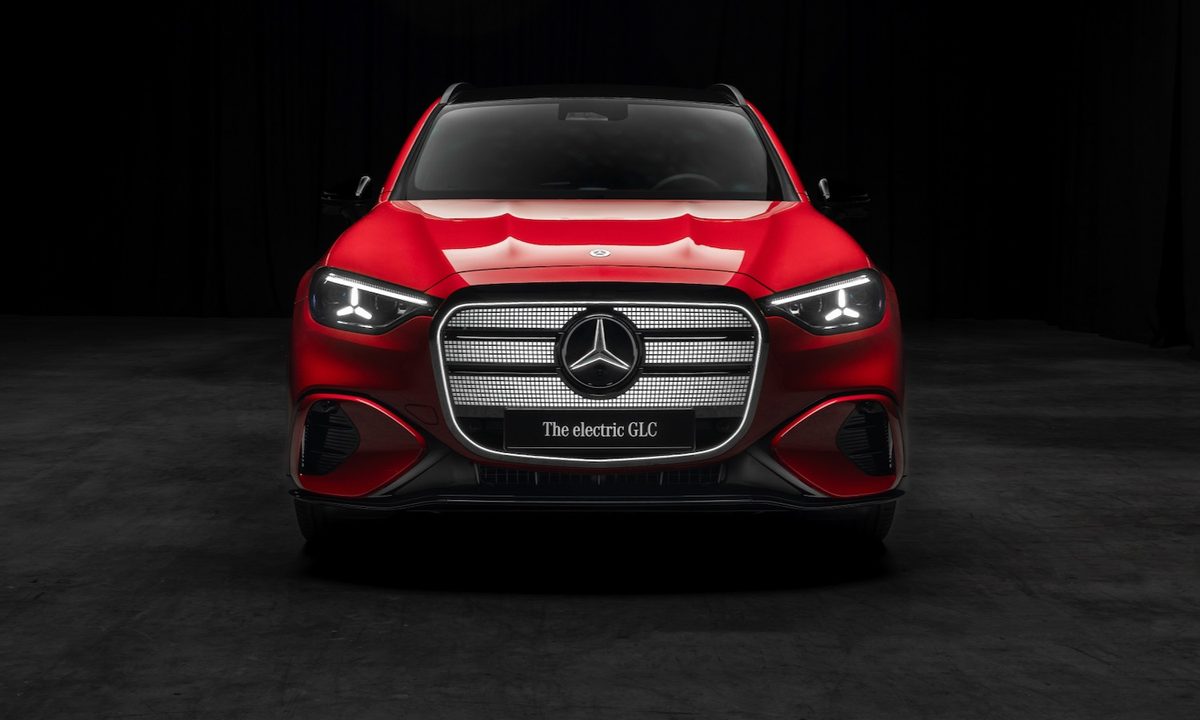
Officially the GLC with EQ Technology, the EV looks a lot like a gasoline GLC, but with bigger, illuminated grille and the Mercedes-star headlights from the CLA. However, the electric version also has a 3.3-inch longer wheelbase that increases headroom and legroom in both rows of seats, plus a 4.5-cubic-foot frunk.
Full specs will be released closer to the electric GLC’s arrival in the U.S. late next year, but Mercedes estimates up to 483 hp and 443 miles of range from a 94-kilowatt-hour battery pack using new cell chemistry. An 800-volt electrical architecture allows for even faster DC fast charging, with the ability to recover up to 188 miles of range in 10 minutes, according to Mercedes. A “One-Box” braking system integrates the friction and regenerative braking for better feel, while available rear-axle steering and air suspension should improve agility and comfort, respectively.
Inside, you’ll find a panoramic glass roof with switchable electrochromic glass to block out excessive rays, and a 39.1-inch dashboard display comprised of a 10.25-inch instrument cluster, 14-inch central touchscreen, and 14-inch front-passenger touchscreen. It runs the new Mercedes-Benz Operating System (MB.OS) and Mercedes-Benz User Experience (MBUX) infotainment software that debuted in the CLA, with a cacophony of voice assistants. ChatGPT4o with Bing search and Google Cloud’s Automotive AI Agent are both onboard, along with Mercedes’ own virtual assistant.
Porsche lets you charge a car like a smartphone

Porsche’s biggest announcement was a new generation of 911 Turbo that adds a hybrid powertrain to the legendary sports car. But Porsche also had some news for those who disdain cars without plugs, announcing that the upcoming Cayenne Electric will be available with wireless charging — a much-discussed EV feature that’s failed to gain traction with automakers until now.
Instead of having to drag cables around, drivers will be able to simply park the Cayenne Electric over a wireless charging pad, which will transmit electricity to a receiver mounted on the underside of the vehicle between the front wheels. Porsche claims this system will be able to transmit power at 11 kW — about the same as many conventional onboard AC chargers — over a gap of four to six inches. Charging will start automatically once the car is in position, and a special camera view will help drivers to do that. Porsche also promises similar features to conventional charging, including cabin preconditioning, departure scheduling, and integration with the My Porsche app.
Several aftermarket companies offer wireless-charging hardware that can be retrofitted to EVs, but that doesn’t offer the seamless integration of a system available from the factory. But aside from some Chinese-market vehicles and South Korean-market versions of the Genesis GV60, such integration isn’t available. Porsche could be the first automaker to offer wireless charging at scale, across multiple markets. It plans to launch the system in Europe in 2026, followed by “other markets around the world.”


