
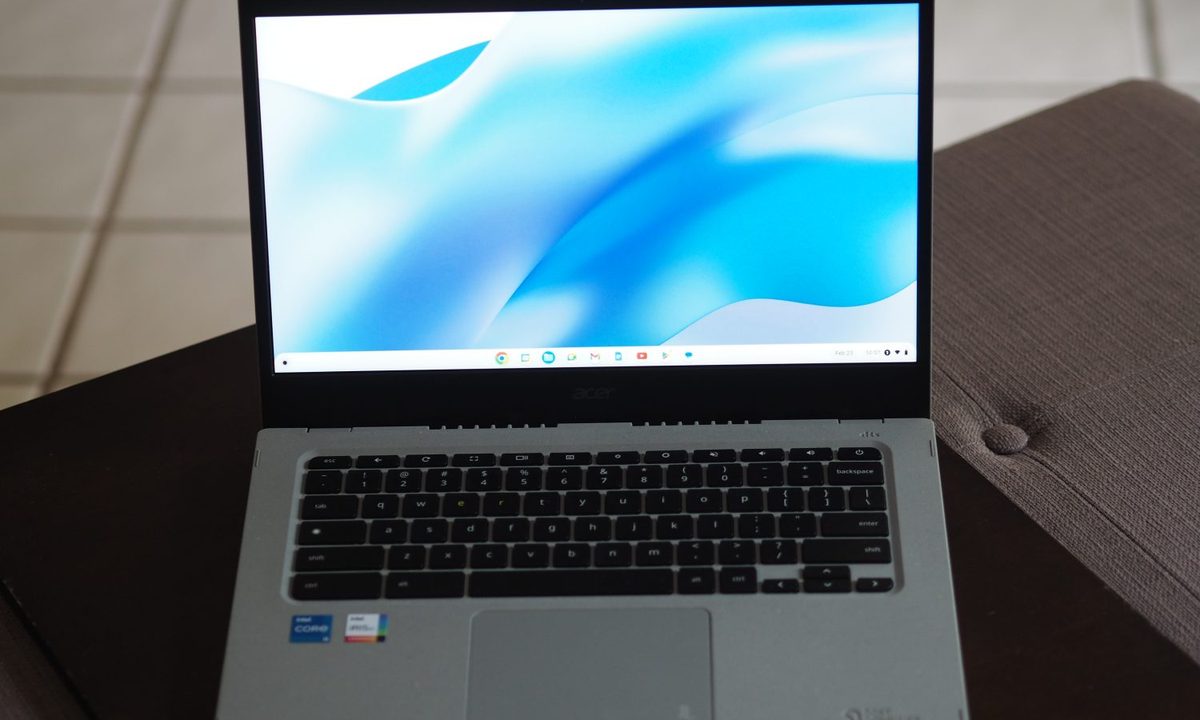
“Green credentials can’t save the Acer Chromebook Vero 514 from its cheap feel and disappointing display.”
- Very fast performance
- Decent battery life
- Good touchpad
- Class-leading sustainability
- Lid is too bendable
- Display is subpar
- Chassis is thick and unattractive

“Why you can trust Digital Trends – We have a 20-year history of testing, reviewing, and rating products, services and apps to help you make a sound buying decision. Find out more about how we test and score products.“
Acer’s laptop lineup, the Vero, has the express purpose of being as sustainable and using as much recycled material, as possible. The line isn’t limited to Windows, with the Chromebook Vero 514 adding ChromeOS as an option. The laptop features 30% post-consumer recycled (PCR) plastic in the chassis and 50% in the keycaps. The chassis is paint-free, and the display panel is 99% recyclable. Even the touchpad, dubbed OceanGlass, comprises 100% ocean-bound plastics.
If you’re looking for a Chromebook with an eye on the environment, then the Chromebook Vero 514 stands out. But how does it stand up as a laptop? Well, that’s a mixed bag, and it’s not so inexpensive that you can please both your wallet and your conscience.
Specs and configurations
| Acer Chromebook Vero 514 | |
| Dimensions | 12.81 inches x 8.83 inches x 0.80 inches |
| Weight | 3.09 pounds |
| Processor | Intel Core i3-1215U Intel Core i5-1235U |
| Graphics | Intel Iris Xe |
| RAM | 8GB |
| Display | 14.0-inch 16:9 Full HD (1920 x 1080) IPS |
| Storage | 128GB SSD 256GB SSD |
| Touch | No |
| Ports | 2 x USB-C 3.2 Gen 2 1 x USB-A 3.2 Gen 1 1 x HDMI (HDCP) 1 x 3.5mm audio jack |
| Wireless | Wi-Fi 6E and Bluetooth 5.2 |
| Webcam | 1080p |
| Operating system | ChromeOS |
| Battery | 56 watt-hours |
| Price | Buy at Best Buy |
Acer offers two configurations of the Chromebook Vero 514. First, there’s our $571 (on sale from $600) Best Buy review configuration with an Intel 12th-gen Core i5-1235U CPU, 8GB of RAM, a 256GB SSD, and a 14.0-inch Full HD IPS display. For $500, also from Best Buy , you can opt for a Core i3-1215U, 8GB of RAM, a 128GB SSD, and the same display. The review machine is far more attractive, with a much faster CPU and twice the storage for $100 more.
Recycled, and it feels like it

The Chromebook Vero 514 looks and feels completely different from any laptop I’ve reviewed. Its chassis has a thick, rough surface that feels more to me like the plastic you’d find on a cheap toy. That sounds harsh, but I’m just giving my personal impressions. Our Acer Aspire Vero review was kinder. None of what I say here means it’s structurally compromised. The chassis is rigid without bending or flexing, but the lid has a lot of give. You don’t have to exert much force to bend it, which lends an air of cheapness. At least there’s no display distortion. The hinge is stiff, requiring two hands to pry open the lid.
Since the recycled plastic is unpainted, you can see colored flecks of different kinds of plastic used in its construction. I’m sure that’s on purpose, and it lends an interesting aesthetic to the otherwise boring grey color scheme. The lines are simple, and it’s a minimalist design, with only the nature of the recycled plastic making it stand out. It’s not the most attractive laptop, and a buyer will have to be dedicated to the environment to overlook its less desirable aspects.

The top and bottom display bezels are huge by modern standards, while the side bezels aren’t particularly small. That makes this machine wider and deeper than it needs to be, given its 14.0-inch old-school 16:9 display. It’s also quite thick at 0.80 inches while being reasonably light at 3.09 pounds. Compare that to the similarly priced Acer Chromebook Spin 513 that’s 0.64 inches thick and weighs 2.83 pounds. The Chromebook Spin 513 is a convertible 2-in-1 that you’d expect to be a little thicker, which points out how thick the Chromebook Vero 514 really is.
The Chromebook Vero 514’s standard island keyboard with medium-sized black keycaps has good spacing, but the switches are a little loose. There’s just enough of a click in the bottoming action to make the keyboard OK for longer typing sessions, but I’ve used similarly priced Chromebooks with better keyboards. The keyboard is backlit with the usual ChromeOS range of levels, and the “e” and “r” keys are lime green. The touchpad is decently sized and precise, with quiet and confident clicks. The display isn’t touch-enabled.

With USB-C and legacy ports, connectivity is fine, but there’s no Thunderbolt 4. That’s not a ding against the laptop, though, given that only a few recent Chromebooks have added Thunderbolt 4, and they’re considerably more expensive. The $1,100 HP Elite Dragonfly Chromebook is one example. Wireless connectivity is up-to-date with Wi-Fi 6E and Bluetooth 5.2.


Finally, the webcam is 1080p, which is welcome on a budget Chromebook. There’s a physical cover you can use for some added privacy. There’s no biometric login, though, which some lower-priced Chromebooks have started to add.
Being eco-friendly doesn’t mean it’s slow

ChromeOS is a lightweight operating system that doesn’t require superfast CPUs for excellent performance. However, that’s not to say it can’t benefit from a good CPU, and the Chromebook Vero 514 utilizes a 15-watt Intel 12th-gen Core i5-1235U with 10 cores (two Performance and eight Efficient) and 12 threads. It’s a CPU that provides good performance in Windows 11 laptops. In a Chromebook, it’s incredibly fast.
Toss in the Chromebook Vero 514’s 8GB of RAM (again, plenty for ChromeOS) and speedy PCIe SSD, and you have a recipe for a fast laptop. According to the Android version of Geekbench 5, the Chromebook Ver0 514 is among the fastest Chromebooks we’ve tested. I also ran the Speedometer 2.0 web benchmark, which is important for ChromeOS given its reliance on the Chrome browser for much of its activity, and it again scores at the top of the Chromebook heap.
I could keep as many Chrome tabs open as I liked and run a few Android apps in the background without noticing any slowdowns. The Intel Iris Xe GPU also provided good Android gaming performance, with Asphalt 9 running smoothly (although not comfortably on a clamshell). Suffice it to say that the Chromebook Vero 514 is as fast as you’ll need your Chromebook to be for just about any task you throw at it.
| Geekbench (single / multi) |
Speedometer 2.0 | |
| Acer Chromeboook Ver0 514 (Core i5-1235U) |
1,437 / 4,909 | 201 |
| HP Elite Dragonfly Chromebook (Core i5-1245U) |
1,394 / 4,055 | 206 |
| Acer Chromebook Spin 513 (MediaTek Kompanio 1380) |
936 / 3,438 | 76 |
| HP Chromebook x360 14c (Core i3-1125G4) |
898 / 2,866 | N/A |
| HP Chromebook x2 11 (Qualcomm Snapdragon 7c) |
590 / 1,689 | 45 |
| Asus Chromebook Flip CX5 (Core i5-1135G7) |
1,190 / 4,151 | 163 |
Battery life was solid, lasting for almost nine hours in our web browsing test. That beats the other 12th-gen Core i5-based laptop on our list but falls slightly behind the 11th-gen Core i5 machine. It couldn’t keep up with the ARM-based Chromebooks, unsurprisingly. It was stronger in the video looping test, with only six minutes separating it from the ARM-based leader. That’s likely down to the low-resolution display.

Depending on your workflow, you’ll probably get close to a full day of productivity out of the Chromebook Ver0 514. You might need to take a little more extended lunch break, though, to make it all the way.
| Web browsing | Video | |
| Acer Chromebook Vero 514 (Core i5-1235U) |
8 hours, 51 minutes | 12 hours, 36 minutes |
| HP Elite Dragonfly Chromebook (Core i5-1245U) |
7 hours, 59 minutes | 9 hours, 13 minutes |
| Acer Chromebook Spin 513 (MediaTek Kompanio 1380) |
11 hours, 7 minutes | 12 hours, 42 minutes |
| HP Chromebook x360 14c (Core i3-1125G4) |
7 hours, 44 minutes | 8 hours, 2 minutes |
| HP Chromebook x2 11 (Qualcomm Snapdragon 7c) |
12 hours, 42 minutes | 10 hours, 59 minutes |
| Asus Chromebook Flip CX5 (Core i5-1135G7) |
9 hours, 25 minutes | 8 hours, 50 minutes |
An old-school and underwhelming display

The laptop industry is moving away from 16:9 displays, instead adopting taller and more productivity-friendly 16:10 and 3:2 aspect ratios. I’ve also seen higher-resolution displays on lower-priced Chromebooks, like the 2K (2256 x 1504) display on the Chromebook Spin 513. That makes the 16:9 Full HD (1920 x 1080) display immediately disappointing.
I also found the display to be relatively dim, with underwhelming colors and contrast that couldn’t stop blacks from bleeding into grey. It’s not a terrible display for typical productivity tasks, but creators and media consumers won’t love it.
Audio quality was also underwhelming, with two downward-firing speakers that didn’t get loud or provide high-quality sound. Mids and clears were just okay, and there was no bass. You’ll want to use a pair of headphones or external speakers for streaming video and, really, for anything other than normal system sounds.
Great for the environment, but not a great laptop
The Chromebook Ver0 514 contributes to the sustainability movement with a ton of recycled materials, and it has a unique look and feel. By that standard, it’s a solid notebook. By other standards, such as the disappointing display and mediocre keyboard, it’s not quite so impressive.
It is fast, though, and its battery life is decent. At $600, it’s not a cheap Chromebook, but it’s not overly expensive, either. Still, I find it hard to recommend to anyone whose priorities go beyond the environment.


