
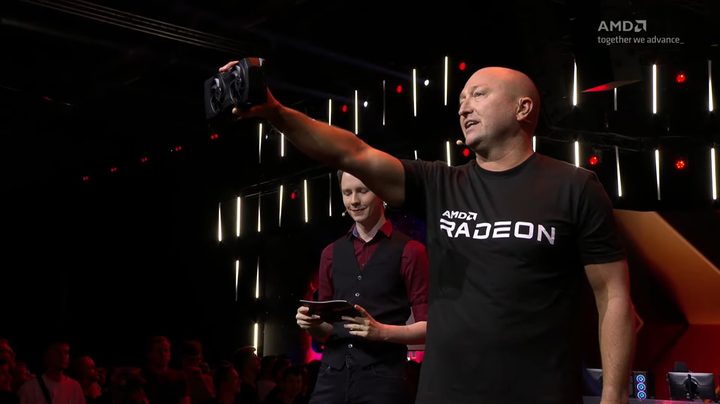
AMD has just unveiled two new graphics cards aimed at gamers — the Radeon RX 7800 XT and the RX 7700 XT. Set to rival some of the best graphics cards in this generation, the two GPUs are a way to bridge the gap in AMD’s modest RDNA 3 lineup. AMD teases that both cards are suited for 1440p gaming, which could help them compete in the mainstream gaming market.
The prices are what stand out: the RX 7800 XT starts at $500, while the RX 7700 XT goes for $450. That significantly undercuts Nvidia’s RTX 4070 at $600, though the RX 7700 XT is more expensive than the RTX 4060 Ti at $450. Nvidia could really use some competition, so let’s hope that AMD’s new GPUs will be powerful enough to make a dent in Nvidia’s market domination.
These two new cards are probably some of the most anticipated AMD products in a long time, given that they’re following in the footsteps of GPUs like the RX 6700 XT and the RX 6800 XT that continue to sell well and find their way into many gaming PC builds. They represent a much-needed halfway point between the high-end RX 7900 XTX/RX 7900 XT and the budget RX 7600.
Here’s how they stack up in terms of specs:
| AMD RX 7700 XT | AMD RX 7800 XT | |
| Compute Units (CUs) | 54 | 60 |
| RT accelerators | 54 | 60 |
| AI accelerators | 108 | 120 |
| Game clock | 2,171MHz | 2,124MHz |
| Boost clock | 2,544MHz | 2,430MHz |
| Memory | 12GB GDDR6 | 16GB GDDR6 |
| Memory speed | 18Gbps | 19.5Gbps |
| Bus width | 192-bit | 256-bit |
| Infinity Cache | 48MB | 64MB |
| Total Board Power (TBP) | 245W | 263W |
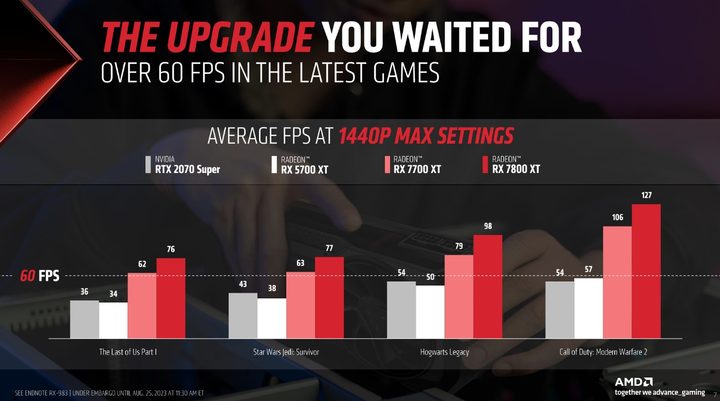
With these new GPUs, AMD promises to deliver an average of 60 frames per second (fps) when playing at 1440p with max settings. This includes some of the most demanding games, such as The Last of Us Part I or Hogwarts Legacy. Interestingly, while AMD advertised the RX 6800 XT as a 4K card, it sticks to a more reasonable 1440p expectation for its successor. This makes sense, as the specs of both cards certainly show a drop compared to the flagships, but the RX 7800 XT should still have some 4K gaming potential — it’s possible that AMD just doesn’t want to make any promises about that just yet.


To show off the performance of these upcoming GPUs, AMD shared some internal benchmarks, first comparing the duo to the Nvidia RTX 2070 Super and the RX 5700 XT. This isn’t a fair comparison, of course, so the gains are massive — the RX 7800 XT averages 76 fps at 1440p in The Last of Us Part I, with 62 fps for the RX 7700 XT and a mere 36 for Nvidia’s RTX 2070 Super.
The benchmarks that make more sense pit the RX 7800 XT against Nvidia’s RTX 4070, and the RX 7700 XT against the RTX 4060 Ti 16GB. Both GPUs show a commanding lead over their Nvidia counterparts in most games. In Call of Duty: Modern Warfare 2, the RX 7800 XT beats Nvidia by 23%, while the RX 7700 XT dominates by 31%. There are some titles where Nvidia wins, though, such as Doom Eternal with ray tracing enabled, where the RTX 4070 finishes 18% ahead.
AMD also teased FidelityFX Super Resolution 3 (FSR 3) by showing screenshots from Forspoken being played at 1440p, on ultra-high settings, with ray tracing enabled. It appears that running FSR 3 with native anti-aliasing, anti-lag, and AMD’s fluid motion frames boosts the frame rates from 64 fps to 106 fps, which is no small feat. It’ll be exciting to see the tech in action and how it compares to Nvidia’s DLSS 3.5.
While AMD hasn’t announced the release of FSR 3 yet, we know that the RX 7800 XT and RX 7700 XT are coming on September 6, so they’re just around the corner.


