  1. Home
  2. Computing
  3. News

AMD is taking the gloves off in the AI arms race

Add as a preferred source on Google
AMD's CEO presenting the MI300X AI GPU.
AMD

AMD looks ready to fight. At its Advancing AI event, the company finally launched its Instinct MI300X AI GPU, which we first heard about first a few months ago. The exciting development is the performance AMD is claiming compared to the green AI elephant in the room: Nvidia.

Spec-for-spec, AMD claims the MI300X beats Nvidia’s H100 AI GPU in memory capacity and memory bandwidth, and it’s capable of 1.3 times the theoretical performance of H100 in FP8 and FP16 operations. AMD showed this off with two Large Language Models (LLMs) using a medium and large kernel. The MI300X showed between a 1.1x and 1.2x improvement compared to the H100.
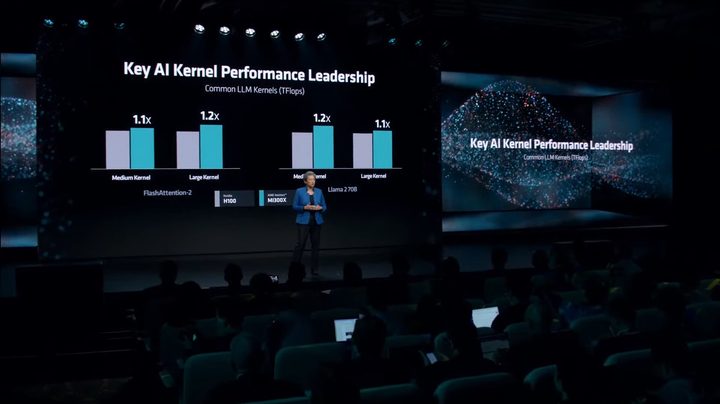
AMD's CEO presenting the performance of MI300X AI GPU.
AMD

In a moment that looks ripped straight out of an Nvidia conference, AMD’s CEO Lisa Su introduced the MI300X Platform, which combines eight of the GPUs on a single board. AMD says these boards offer the same training performance as Nvidia’s H100 HGX and 1.6 times the inference performance. In addition, AMD says you’re able to run two LLMs per system, while H100 HGX can only handle one.

Recommended Videos

To illustrate how big of a deal this is, AMD brought out Microsoft’s Chief Technology Officer Kevin Scott to talk about how AMD and Microsoft are working together on AI. It’s important to highlight that the wildly popular ChatGPT is run on Microsoft servers, and it was originally trained on thousands of Nvidia GPUs.
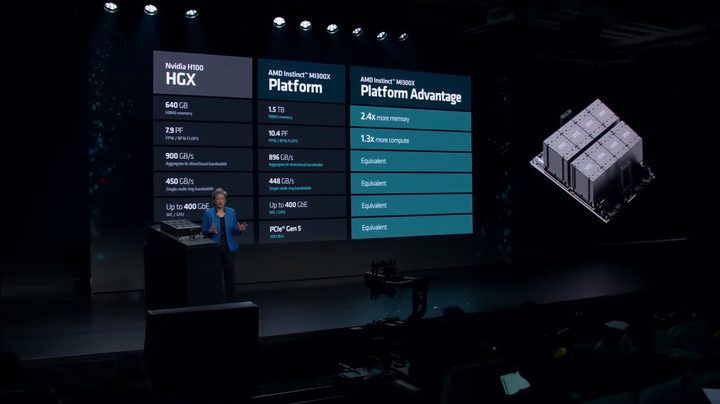
A comparison between AMD's MI300X and Nvidia's H100.
AMD

In addition to the MI300X, AMD announced the MI300A, which is the first APU for AI, according to AMD. This combines AMD’s CDNA 3 AI GPU architecture with 24 Zen 4 CPU cores, along with 128GB of HBM3 memory. AMD says this is a balance between AI performance and high-performance computing, offering the CPU prowess that we recently saw on Threadripper 7000 to data centers.

Despite jumping on the AI bandwagon with the rest of the tech world, AMD has taken a deep backseat to Nvidia up to this point. Nvidia started investing big in AI years ago, giving it a massive head start over AMD and Intel. That early investment has catapulted Nvidia into becoming a trillion-dollar company this year.

With a GPU cluster that’s positioned to challenge Nvidia’s H100, as well as partnerships with Meta and Microsoft, AMD is finally entering the ring. AMD may exit bruised and bloodied, but it still looks like AMD is ready to put up a fight.

Jacob Roach
Former Lead Reporter, PC Hardware
Jacob Roach is the lead reporter for PC hardware at Digital Trends. In addition to covering the latest PC components, from…
In a market where Mac has been aspirational, it’s somehow a better deal than windows machines now
Windows Laptops became so expensive that MacBooks look sensible now
Computer, Electronics, Laptop

For a long time, the laptop buying advice was simple enough. Windows had a more versatile portfolio that brought you affordable, mid-range, high-end, and even gaming options, while MacBooks were known as the easy premium recommendation.

But owing to the pricing circus caused by memory shortages and component price hikes, the equation makes no sense anymore.

Read more
HP’s new RTX 5070 laptop feels like the sweet spot between thin and bulky
The new HyperX Omen 15 combines AMD and Intel and targets portability without fully sacrificing performance.
HP HyperX OMEN 15 Gaming Laptop

Modern gaming laptops have largely drifted toward two extremes lately: massive 16-inch and 18-inch desktop replacements, or ultra-compact 14-inch machines that still feel slightly cramped for serious gaming sessions. That’s exactly why HP’s new HyperX Omen 15 feels refreshing, because it brings back the familiar 15-inch gaming laptop formula with a chassis that still feels portable without sacrificing proper gaming hardware underneath.

HP’s compact HyperX Omen 15 packs RTX 5070 graphics with AMD and Intel options

Read more
Corsair is putting Chinese RAM in mainstream market. It won’t quite end the crisis though
A cheaper DDR5 supplier could shake up the market, but it is not a magic fix
Samsung DDR4 RAM in hand

After months of painfully expensive RAM and SSD prices, the memory market may finally be showing signs of pressure from an unexpected direction: China. New reports suggest that Chinese memory manufacturers are rapidly expanding production of DRAM and NAND chips, and that major hardware brands are starting to take notice. The most notable example so far is Corsair, which has reportedly tested DDR5 memory modules using chips from Chinese DRAM giant ChangXin Memory Technologies, better known as CXMT.

This feels inevitable. Memory prices have remained frustratingly high across PCs, laptops, and storage devices for months. So when Chinese suppliers began offering RAM at nearly half the cost of some global competitors, manufacturers were always going to at least explore the option. According to market reports, some CXMT DDR5 modules are reportedly being sold near the $150 range, while equivalent products from larger global suppliers can hover between $300 and $400.

Read more