
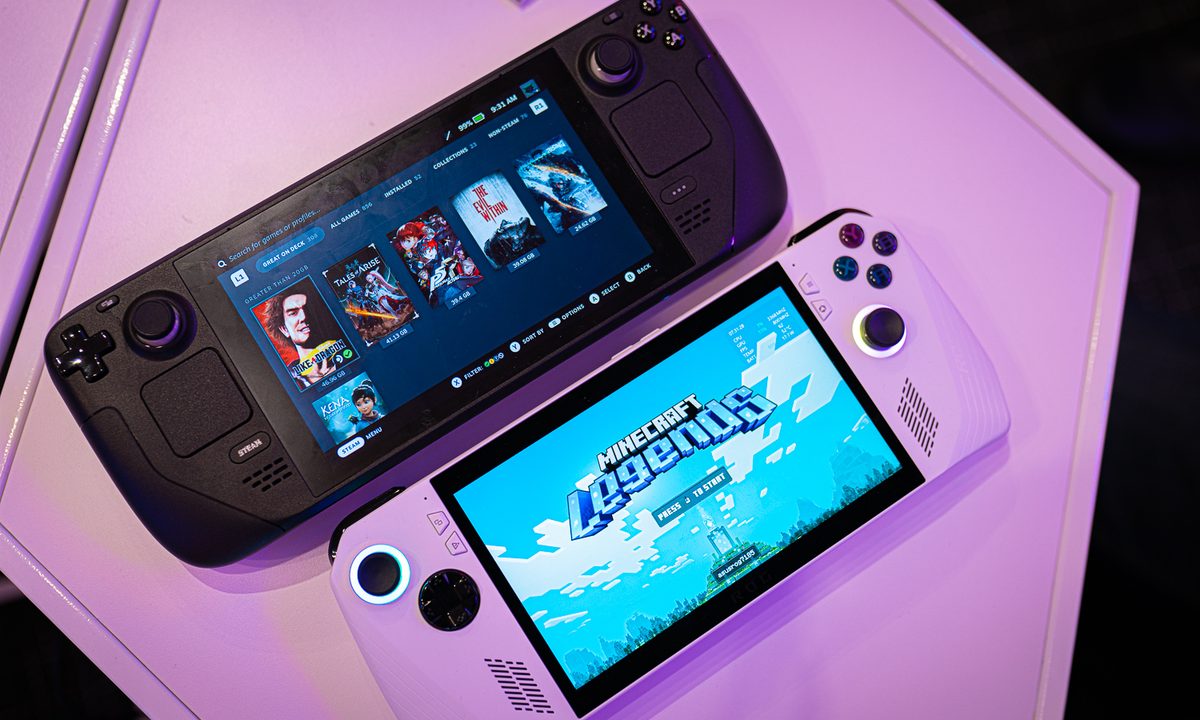
As AMD confirmed to Digital Trends last year, the new range of Ryzen Z2 chips is here to kick off 2025. Announced during AMD’s CES 2025 keynote, there are three models that make up the Ryzen Z2 range, which AMD says is designed to meet the “explosive demand” for handheld gaming PCs. Although we don’t have any specific devices featuring the Ryzen Z2 range yet, AMD says “you’ll see [the Ryzen Z2] coming to market from a number of partners — the Legion Go, the ROG Ally, the Steam Deck.”
You can see how the range breaks down below. Similar to AMD’s first generation of handheld APUs, we’re getting both a base Ryzen Z2 and an Extreme variant. Both come with eight cores and 16 threads, but the Z2 Extreme boasts 16 graphics cores compared to 12 on the base Ryzen Z2. The Ryzen Z2 Extreme can also climb a bit higher, up to 35 watts. Compared to the Ryzen Z1 range, both of these chips also come with a boost to 24MB of cache, compared to 16MB on the Ryzen Z1 Extreme.

As you can read in our Asus ROG Ally Ryzen Z1 review, the base model of AMD’s gaming APU was rather disappointing in the previous generation. Thankfully, it looks like the specs are much closer for the Ryzen Z2 Extreme and Ryzen Z2 now, so hopefully there won’t be such a large gap in performance between the two chips.
New to the lineup is the Ryzen Z2 Go, which is massively cut-down compared to the other two options. You’re getting just four cores and eight threads, a much lower boost clock speed, and only 10MB of cache. Given the high pricing of handhelds like the Lenovo Legion Go, this chip looks like a way to offer inexpensive entry-level gaming handhelds that haven’t existed previously, at least among Windows-based devices. AMD didn’t share any performance estimates, but the specs suggest that the Ryzen Z2 Go will be quite a bit weaker than the other two options in the range.
Despite promising “console-class” performance, AMD didn’t share any firm numbers about the Ryzen Z2 range. That’s a big question, as the Ryzen Z2 range is carrying the same RDNA 3 architecture forward that we saw in the Ryzen Z1 range. There’s been a bump to graphics cores — the Ryzen Z1 Extreme came with 12 RDNA 3 compute units — but it’s hard to say how much performance that accounts for.
AMD also didn’t share battery life estimates, though it hinted at “hours and hours of battery life” with the Ryzen Z2 range. Specifics about battery life will come down to the individual handheld — the Steam Deck OLED has better battery life than the base Steam Deck, despite both using the same AMD chip — but it appears there’s been some focus on improving battery life compared to the first generation of handhelds.
Although we don’t know any specific handhelds packing the Ryzen Z2 range yet, AMD says they’ll start rolling out throughout the first quarter of 2025. We’ll likely hear about at least a few of them at CES 2025 now that the chips themselves have been revealed.


