

Apple has officially announced the M2 chip at its WWDC 2022 keynote. It’s the follow-up to the successful M1 chips that began Apple’s two-year transition to its own silicon for its Macs.
Products using these chips aren’t out yet, so there’s a lot we still don’t know, including details about performance and specs. But from both what Apple has announced about the M2 and leaked information about the M2, here’s everything we know so far.
What products are getting the M2?
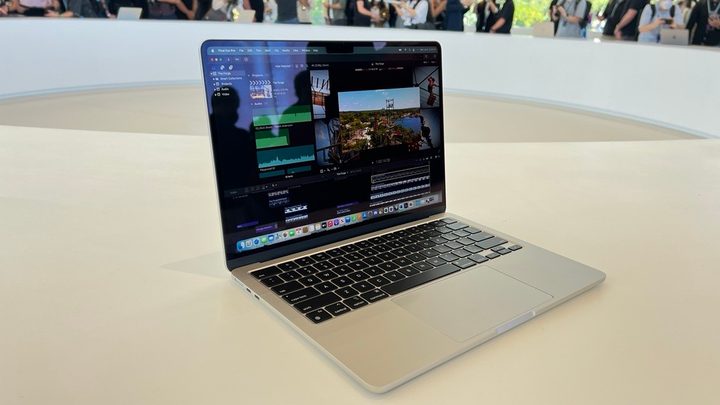
It was widely speculated that the next generation of Apple Silicon would be announced WWDC, and those assumptions were at least partially correct. Apple unveiled a redesigned MacBook Air packed with the M2 chip, and its new look closely resembles the newly revamped MacBook Pros. The 13-inch MacBook Pro will also receive the M2 chip, but Apple didn’t give it the same refreshed design treatment as the MacBook Air.
In following with the cycle of the M1, we also expect the M2 to appear in an upgraded Mac Mini and 24-inch iMac.
Beyond just the base M2, Apple will likely expand upon it for its more powerful options, such as the M2 Pro, M2 Max, and M2 Ultra. These chips are rumored to eventually show up in pro-level products such as the 14-inch MacBook Pro, 16-inch MacBook Pro, Mac Studio, and more.
Performance and specs

We won’t be able to confirm performance results for the M2 until we’ve reviewed the systems ourselves, but Apple has released some of its own claims about what improvements have been brought to the chip.
It’s still features an 8-core CPU, which breaks down into four efficiency cores and four performance cores. This is the same core configuration as what was offered on the M1.
The M2 is based on a second-generation N5P process node from TSMC, rather than the rumored N3 node. Reporting indicates that this was due to production delays and lockdowns in China, leaving Apple to use this 5nm node as the basis for the M2. The N5P node offers just a 7% performance improvement over N5 with 15% less power draw, while the true next-gen node, the N3, is said to deliver up to 15% higher performance and 30% lower power draw than the N5.
Ultimately, that means the M2 will offer less of a jump in performance than Apple may have originally wanted.
The M2 does include some new features and upgrades that sweeten the deal, though. For example, it now supports up to 24GB of Apple’s unified memory. It also supports 50% more memory bandwidth, up from 50GBps to 100GBps.
Apple has also brought over the same “high-performance media engine” that’s included in the M1 Pro and M1 Max. That means faster, hardware-accelerated media encoding. Apple also claims its neural engine is up to 40% faster.
Overall, Apple says the M2 CPU is 18% faster than the M1. But the graphics have gotten an upgrade too. The M2 now features 10 GPU cores, up from 7. Apple says this leads to 35% better graphics performance. This is also strengthened by the improved Metal 3 graphics framework, and even MetalFX Upscaling for improved performance in some games.
Price and release date
Only two M2 devices have been announced so far: The new MacBook Air and the 13-inch MacBook Pro. The M2 13-inch MacBook Air is selling for $1,299, the same as the M1 option when it was released. The M2 MacBook Air is more expensive than its M1 counterpart, starting at $1,199. The M1 MacBook Air started at (and still sells for) $999.
Both M2 devices will be available next month, but you can pre-order them now.


