
The new Apple M3 is the “most advanced chip ever built for a personal computer,” according to Apple, and will appear in some of the best MacBooks. Announced in October 2023 and sporting a new process, the M3 promises up to 60% higher performance in some apps. But will it really be worth an upgrade over the M1 or M2?
We’ve already seen the M2 at work in devices like the Mac mini, and we’ll have to wait until the M3 launches to really know how it performs. But based on what we know right now, here’s how the M3 stacks up to the M2.
Before getting into it, it’s worth pointing out that we’re looking specifically at the M3 and M2 here. Apple also offers M3 Pro and Max variants, as well as the M2 Ultra, but we’re looking at the base chips.
Where can you get them?

Apple doesn’t update its entire lineup of Macs with a new chip right away. Although it’s fair to assume the M3 will eventually work its way across Apple’s product lineup, there are some devices stuck on M2. That might make the decision between the chips straightforward if you’re looking for a particular device. Here are the Macs currently available with the M2:
- 13-inch MacBook Air
- 15-inch MacBook Air
- 13-inch MacBook Pro
- Mac mini
The M3 is only available in two devices to start: the 24-inch iMac and the 14-inch MacBook Pro. The 14-inch MacBook Pro with the M3 will replace the 13-inch MacBook Pro with M2, but otherwise, the M2 and M3 devices will live alongside each other.
That makes pricing a little interesting. Like the M2, Apple is offering the M3 with either an eight-core or 10-core GPU, both alongside an eight-core CPU. The 24-inch iMac starts at $1,300 for the eight-core version and costs $1,500 for the 10-core version. The 14-inch MacBook Pro with M3 starts at $1,600, presumably with the eight-core GPU. It also comes with 8GB of unified memory and 512GB of storage.

You can get an M2 for much less. In the 13-inch MacBook Air, you’ll spend $1,100 or $1,400 for the 8-core or 10-core GPU, respectively. The 15-inch MacBook Air starts with the 10-core GPU for $1,300. Unsurprisingly, the Mac mini is much cheaper, clocking in at $600 for the 10-core M2.
If you want to access the M3 in a MacBook right away, you’ll need to spend more. However, we expect that Apple will transition the M3 to products like the Mac mini in the future, so it might be best to wait if you aren’t interested in one of the products Apple is currently offering the M3 in. It’s also worth being said that the new M3 iMac is replacing the M1 model entirely and will sell for the same price.
What’s different under the hood?
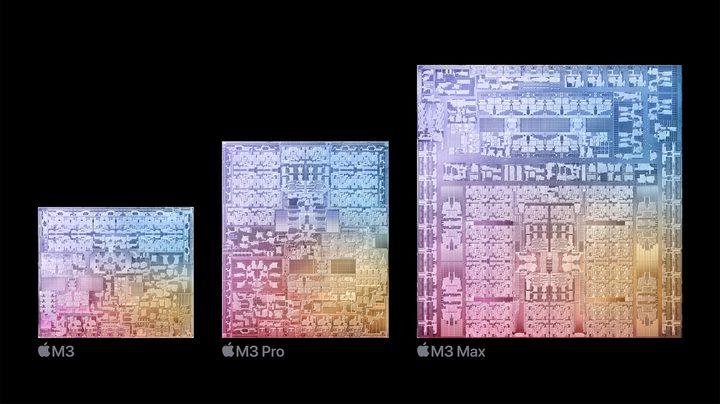
Both the M2 and M3 are similar in terms of overall core count. They both come with an eight-core CPU, along with either an eight-core or 10-core GPU. Once again, Apple is using Unified Memory on the system-on-a-chip (SoC), with the M3 topping out at 24GB, just like the M2. The more expensive M3 Pro and M3 Max chips can support up to 128GB, so we could see a bump with the M3 line in other devices in the future.
The big difference between the M2 and M3 is under the hood. The M3 is the first chip to use a 3nm process, while the M2 uses a 5nm node. That just means the M3 can cram more transistors in the same space, leading to higher performance and better efficiency. The M3 is able to pack in 25 billion transistors, which is 5 billion more than M2.
Apple is also touting a completely new GPU architecture for the M3. This new architecture centers around a feature called Dynamic Caching, which is claimed to offer higher performance by allocating local memory in real time. Apple claims this is an industry first, serving as a “cornerstone” for the new GPU architecture.
In addition to Dynamic Caching, the M3 is the first chip in Apple’s lineup to support hardware-accelerated ray tracing and mesh shading. These are two major features of DirectX 12 on PC, and it seems that Apple finally has the mix of hardware to enable support through its Metal API. These features can help some pro apps, but they seem squarely targeted at gaming. More games are supporting ray tracing, and some titles, such as Alan Wake 2, require mesh shaders to run properly.
Apple also added an “enhanced” Neural Engine to M3, which is said to offer 60% higher performance in AI workloads compared to M1. Unfortunately, Apple didn’t offer a direct comparison to the M2 on this front.
What about performance?
We haven’t tested the M3 yet, so all we have to go on are Apple’s claims about the performance of the chip. Further complicating matters is that Apple mainly focused on performance compared to the M1, not the M2. Presumably, this is because the 24-inch iMac never saw an upgrade to M2.
Still, we can speculate on performance based on how the M1 and M2 compare. Apple says the M3 offers 35% higher CPU performance overall compared to the M1, or the same performance at half the power. Based on our MacBook Air M2 review results, we saw the M2 outpacing the M1 by about 18% in multi-core performance. That sets the M3 up for a similar jump in CPU performance, which is an expected increase in performance, even if it’s not all too exciting.
The larger jump seems to come from the redesigned GPU. Apple says that the M3’s GPU delivers 65% more performance than the M1, which is a massive jump. It’s hard to extrapolate exactly how that compares to M2 — the new features of the M3 GPU could give it a large advantage depending on the game or app. But it’s safe to assume the M3 will offer a bigger boost in GPU performance than CPU performance, at least compared to the M2.
We won’t know for sure how the M3 performs compared to the M2 until we’ve had a chance to test the chip. We’re expecting a larger jump from the M2 to the M3 than from the M1 to the M2, though, and that comes down to the 3nm node.
About a year ago, we heard rumors that Apple delayed the “real” M2 to 2023. The original M2 was meant to be built on a 3nm node, according to reports, but Apple reversed course and built it on a refined version of the 5nm node that the M1 used. The fact we saw a performance improvement with the M2 was a miracle in itself, although it involved chips running hotter under the hood. Now we’re seeing that true jump in efficiency in the M3, and it should be significant.
A waiting game for now

Of course, the performance improvements that the M3 will likely bring are important, but Apple has carefully curated the list of products that you’ll find the M3 and M2 in. For the 24-inch iMac, Apple is likely offering performance that’s leagues ahead for the same price as the M1 model. We’ll probably see discounts on the M1 24-inch iMac once the M3 version releases, but it’s hard imagining it will offer a better value considering how old the M1 version is at this point.
The conversation will get more messy as the M3 works its way through Apple’s product stack. Once we see an M3 available in the MacBook Air and Mac Mini, you’ll have to weigh the price of the M2 models against the newer versions. For now, though, all we can do is wait until we have a chance to test the Apple M3 to see what it’s capable of.


