
We’re in an unprecedented moment right now in the world of laptops, and Intel is trying its best to not get lost in the shuffle.
At its keynote at Computex 2024, Intel announced a preview of its upcoming Lunar Lake chips. They’re coming early in the cycle — at least a few months ahead of when they normally would have. But Intel doesn’t have a choice. Its hand has been forced by Microsoft, Qualcomm, and AMD — and it wasn’t about to be left in the dust.
But among the sparse details around Lunar Lake, Intel had at least one very solid laptop to show off that’s waiting for the new chips.
A stunning Zenbook
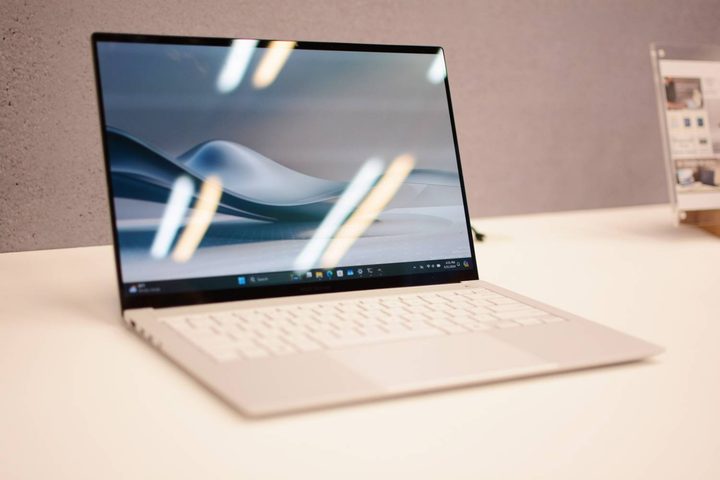
Among the laptops revealed that are being held for the launch of Intel Lunar Lake, only one really stood out. The addition of the MSI Claw 8 was a nice surprise, even if the original was a bit of a bomb. But at least as of now, the only Lunar Lake laptop that stood out was the Asus Zenbook S 14.
This is a replacement of the Zenbook S 13, that comes with a slightly larger OLED screen and some new visual flair. I have to say — this is the best-looking Zenbook ever made. The lid has the lines of the monogram Asus logo, now with a “ceraluminum” finish that looks great.
Inside, it’s got thin bezels around the screen, a massive haptic feedback trackpad, and a unique “geometric grille design” across the top. Both the dark and light color options look killer too. In a lot of ways, it feels like it’s learned a bit from the success of the recent ROG Zephyrus G14 redesign.


Now, the Zenbook S 13 was already one of the very thinnest laptops you could buy at 0.43 inches. That’s marginally thinner than the MacBook Air, making it the laptop to beat in terms of portability. This is a really important thing for Intel to hold on to due to how much the efficiency of the Snapdragon X chips has been talked about. The Zenbook S 13 seems like it would have been the perfect model for Qualcomm’s platform, but the fact that Asus saved it for Intel’s launch says a lot.
That’s not to say we’ll never see a Qualcomm or AMD version of this device. Interestingly, Asus’ launches around support of the Qualcomm-based Copilot+ PCs was rather quiet. It only had the Vivobook S15 to show, and that’s a particularly old-school and budget-friendly device that was at odds with the more premium devices its competitors were showing off. The addition of the new ProArt PZ13 2-in-1 announced at Computex firms up the company’s commitment to Qualcomm, but the fact that it’s saving a gorgeous redesign of its flagship laptop for Intel Lunar Lake feels significant.
And yet, the fact that impressions of Intel’s positioning right now rely on just a single laptop aren’t necessarily a good sign.
A race to the finish

Dell, Asus, Acer, Lenovo, and Samsung all just announced their sharpest new laptops at Microsoft’s Copilot+ PC event and they all support Qualcomm. HP even took the opportunity to rebrand its entire lineup of laptops. Importantly, it came in the middle of the year at an unusual time for laptop releases.
There’s no way to say it nicely — Qualcomm’s new Snapdragon X chips have commanded a lot of regard in the past month. With the push for neural processing units (NPUs), Arm, and Copilot+, the tables have flipped on x86 laptops. AMD and Intel are being forced to vie for the attention of the big laptop brands. Just look at Microsoft itself, which launched the latest Surface Laptop and Surface Pro exclusively for Qualcomm. That hurts. And since Intel’s next-gen chips are last in line, it’s hard not to feel like it’s at the back of the pack right now.
AMD at least had the benefit of being the first to respond at Computex. But even there, as great as the new Zen 5 chips look, there weren’t a ton of new laptops to support. There were some new gaming laptops of interest, while the Asus ProArt P16 was perhaps the most impressive achievement. It’s packing the 50 tera operations per second (TOPS) of the NPU with the improved performance of the Ryzen AI 300 chip, and up to an RTX 4070 graphics. That’s something no Qualcomm laptop available right now can do. When it comes to raw performance in AI workloads, it certainly looks to be as good as it gets.
But in general, Ryzen AI 300 could hardly be considered a huge release. AMD depends a lot on gaming laptops, and those are likely waiting for a new generation of Nvidia graphics before it releases a refresh. Without them, it was fairly slim pickings.
I’m sure Intel’s situation will look a lot more promising by the end of the year. There’s no way companies like Dell, HP, and Lenovo, which depend so much on Intel’s name recognition to sell laptops, can ignore it. That’ll remain true throughout 2024 and beyond. In fact, it’s the reason it’s always been so hard for AMD to gain any ground against Intel over the years, especially in mainstream laptops.
But the tide is turning. At least from the vantage point of Computex, the pressure is on Intel to deliver big with Lunar Lake to stay in good favor with its laptop partners. Without them, Intel’s in trouble.