
Intel has just given us a much larger glimpse into its future Meteor Lake lineup. At the 2022 IEEE VLSI Symposium, the company talked about the 14th generation of its processors, detailing the future process node and the improvements the new Intel 4 process should bring.
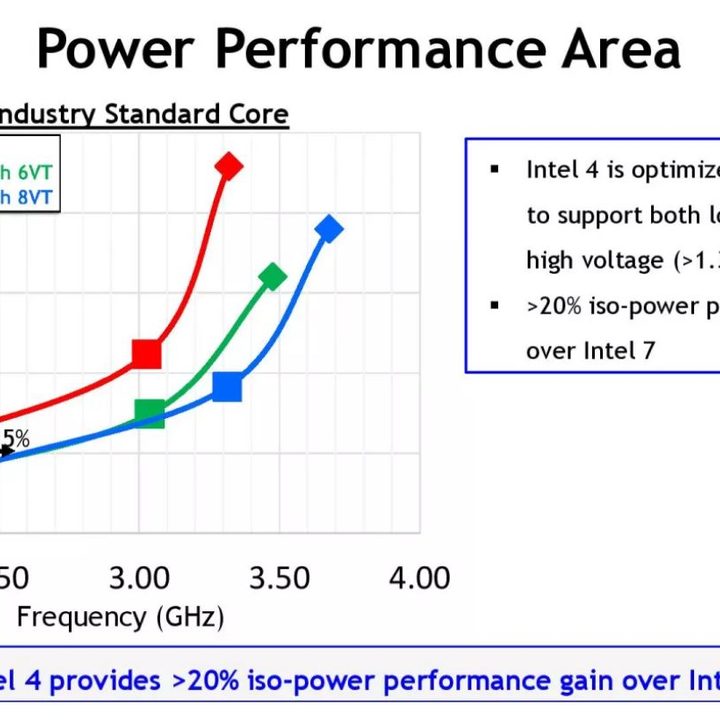
The teaser certainly sounds promising. Intel claims that Meteor Lake CPUs will provide 20% higher clock speeds than the previous generations, all while maintaining the same power requirements.
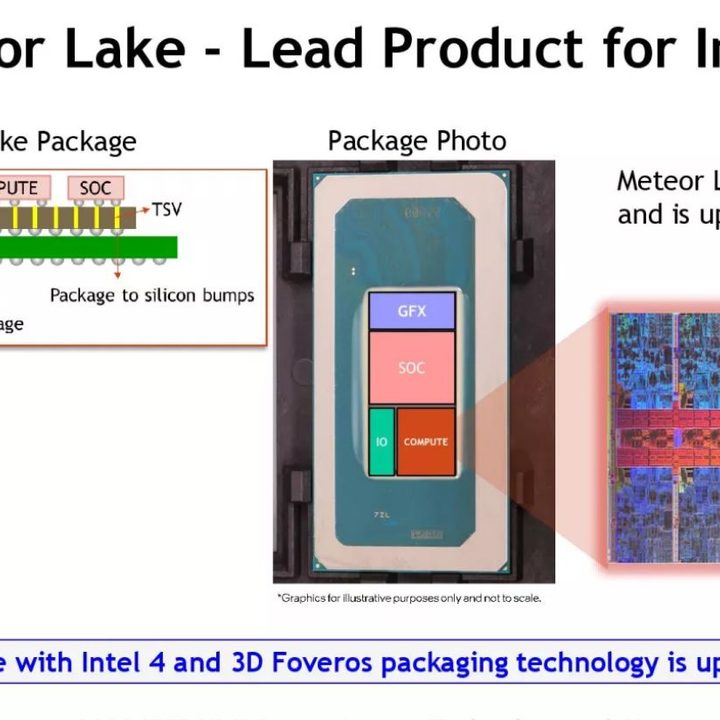
Intel Meteor Lake is still quite far off — the company confirms that the new chips are on track to meet the 2023 launch deadline, although no specifics have been given at this time. Before we ever see Meteor Lake, we will see the launch of Intel Raptor Lake in the fall. However, unsurprisingly, both Intel and the tech world at large are looking to the future — and as far as the 14th generation of Intel chips goes, the future looks pretty exciting.
During the 2022 IEEE VLSI Symposium, Intel took the public on a deep dive into the upcoming Intel 4 process node, which is what Meteor Lake is based on. As a successor to the Intel 7 (used for Alder Lake and Raptor Lake), it will require a new socket, and it will feature a new architecture. Intel claims that the changes introduced in that generation will deliver huge performance gains while keeping the power consumption at a similar level to what we’ve grown used to with 12th-gen CPUs.
The company teased that Meteor Lake will deliver up to 21.5% higher frequencies at the same power requirements as the Intel 7 process. Similarly, when scaled down to the same frequency as Intel 7, Meteor Lake will sport an up to 40% power reduction. This is going to be achieved through various changes in the chip’s architecture, such as a 2x improvement in area scaling. This means that it has doubled transistor density compared to the Intel 7, at least for the high-performance libraries.
With the new process node, Intel will largely use extreme ultraviolet (EUV) lithography as a way to simplify manufacturing. Simply put, this reduces the number of steps needed to manufacture the node by a significant amount. It should result in higher yields and reduce production errors. As a result of EUV, Intel noted a 5% reduction in process steps and a 20% lower total mask count.
The Intel 4 name is a code name for Intel’s 7nm process node, which means a switch from 10nm to 7nm for Intel. The new chips will utilize Intel’s Foveros 3D packaging technology and will feature a four-die setup joined by TSV (through silicon-via) connections. These four tiles will be split into the input/output tile (I/O), the system-on-a-chip tile, the compute tile, and the graphics tile.
Intel has shared a blown-up image of the compute die for Meteor Lake, complete with six blue-colored performance cores (Redwood Cove) and two clusters of four Crestmont efficiency cores, colored in purple. In the middle of the chip, you can see the L3 cache and the interconnect circuitry. The company has yet to divulge the exact description of the I/O and the SOC tiles.
In addition to teasing the Intel 4 process, the manufacturer also talked about what comes next — moving on to Intel 3. Intel 3 will come with enhanced transistors and interconnects, and it’s worth noting that I4 will be forward compatible with I3, so it won’t require a full redesign. Intel will stay true to the EUV technology, with more EUV layers that simplify the design even further. According to the current estimations, the I3 node will be around 18% faster than the I4. Once Intel is done with I3, it will move on to the 20A and 18A nodes and even more exciting technologies.
All in all, Intel’s sneak peek is very detailed and quite technical, so if you’re a fan of that, make sure you read the full write-up prepared by Tom’s Hardware. Although Meteor Lake is a while off, there’s still plenty to be hyped for this year. We’ve got the Intel Raptor Lake coming up, and around the same time, AMD is slated to launch the Ryzen 7000 series of CPUs.


