We finally got an official look at the upcoming Quest 3 VR headset at Meta’s gaming showcase. Meta’s newest budget headset isn’t shipping yet, but we gleaned a few details to whet your appetite.
The Quest 3’s most significant upgrades are focused on mixed reality and graphics. Meta showed off the headset’s ability to show the outside view on the internal display in good quality and full color. The Quest 2 could only give a pixelated monochrome passthrough view.
Since you can see your actual surroundings, you can stay grounded in reality, moving confidently around the room without bumping into furniture, people, or pets while still seeing graphics overlaid by games and apps, according to Meta.
The Quest 3 also has a depth sensor, which is entirely new to Meta headsets. This allows the headset to scan the room, plotting the shape and distance of walls and surfaces. With this 3D map of your surroundings, you don’t need to manually draw out a guardian boundary, which provides a visual cue when you get close to straying from a safe play space.
The depth sensor’s room-mapping feature can help games and apps identify real-world objects for interaction. Currently, gamers have to laboriously mark the location of walls, tables, chairs, and shelves for virtual armies to march across, balls to bounce off of, and virtual paint strokes to be laid upon.
The timing of Meta’s teaser, a few days ahead of Apple’s Worldwide Developers Conference, wasn’t accidental. Apple’s first XR headset is expected to be announced on June 5, 2023.
Rumors suggest Apple’s Reality Pro will excel at mixed reality with remarkable realism. Its ARKit software already allows the iPhone to map rooms and place virtual objects on surfaces with appropriate shadows and occlusion if you place your hand in front. Apple’s XR headset will undoubtedly be as impressive as it is expensive when it finally arrives.
In the meantime, Meta wants to remind everyone it’s currently the mixed reality leader with years of refinement and over 500 games available for the low-cost Quest 2 platform. The Quest 3 will be compatible with these titles as well. And you’ll be shooting and swiping better than ever with the new ringless touch controllers.
The Meta Quest 3 will be 40% thinner, yet offers twice the GPU performance of the Quest 2. In a Facebook post, Meta CEO Mark Zuckerberg said it will feature better displays and resolution without elaborating further. There is speculation that the Quest 3 will have pancake lenses similar to the Quest Pro.
The Meta Quest 3 will sell for $500 and launch this fall. More details will be available at Meta Connect on September 27, 2023.
Price cuts and performance tuning for older Quests
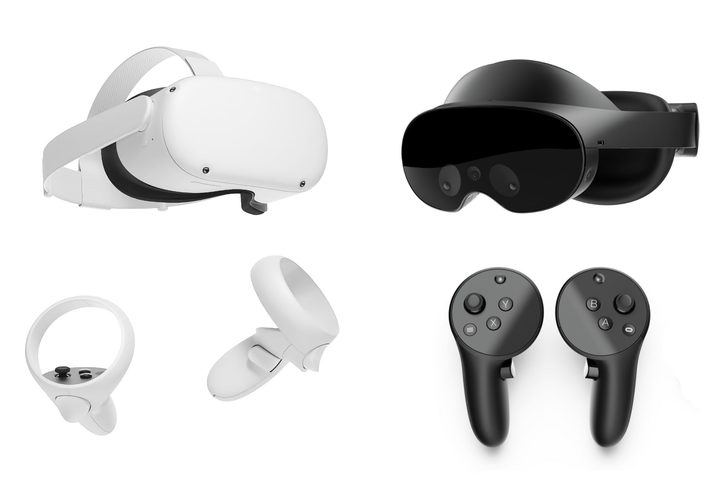
Meta also announced price cuts on the aging Quest 2. It will return to the original price of $300, a $100 price drop from the present cost. That happens on June 4, 2023.
The Quest 2 and Quest Pro have slower processors than the new Quest 3, but Meta continues to wring more power from the XR2 chip. Performance tuning will bring up to 26% better CPU speed and for each. The Quest 2 will get a 19% GPU boost and the Quest Pro’s GPU will become 11% faster after the next software update.
Meta pointed out that this will lead to smoother gameplay, more responsiveness, and increased pixel density in games and apps that are updated to take advantage of these improvements.