

Everyone owes Sony an apology. When the PS5 was announced and Ratchet and Clank: Rift Apart was shown off as exclusive for the platform, there was a barrage of finger-pointing at Sony over the game’s next-gen exclusive status. The argument from Sony was that the game required the PS5’s world-class storage interface, and anything less simply wouldn’t work.
Now that the game is available on PC, I can see exactly what Sony was referencing. As you can see from Digital Foundry’s first look at the game, it simply doesn’t work on the PS4’s slow, 5,400RPM hard drive.
Our first look at Ratchet on PC! It has a few issues but it's overall in good shape! Infinitely better than TLOUP1 and Jedi Survivor at launch. The funniest bit is when Rich tried running the game off an actual PS4 hard drive on a machine just above min spec! https://t.co/Qt0qkYwzeu pic.twitter.com/hgFrXKVGSG
— John Linneman @dark1x.bsky.social (@dark1x) July 26, 2023
But wait just a minute. On PC, Ratchet and Clank: Rift Apart technically supports a spinning hard drive. The minimum system requirements recommend an SSD, but according to the developer, a spinning hard drive will work just fine.
It won’t, as I’ll get to later, but there’s a problem brewing in the world of PC gaming centered around storage, and it’s becoming too big of a deal to ignore.
SSD required
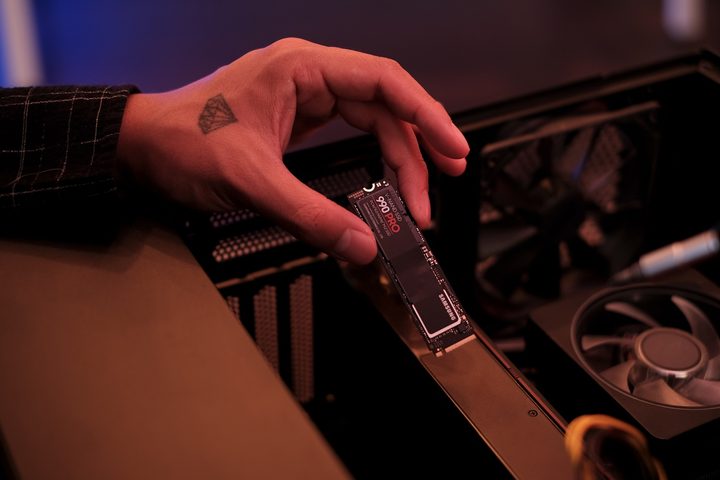
This year, we’ve finally seen developers require an SSD for games. Starfield received a load of pushback after it was revealed the game would require an SSD as a minimum spec. That’s despite the fact that Cyberpunk 2077 will require an SSD as part of its Phantom Liberty expansion, as well as Diablo 4 releasing with the minimum SSD spec.
PC gamers aren’t exactly great with change. Backward compatibility is a law, and user choice is everything, so it’s not surprising that game developers have held up to HDD support for as long as possible. It’s starting to become clear that high-speed storage doesn’t just lead to faster loading times, though. It’s a critical component in a next-gen ecosystem that can enable more vibrant and stable PC releases.
Case in point: RTX IO. I recently wrote about RTX IO in Portal: Prelude RTX, and it was clear that the storage tech vastly improved texture loading times and shrunk the install size of the game considerably. One part of RTX IO (as well as Microsoft’s DirectStorage) that isn’t being talked about as much is how it lowers CPU utilization, which can make games much more stable.
Here’s how Nyle Usmani, product manager at Nvidia, described it: “RTX IO alone cannot completely remove stutter, but it can be an aiding technology to help reduce stuttering. It can do so by scaling down the dependence on CPU compute when the need to load textures and geometries ‘faster’ is the cause of stuttering, and freeing up the CPU to work on other tasks.”
That can make a big difference, especially in games that suffer from traversal stutter. For example, Redfall and Star Wars Jedi: Survivor both primarily run on two CPU cores, and as we’ve learned from the developers of Hi-Fi Rush, it’s very easy for these cores to become overloaded with work. When they’re overloaded, stutters happen, and the only way around that is to spread out the work. That’s what high-speed storage, along with features like RTX IO and DirectStorage, can accomplish.
A next-gen storage ecosystem
A lot of this is the beginning stages of the storage interface we’ve seen in the Xbox Series X and PlayStation 5 for nearly three years. Especially in games that are exclusive to next-gen consoles, such as Star Wars Jedi: Survivor and Ratchet and Clank: Rift Apart, developers are taking advantage of that storage interface. There are much more PC gamers overall, but the most recent data shows that consoles are where the lion’s share of new games are sold. Naturally, developers are going to cater their games to those platforms and what they’re capable of.
This system of fast storage and next-gen features like RTX IO and DirectStorage works best with an SSD. If you’re familiar with DirectStorage, at least, you’ll know that it technically supports spinning hard drives. But that experience, at least based on the few games we’ve seen isn’t great.
That brings us back to Ratchet and Clank Rift Apart. It is, by most accounts, a resounding success of a PC port. The game performs well across a wide range of hardware, it’s fully supported on Steam Deck, and it includes a slew of features including RTX IO, Nvidia Deep Learning Super Sampling (DLSS), AMD FidelityFX Super Resolution (FSR), and ray tracing.
It’s just the storage that’s the problem. Sure, the game falls apart on a slow, dated PS4 hard drive, but it also doesn’t work on a standard 7,200RPM hard drive despite being technically supported. I experienced three crashes in the first 30 minutes of the game, a variety of stutters over every invisible loading zone, and the hilarious display of slow loading you can see below on a 7,200 RPM WD Black HDD.
There isn’t much reliable data to gauge how many PC gamers are still rocking an HDD. If you fit into that group, though, it’s time for an upgrade. Not only do SSDs deliver much faster loading times, as we’ve seen for years, they’re becoming a critical part of your PC that allows games to look better and run more stably. Faster texture streaming means less pop-in and reduced CPU load means less stuttering, both of which have been key issues with PC ports in 2023.
There’s not much of an excuse now, either. A 2TB WD Black SN850X SSD is $110 at the time of writing. That’s the latest, fastest NVMe option from this line, sporting PCIe 4.0. A 2TB WC Black 7,200RPM spinning hard drive costs $93. It’s true that spinning hard drives are much cheaper when you scale up to 4TB and above, but for everything under 2TB, you’re spending around the same price on an SSD, and sometimes even less when they go on sale. That’s especially true of slower 2.5-inch SATA SSDs.
It’s not time to kill off hard drives entirely. They’re still a cheap way to store a lot of data long-term, and they’re a great option for movies, photos, music, and other media so you can keep your SSD just for your games. It’s becoming harder and harder to justify installing any game on a spinning hard drive, though, and as Ratchet and Clank Rift Apart proves, it leads to a much worse gameplay experience.


