
3D printers can make objects of practically any shape you can dream up, but despite the fact that they’re so capable, there’s one thing that they often struggle with: overhangs.
Filament-based 3D printers create objects one layer at a time, from the ground up. So if the object you’re printing has any overhangs that protrude at angles over 45 degrees, the printer is (usually) incapable of making the object without support structures, and therefore must print little plastic scaffolds to hold up the object while it prints. The downside, of course, is that this uses extra plastic, and often leaves burrs and imperfections on the object when the supports are removed.
Luckily, two students from the Zurich University of Applied Sciences (ZHAW) have created a solution to this problem.
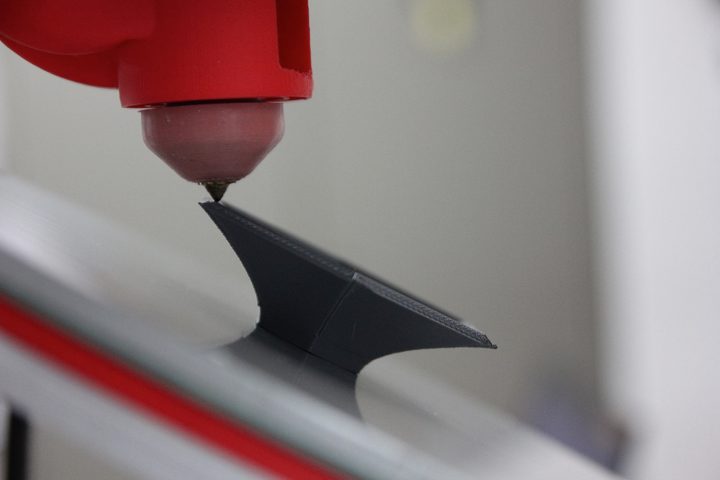
What Oliver Tolar and Denis Herrmann have developed is a 3D printer prototype that uses a tilting printer bed to print objects with a critical overhang. Better yet, it’s able to print these overhangs in such a way that they don’t require added support material.
The printer itself can be pivoted with a total of six axis: three which control the print head, and another three which control the printer bed. The result is a massive range of movements that would be impossible using a conventional 3D printer. Picture the way you might use one hand to move a model as you paint it with the other, and you won’t be far off!
“The advantage lies in the time saving at printing time,” Professor Dr. Wilfried Elspass of the ZHAW School of Engineering, who oversaw the project, told Digital Trends. “At the same time, there is no need to remove the support material after printing. Another potential application will be that an already existing component such as an actuator or sensor can be directly printed. It is thus possible, for example, to integrate electronic components directly into a printed part.”
It’s definitely a neat idea, and one that could save valuable minutes and hours spent sanding and cutting away extraneous aspects of our prints. Unfortunately, if you do like the idea it could still be a while before its creators are even able to think about bringing it to market — if they ever do.
That’s because, with the limited time Tolar and Hermmann had to work on the project, they didn’t have long enough to properly develop the necessary software for it to work.
“Next the software for generating the control data must be further developed,” Elspass continued. “A commercial implementation of the new printer is not yet planned. However, further research and development activities will follow.”
Color us intrigued!


