  1. Home
  2. Space
  3. Emerging Tech
  4. News

See both of NASA’s explorers, Curiosity and InSight, on the surface of Mars

Add as a preferred source on Google

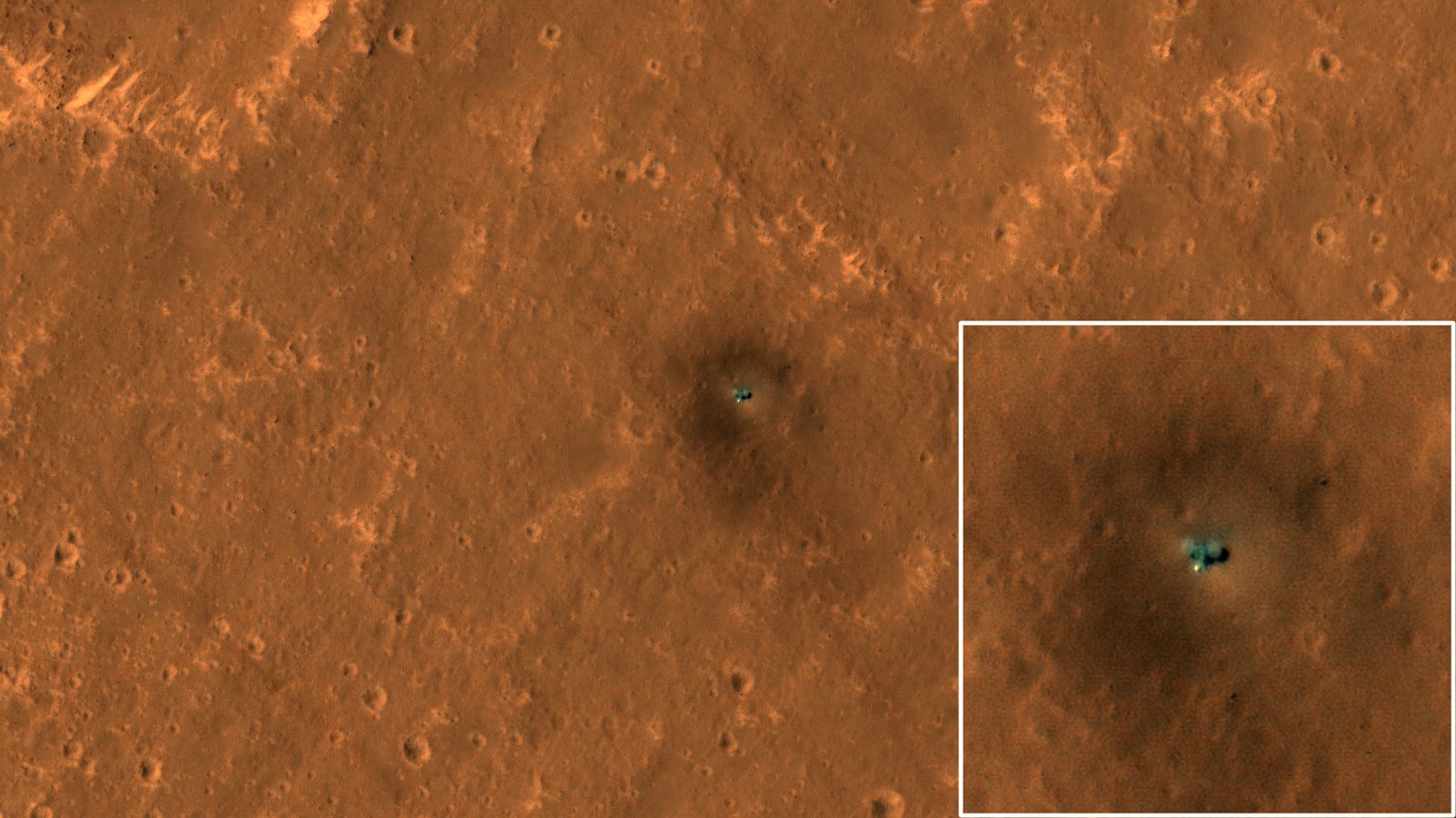
The HiRISE camera on NASA’s Mars Reconnaissance Orbiter got its best view yet of the InSight lander on September 23, 2019. NASA/JPL-Caltech/University of Arizona

NASA’s Mars Reconnaissance Orbiter (MRO) is currently in orbit around the red planet and is snapping photos of its surface using an instrument called the High-Resolution Imaging Science Experiment (HiRISE). Recently, HiRISE imaged not just one but both of NASA’s missions which are on the planet right now.

Recommended Videos

First up, HiRISE took the image above showing the most detailed aerial view yet of the InSight lander. The greenish speck in the middle of the image is the landing site in the Elysium Planitia region, and you can see the two circular panels that the lander uses to collect solar power. Just below the lander, you can see the dome of the heat shield covering the seismometer which is listening out for marsquakes.

This animation shows the position of NASA’s Curiosity rover as it journeyed through “the clay-bearing unit” on Mars between May 31 and July 20, 2019. The HiRISE camera on NASA’s Mars Reconnaissance Orbiter took both images. Credit: NASA/JPL-Caltech/University of Arizona.
About 373 miles (600 kilometers) away from InSight, the Curiosity rover is exploring, as you can see in the images above.

This is not the first time that HiRISE has spotted Curiosity on the surface of Mars. In an image released in July this year, HiRise saw Curiosity in a location called Woodland Bay, part of a region called the clay-bearing unit in Mount Sharp. That image was detailed enough that you could even make out Curiosity’s mast which holds instruments like the ChemCam for analyzing rock samples.

Curiosity is still in the clay-bearing now, though it will soon be moving on to a new area called the sulfate-bearing unit. Between May and July, the rover traveled 1,106 feet (337 meters) from Woodland Bay to a new location called Sandside Harbour. In the animation above, Sandside Harbour is in the middle near the bottom of the image, next to the dark patch of sand. Above the rover, you can even make out the tracks left by Curiosity as it moved through the area.

Curiosity is now collecting data about the composition of rocks in the area, in order to learn more about the history of water on Mars and whether the planet was ever capable of supporting life.

Georgina Torbet
Georgina has been the space writer at Digital Trends space writer for six years, covering human space exploration, planetary…
Stunning close-up footage shows NASA’s moon rocket roaring to space
On its first crewed flight, NASA's lunar rocket displays its awesome power.
NASA's SLS rocket roars skyward at the start of the Artemis II mission on April 1, 2026.

As NASA’s Artemis II astronauts journey back to Earth following their breathtaking close encounter with the moon earlier this week, the space agency has just shared some stunning footage (below) of the rocket launch that sent the crew on its way on April 1.

The close-up tracking shot shows the awesome power of the Space Launch System (SLS) rocket’s four core RS-25 engines together and its two solid rocket boosters as the 98-meter-tall vehicle roars away from the launchpad at the Kennedy Space Center in Florida.

Read more
How to watch NASA’s moon crew splash down at end of historic mission
The Orion spacecraft's final moments before splashdown will be the most perilous of the entire mission.
Earth and the moon as seen from the Orion spacecraft during the Artemis II mission in April 2026.

The Artemis II astronauts have looped around the moon, captured some extraordinary imagery (above), set a slew of records, and are now on their way back to Earth.

The 10-day mission will reach its climax on Friday, April 10, during a dramatic homecoming that will see the Orion spacecraft enter our planet’s atmosphere at a speed of nearly 25,000 miles per hour.

Read more
Notable firsts of the Artemis II moon mission … so far
The Artemis II crew are now on their way home, so let's take a look at the mission's achievements so far.
The moon as seen from the Orion spacecraft during the Artemis II mission.

Having just looped around the moon in a historic flyby of our nearest neighbor, the Artemis II crew are now on their way back to Earth.

NASA’s Victor Glover, Reid Wiseman, and Christina Koch, along with the Canadian Space Agency’s Jeremy Hansen, launched aboard the Orion spacecraft from the Kennedy Space Center on April 1, lifted to space by the mighty SLS rocket.

Read more