  1. Home
  2. Emerging Tech
  3. Web
  4. News

Panasonic’s ‘Life Innovation Container’ delivers solar power in a box

Add as a preferred source on Google
Image used with permission by copyright holder

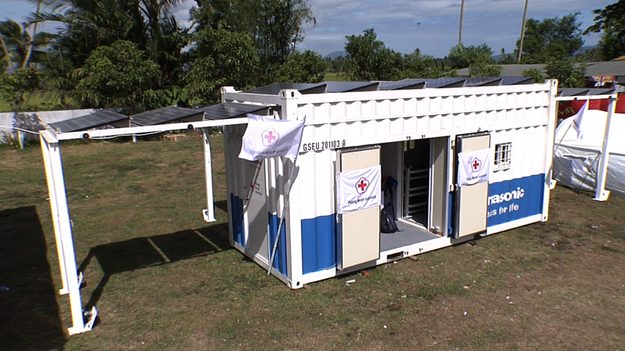
At an Indonesian Red Cross Society event last week, Panasonic rolled out its “Life Innovation Container,” a shippable solar power plant aimed at off-grid use and disaster relief. Actually designed like a shipping container, the giant metal box features expanding solar panels and a massive amount of battery storage. Panasonic claims the plant can be delivered fully charged to stricken areas and provide power for three days without sunlight.

The plant uses 18 high-efficiency HIT solar modules to charge an array of 48 lead batteries. The whole shebang generates an average of 6.7 kWh. In a disaster zone, that’s enough power to run a command and information center fully equipped with laptops, data connections and, as Panasonic slyly showcased at the Indonesian event, slick flat-screen televisions – for informational purposes, of course.

Recommended Videos

As a power source for off-grid areas, the LIC’s claimed output is enough to light up, say, around 260 25-watt compact fluorescent bulbs. While the unit’s utility in disaster relief is obvious, it’s as a power source for out-of-the-way places that the LIC is most intriguing. With the developing world ever-hungrier for power, this unit offers an alternate to a niche previously dominated (if not owned outright) by diesel generators. Being solar and easily delivered by ship, train or rail, Panasonic has created an interesting power solution that’s clean and, possibly more importantly for truly remote areas, doesn’t require regular fuel deliveries.

The question is whether or not this unit can provide the sustained high output of a fossil fuel generator. At the very least, Panasonic put a lot of emphasis on energy storage, and the unit has been successfully used in Japan’s post-tsunami relief efforts. And with energy demand outstripping power grid expansion in much of the developing world, this type of modular power production will become increasingly important.

Derek Mead
Former Digital Trends Contributor
A chemical bath could bring your old EV battery back to near-full strength
Cornell researchers have developed a recycling process that restores spent lithium-ion cells to 95% of their original capacity while cutting recycling costs by more than half.
Li-ion battery close up showing recycling symbol

Your next phone or EV could run on a recycled battery that performs nearly as well as a new one. Cornell University researchers have developed a new recycling technique that restores spent lithium-ion cells to up to 95% of their original capacity, while cutting recycling costs by 56%.

A bath instead of a shredder

Read more
The best new ChatGPT feature is one most people will never use
Logo, Emblem, Symbol

For years, the biggest conversation around AI has been what these tools can do. They can browse the web, analyze documents, connect to your apps, conduct research, and increasingly act on your behalf. But as AI systems become more capable, another question has become harder to ignore: what happens when an AI assistant is tricked into handing over information it shouldn’t?

OpenAI’s new Lockdown Mode is its latest answer to that problem. Available across all ChatGPT account types, Lockdown Mode is an optional security setting designed for people and organizations handling sensitive information. The trade-off is that you get stronger protection against certain forms of data theft, but you lose access to some of ChatGPT’s most powerful features.

Read more
An app that lets anyone control a robot from their phone, no coding required
Sounds cool, right? Forget doomscrolling, now your phone can operate a robot arm instead
Representative Image

A team of researchers at Georgia Tech has developed a new smartphone-based system that could dramatically simplify how people interact with robots. Called COBALT, the platform allows users with little to no computing experience to remotely control robot arms from virtually anywhere in the world using just a phone and an internet connection.

The project, developed at Georgia Tech’s People, AI & Robotics (PAIR) Lab, transforms smartphones into motion controllers for robotic arms. Users simply move their phones in different directions, and the robot mirrors those movements in real time. Basic tasks such as grabbing, moving, and releasing objects can be performed through simple on-screen controls, making the experience feel more like playing a mobile game than operating industrial machinery.

Read more