  1. Home
  2. Emerging Tech
  3. Smart Home
  4. News

This printer can create an image directly onto beer foam

Add as a preferred source on Google
Introducing Beer Ripples

There was a time when being able to print using toner or ink on paper seemed like we were living in the future. Nowadays, we’re a lot more jaded. In an age in which it’s even possible to print using living cells, it takes a lot more to impress us. Fortunately, the makers of a new printer have won us over with their latest innovation: The ability to print edible ink directly onto the foam on a frosty glass of beer. Suddenly a pint of Guinness with a simply rendered clover on top just doesn’t cut it!

Recommended Videos

Beer Ripples is a revolutionary device that prints beautiful, high-resolution images and messages at the touch of a button, using Ripples’ malt-based ink,” Ripples CEO Yossi Meshulam told Digital Trends. “No special training is needed to operate the device. The Wi-Fi connected, counter-top sized device features a highly intuitive touchscreen system, making Ripples a highly convenient and versatile way to transform a simple drink into a one-of-a-kind experience that keeps customers coming back for more.”
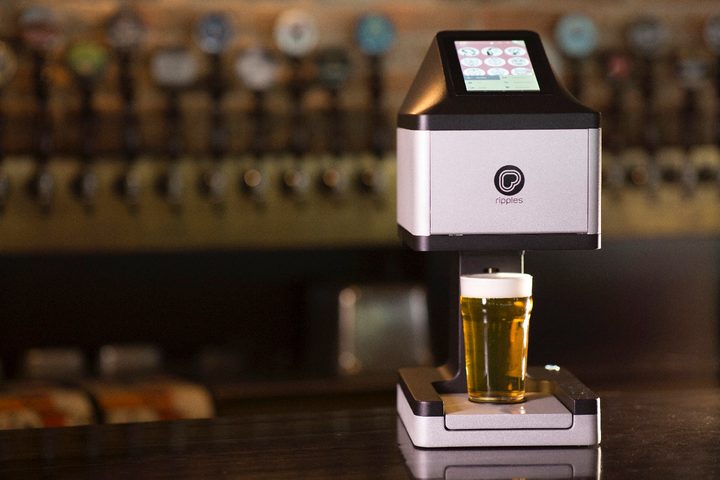
Image used with permission by copyright holder

Meshulam said that the Ripple Maker can print any high-resolution image or design. It’s even possible to send a photo, personal image, or message directly to the Beer Ripples device using a mobile app. Perfect for an original proposal method to a would-be spouse — or, perhaps more realistically, for trolling a buddy.

The device will set you back $3,000, plus an annual $1,500 subscription, which comes with enough malt-based ink for 6,000 prints. While that’s not exactly cheap, it’s important to note that it’s aimed at bars and other businesses, as opposed to something everyday consumers are going to have in their homes. When you factor in the kind of great marketing opportunity that it could represent, suddenly that money doesn’t sound so pricey. If you’re not into beer, the company’s technology also makes it possible to print onto frothy lattes, too.

“Companies such as Twitter, Match.com, Mars, Facebook, Google, and IBM have used Ripples to offer an unforgettable, personalized experience at events, where they might share branded images and text to generate a massive, real-time buzz both at the event and on social media,” Meshulam continued.

Let the age of personalized drinks commence!

Luke Dormehl
I'm a UK-based tech writer covering Cool Tech at Digital Trends. I've also written for Fast Company, Wired, the Guardian…
This tiny sensor could help self-driving cars and robots see better in the dark
Penn State researchers have developed a light-adaptive photomemristor modeled on the human eye that achieves over 95% visual accuracy in shifting light conditions.
Waymo Jaguar I-PACE sensors close up

Penn State researchers have developed a light-adaptive sensor component that could make autonomous vehicle cameras and robots far more reliable in shifting lighting conditions. The work, published Monday in Nature Communications, takes direct cues from how the human eye adjusts between bright and dark environments.

Biology as a blueprint

Read more
A chemical bath could bring your old EV battery back to near-full strength
Cornell researchers have developed a recycling process that restores spent lithium-ion cells to 95% of their original capacity while cutting recycling costs by more than half.
Li-ion battery close up showing recycling symbol

Your next phone or EV could run on a recycled battery that performs nearly as well as a new one. Cornell University researchers have developed a new recycling technique that restores spent lithium-ion cells to up to 95% of their original capacity, while cutting recycling costs by 56%.

A bath instead of a shredder

Read more
The best new ChatGPT feature is one most people will never use
Logo, Emblem, Symbol

For years, the biggest conversation around AI has been what these tools can do. They can browse the web, analyze documents, connect to your apps, conduct research, and increasingly act on your behalf. But as AI systems become more capable, another question has become harder to ignore: what happens when an AI assistant is tricked into handing over information it shouldn’t?

OpenAI’s new Lockdown Mode is its latest answer to that problem. Available across all ChatGPT account types, Lockdown Mode is an optional security setting designed for people and organizations handling sensitive information. The trade-off is that you get stronger protection against certain forms of data theft, but you lose access to some of ChatGPT’s most powerful features.

Read more