
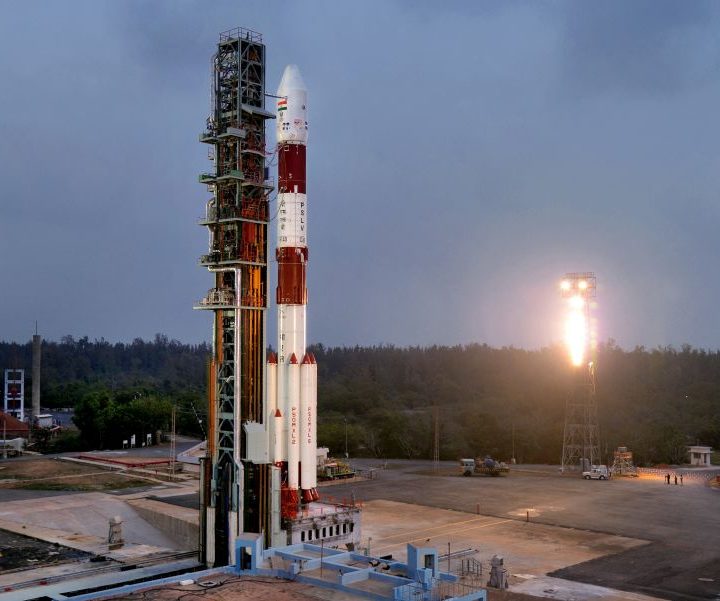
The Indian-built PSLV-C40 launched in January with 31 satellites onboard. It carried a lot of cool stuff into orbit, including the Arkyd-6 satellite — which could lead to asteroid mining — and the first commercial satellite for Finland.
It also carried an unauthorized payload: four tiny satellites from a stealth startup called Swarm Technologies, which didn’t have permission from the Federal Communications Commission (FCC). The nearly undetectable satellites could pose a hazard to the thousands of other orbiting spacecraft, the agency said.
IEEE Spectrum has a detailed report on the launch of the four SpaceBee satellites, which it called “the first ever unauthorized launch of commercial satellites.”
According to CNBC, Swarm Technologies is a stealthy startup founded in 2016 by Sara Spangelo and Benjamin Longmier, former engineers at Google and Apple, respectively. The SpaceBee satellites, much smaller than CubeSats at about the size of a paperback book, were deployed as a demonstration of their space-based concept for an Internet of Things (IoT) communication network.
Swarm claims that its cutting-edge technology will enable worldwide communication for such things as transportation networks and agricultural technologies for far less than current options. Using solar-powered gateways, the satellites would connect to existing IoT devices via Bluetooth or Wi-Fi and transfer that data to Internet-connected ground stations.
Realizing that their tiny satellites would raise red flags at the FCC, the company installed GPS responders and covered the satellites in radar-reflecting material to make them easier to track.
The agency disagreed, however, and rejected Swarm’s application for its satellite launch in December, citing safety concerns. Thousands of tiny pieces of space debris already pose a hazard to orbiting satellites.
Aerospace professor Marcus Holzinger told Spectrum that it’s not necessarily the mass of the SpaceBees, it’s the velocity. “Even at that size, you’re talking about a substantial energy transfer should they hit something,” he said. “Anything that size impacting at orbital velocities can be catastrophic.”
Swarm proceeded with launch plans anyway, using a broker called Spaceflight Industries to get its payload placed aboard the Antrix rocket. Spaceflight was unaware of the concerns raised by the FCC, and received an e-mail days before launch assuring that regulatory approval was imminent. “Spaceflight has never knowingly launched a customer who has been denied an FCC license,” the company said in a statement to Spectrum. “It is the responsibility of our customers to secure all FCC licenses.”
The FCC has come down hard on Swarm, revoking authorization for its next four satellites, which were scheduled for launch on a Rocket Labs mission in April. CEO Peter Beck, last seen sending a giant disco ball into orbit, issued a statement saying, “Rocket Lab will not launch spacecraft that do not have the relevant regulatory approvals or licenses.”
According to Spectrum and CNBC, Swarm Technologies has not responded to multiple requests for comment.


