It’s been an unexpected year of change for Mario. The Super Mario Bros. Movie reversed the series’ big-screen fortunes, delivering a blockbuster hit led by (non-Italian) Chris Pratt. More shockingly, Nintendo recently announced that longtime Mario voice actor Charles Martinet is stepping down from the role after decades of work. A new era is dawning on the Mushroom Kingdom, and you can feel a bit of anxiety among longtime fans who don’t want the character they love to change too much.
With all those complicated threads coming together, Super Mario Wonder feels like a fitting game for the moment. It’s a throwback to Mario’s traditional 2D platformers, keeping old fans happy while still promising some level of transformation — and I’m not just talking about Mario’s new elephant form. Whether it was Nintendo’s intention for not, it could wind up being the most symbolic release in the franchise’s long history.
That context was in the back of my mind when I demoed an hour of Super Mario Wonder, jumping through six of its main courses and two bonus stages. Longtime fans won’t be disappointed, as the latest entry retains all of its staples and Nintendo’s enduring 2D design chops. What’s more exciting, though, is how many new ideas Super Mario Wonder brings to an old formula. It’s not a total transformation, but it exists in a healthy middle ground that should make it a reliable crowd-pleaser.
The Flower Kingdom
I’m not sure anyone needs me to go over the basics of a 2D Mario game at this point: run, jump, collect coins and power-ups. All of those gameplay hooks are unchanged, as is Nintendo’s level design philosophy. If you still love that formula, that’s probably all you need to know until reviews hit this October.
The more I dug below the surface, though, the more I found a number of ways Super Mario Wonder builds on that formula. Part of that comes from some shake-ups to its world and look. It’s not set in the Mushroom Kingdom, but rather the brand new Flower Kingdom, which is ruled by a pint-sized prince who falls victim to Bowser’s usual antics. It’s not just a name change; the Flower Kingdom has its own distinct feel. That’s due in large part to an art overhaul that washes the world in cool blues and purples. It’s a painterly look that’s more transformative than it looks in screenshots.
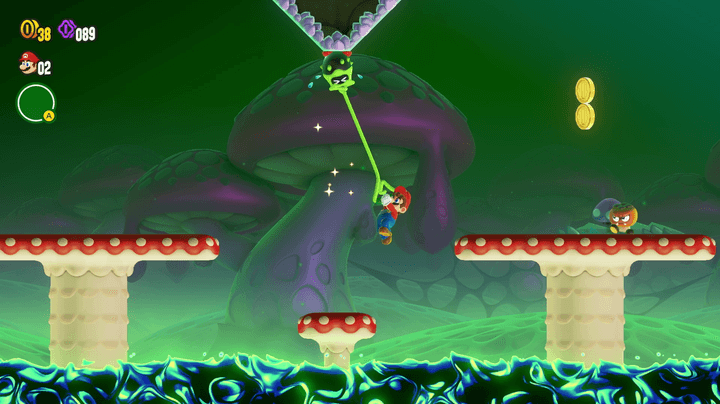
That art style comes with some new animation tricks, which is where Mario Wonder really catches my eye. This is the most expressive I’ve ever seen Mario and his buds in a 2D game, with richer movements and facial tics that make it look like a cartoon. Small touches go a long way; when Daisy exits a horizontal pipe, she clings to the side of it for a moment to make sure the coast is clear. Little moments like that bring more life to the series rather than making it feel like a level suite pumped out of Super Mario Maker.
The Flower Kingdom is also home to quite a few new enemy types, expanding a stale list of longtime Mario foes. Nintendo is at its best here, inventing creative new monsters that instantly feel iconic. Maw Maws are an immediate highlight, rushing at Mario and his pals with their comically enormous mouths hanging open. Bloomps, on the other hand, double as a platforming tool, as Mario can bounce off of the balloon-like animals. With creative visual changes like that, Super Mario Wonder almost feels a bit like Super Mario Bros. 2 from a creative standpoint.
Gameplay twists
Super Mario Wonder starts to look really different when digging into its new gameplay systems. For one, it contains the most playable characters in any mainline Mario platformer. Daisy and Toadette join the usual Mario cast, while Nabbit and different-colored Yoshis double the cast. The latter are aimed at beginners, as they’re invincible and can’t actually use transforming power-ups. However, another player can jump onto a Yoshi to ride it, benefitting from that invincibility temporarily.
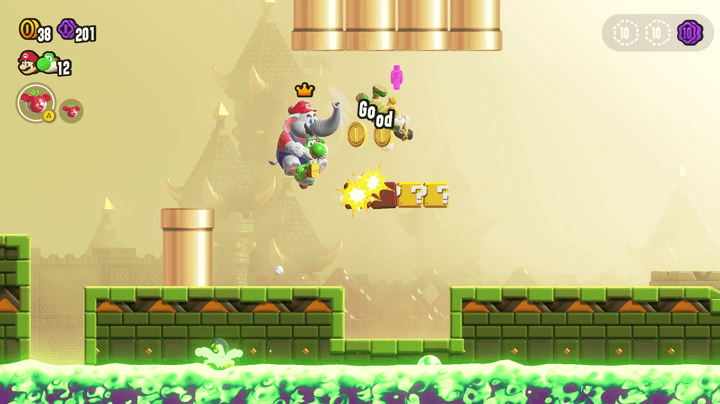
There aren’t any real differences between characters otherwise, but that’s where the platformer’s biggest change comes in: badges. Before entering a level, players can equip one badge that gives them (and co-op players) a specific perk. Some are simple boosts, like starting levels with a mushroom or getting coins whenever an enemy is squashed. Others are more game-changing, giving Mario and his pals special moves. For instance, Luigi’s floaty high-jump becomes a badge here. Other badges turn characters’ hats into gliders or give them a crouching jump. It’s a small system, but one that adds just a little bit of play tyle customization onto a series that has never really had that before.
New badges can be earned by completing challenges in the world, as well as bought from shops with purple flower coins, which are strewn around stages. Those coins can also be used to buy 1 Ups, collectible “Standees,” and more.
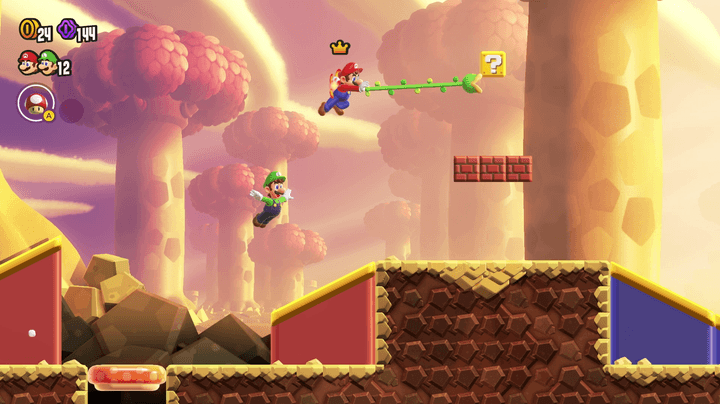
Mario Wonder packs in some surprising online twists, too. In addition to co-op play, it includes a unique option that will let players see the shadows of other players currently playing whichever course they’re in. That’s not ghost data either; it’s happening live. During my demo, I could see Luigi moving around the level I was in alongside me. I turned around and noticed it was another demoist’s character appearing in my game. While you can’t really interact with shadows, it’s a neat social feature that could help distant players show one another the path to secrets.
On top of that, Super Mario Wonder includes four-player co-op that functions similarly to the New Super Mario Bros. series. I played a few stages with two other players, and it was just as joyfully chaotic as ever. Though what I’m most looking forward to is the fact that any level can be turned into a race, adding a bit of competition alongside co-op play.
Transforming Mario
I’ve used the word “transformative” a lot here, and that’s for good reason. Transformation seems to be the core theme of Mario Wonder, as a new approach to power-ups makes it feel more like a Kirby game at times. For starters, there’s Mario’s new power-ups. The Elephant ability gives characters a massive trunk that they can use to smash boxes. The trunk can also be filled with water that can be spat at enemies to stun them or used to revive dead flowers. In a later level, I gained a drill ability, which let me burrow underground to avoid enemy attacks and find secrets (that one seems like a pretty direct nod to Kirby). Finally, a bubble power would let me trap foes in a bubble and bounce on them.
It isn’t just the characters themselves that shape-shift. Super Mario Wonder’s most visually exciting feature comes in the form of Wonder Seeds, items that change the entire world for a time. In one level, grabbing a seed lets loose a train of foes that take me on a roller-coaster ride around the level. Another turns green pipes into sentient creatures that crawl around, letting me grab high-up coins by jumping on their folded-up backs. Though the best one I experienced temporarily turned me and my allies into Goombas, taking away our ability to jump. To return to form, we’d have to hide behind trees to avoid hungry Maw Maws.
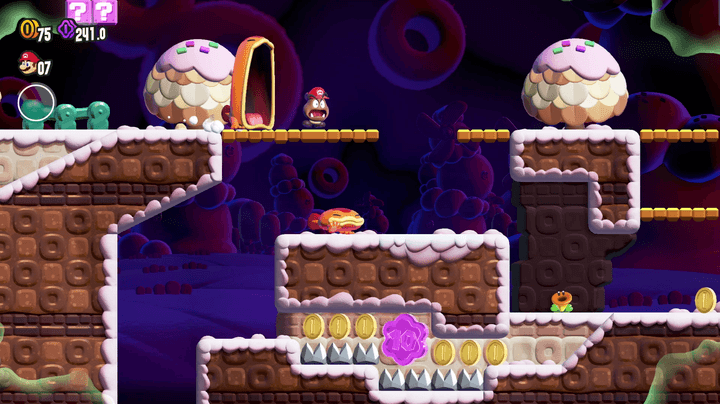
Each Wonder Seed effect I saw was a delightful surprise, twisting the Mario formula in ways I’ve really never seen before. It’s in that reaction that I begin to fully understand the significance of the game’s on-the-nose title. It seems like Nintendo wants to surprise players this time around, leaving them with a newfound sense of (you guessed it) wonder. It’s a necessary change considering that the New Super Mario series, Mario’s last 2D outing, sticks pretty close to the fundamentals. This feels like more of a reinvention, even if the core gameplay is still as familiar as ever.
The most impressive thing I can say about Super Mario Wonder is that I left my demo having no idea what else was in store for me in the full game. That feeling was something that made Super Mario Odyssey so effective, but it’s one that 2D Mario entries have lacked for decades. It’s not a total reinvention of the 2D platforming genre, let alone the Mario formula, but it does feel like the franchise nabbed a new power-up. And that’s the exact modern glow-up the plumber needs if he’s going to become a Hollywood star.
Super Mario Wonder launches on October 17 for Nintendo Switch.