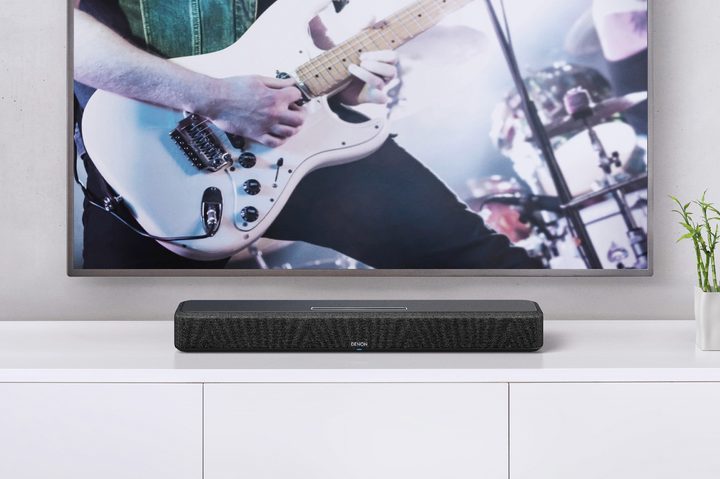
When it comes to soundbars, there’s no lack of awesome options right now, and CES 2021 is showing us that many more are on the way. But that doesn’t mean there isn’t room for new products, especially when they fill a previously empty niche. Denon’s new $599 Home Sound Bar 550, which will be available in February 2021, seems to do just that.
The key to the Home Sound Bar 550’s potential appeal is its vast array of features, combined with a price that places it between bedroom-sized soundbars like the $400 Sonos Beam and $400 Bose Smart Soundbar 300, and their larger cousins, the $800 Sonos Arc and the $800 Bose Soundbar 700.
Using a six-driver array inside a single enclosure, along with three passive radiators, the Home Sound Bar 550 delivers a virtualized Dolby Atmos or DTS:X experience, making it the first Denon soundbar to do so. Like both the Sonos and Bose products, you can expand your home theater system with the addition of Denon’s wireless DSW-1H subwoofer, and any pair of Denon Home wireless speakers as surround modules.

At just 26-inches wide and three inches tall, the Home Sound Bar 550 is relatively small for a full-size soundbar. The top-mounted controls, which illuminate when you approach, give you access to volume, play/pause, track skip/repeat, microphone mute, and let you trigger a voice assistant (more on this later). The Home Sound Bar 550 also comes with its own remote control that has three Quick Select buttons which can be programmed with your favorite audio sources or internet radio stations.
But where things get really interesting is Denon’s inclusion of its HEOS multiroom software. HEOS works similarly to the Sonos system, letting you control all aspects of the Home Sound Bar 550 from a smartphone app. The app lets you group multiple Denon Home speakers or play different music on each device. It provides support for almost every popular streaming service including Tidal, Amazon Music HD, Spotify, Pandora, Deezer, and others. The one big omission is Apple Music, but there’s a workaround: The Home Sound Bar 550 also supports Apple AirPlay 2, so if you have an iOS device, you can stream any audio (including Apple Music) to the speaker.


As a hi-res audio speaker, you can stream lossless 16- and 24-bit music from services like Tidal HiFi and Amazon Music HD, or you can access your own personal hi-res collection from computers or hard drives on your network. For an old-school approach, you can also plug an external hard drive into the USB port on the back panel and play music files that way, too. Failing that, there’s also a Bluetooth connection for audio streaming from virtually any mobile device.
If all of that sounds way too complicated and you happen to own a Roku TV, the Home Sound Bar 550 is also certified as Roku TV Ready, which means you can control all of its features from a simple, easy-to-use on-screen interface using your existing Roku TV remote.
Connecting the Home Sound Bar 550 to a TV can be done with an optical connection, but for the best results, you’ll want to use the HDMI ARC/eARC port. The provided HDMI input, should you wish to use it, supports 4K resolution, HDR, and Dolby Vision pass-through.
Finally, like a cherry on top, you get Amazon’s Alexa built-in, and the speaker can also be controlled via Google Assistant if you have an existing Google smart speaker.
It’s hard to think of anything that Denon forgot to add, so the question becomes: How does the Home Sound Bar 550 sound? As soon as we get our hands on a review unit, we’ll let you know.