The TV world has never been short on acronyms or buzzwords, but lately, it’s been feeling like we’re drowning in that alphabet soup. OLED, QLED, HDR, HDTV, HDMI, ARC, eARC … it’s enough to make your head spin. And though we hate to add to that feeling of vertigo, hang on to your hat; there are two more terms you need to become familiar with because they’re about to change the TV landscape yet again: MicroLED and Mini-LED.
Though they look similar, the terms refer to very different kinds of displays, so let’s get right into what they are, how they’re different from each other, and how they could both play a role in your next TV purchase.
What is MicroLED?
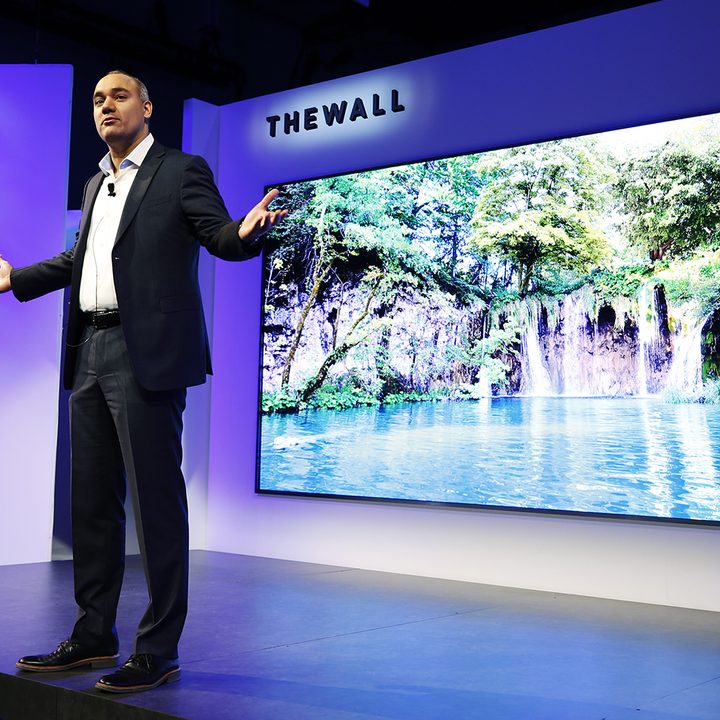
MicroLED is an emissive display technology that works similarly to OLED (Organic Light Emitting Diode) displays, in that each one of its pixels lights up on its own, without the need of a separate backlight. The biggest benefit of any emissive display is that it can achieve a perfect black level. When a pixel isn’t in use, it emits no light at all, which in turn gives you that sense of inky blackness.
But microLED displays have two big advantages over OLED: Because LEDs can get much brighter than OLEDs, that perfect black level is accompanied by impressive brightness, to create an overall contrast ratio that is currently unbeatable by any other technology. How much brighter is it? OLED panels can currently achieve a peak brightness of around 1,000 nits (the base unit display experts use to measure brightness), but microLEDs can potentially produce up to 5,000 nits.
A microLED panel can also be combined with other microLED panels — with no real limits on how many are connected — to create a display that is measured in feet, not inches, and with a resolution that goes all the way up to 16K and beyond. For now, OLED’s maximum size is 88-inches.
Several companies, including LG, Sony, and Samsung are working on microLED displays, but so far, only Samsung and Sony are selling them.
What is mini-LED?
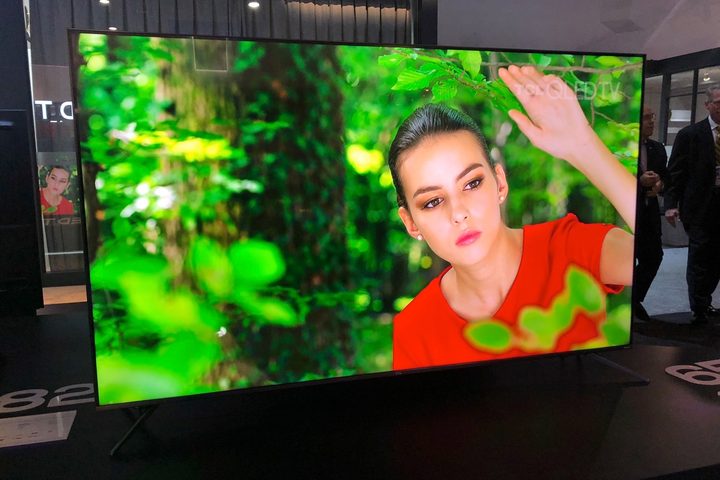
Mini-LED displays belong to the LED TV family, which includes regular LED TVs and QLED TVs. A Mini-LED display uses the same formula as these other TVs — an LED backlight provides the primary source of brightness which then passes through an LCD matrix and a set of color filters to give us the final on-screen image.
Where Mini-LED departs from this model is in the number and size of those LED backlights. A conventional LED TV might use a few dozen, or perhaps a few hundred LEDs to power its backlight. Mini-LED bumps this up to thousands by drastically shrinking the size of the individual LEDs. The reason for this approach is once again to find the holy grail of better contrast, better brightness, and better black levels.
With a larger collection of smaller LEDs, Mini-LED displays can exert greater control over local dimming — the ability to make portions of the screen completely black. If the LEDs are small enough, then, in theory, you could create an LED TV with the same gorgeous black levels as microLED or OLED. When combined with the improved brightness and color made possible by quantum dots, Mini-LED displays could be the technology that finally puts QLED TVs on par with (or even better than) OLED for overall picture quality.
Much like microLED, there are a few different players working with mini-LED tech, but for now, only TCL makes mini-LED TVs you can buy.
Now we’ll match the two technologies against each other in multiple categories to get a better idea about where each excels.
Size

As we explained earlier, there’s no real limit to how big a microLED TV can get. Sony’s CrystalLED (its name for microLED) has been configured as large as 17 feet in size, with a monster 16K resolution to match. With the ability to scale up simply by adding more microLED panels, it’s an incredibly versatile system.
Mini-LED TVs are constrained by the same size limitations as traditional LED displays. Which is to say, they can be made bigger than the biggest OLED TVs, but still nowhere near the wall-sized possibilities that exist with microLED. The limitation on Mini-LED isn’t the LEDs themselves — there’s no limit to how many can be used at once — but with the LCD matrix panels that they illuminate. For now, the largest LED TV we’ve ever seen was Samsung’s 110-inch limited availability UHD TV from 2013.
Winner: MicroLED
Price
For now, microLED displays are only for those with a lot of discretionary spending money. These TVs are so expensive that neither Samsung nor Sony offering official prices on their websites, which reminds us of the expression, “If you have to ask how much it is, you can’t afford it.” Still, a lack of public pricing hasn’t stopped us from putting together some estimates: Sony’s CrystalLED TVs start at around $180,000. And that’s for a 120-inch 1080P resolution setup. Want 4K? That will run you over $700,000.
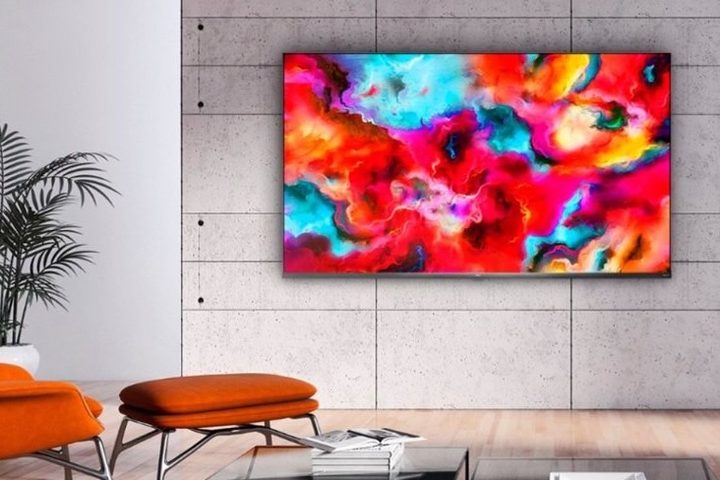
Mini-LED TVs, thankfully, are on-par with other QLED TVs and in some cases are actually cheaper on a size-by-size comparison. TCL’s first kick at the Mini-LED — its 2019 8-Series — costs well under $2,000 for the 65-inch model, making it reasonably affordable.
TCL debuted a new version of its Mini-LED technology at CES 2020, which it calls Vidrian Mini-LED. Vidrian places the Mini-LEDs on a single thin, glass sheet, resulting in a thinner overall display and one which looks to produce even better brightness and black levels. Vidrian-equipped models will likely cost more than their Mini-LED counterparts when they eventually appear, but even then, Mini-LED will remain far more affordable than microLED for many years to come.
Winner: Mini-LED
Brightness, black levels, and contrast
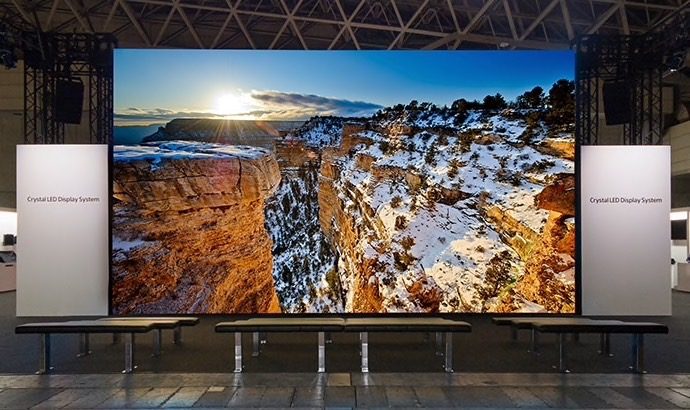
Even though Mini-LED looks poised to help QLED TVs close the gap with their OLED TV competitors when it comes to these attributes, there’s still no contest when Mini-LED goes up against microLED.
With the ability to go perfectly black on a pixel by pixel basis, emissive displays like microLED and OLED have an inherent advantage over any display that doesn’t have pixel-level control over brightness. And microLED’s stunning brightness also means that its contrast ratio is off-the-charts when compared to other displays.
Winner: MicroLED
Availability
This one is pretty straight-forward. Yes, theoretically you can buy a microLED display today, but let’s be honest: Unless you’re among the very wealthiest U.S. residents, you won’t be adding a microLED TV to your media room any time soon.
Mini-LED displays, on the other hand, are available right now albeit only from TCL. Still, both Sony and LG have shown off Mini-LED prototypes, which means TCL’s monopoly on the tech likely won’t last much longer. With a significant head start, however, expect TCL to be a leader in mini-LED TVs for the foreseeable future.
Winner: Mini-LED
MicroLED and Mini-LED are two of the most exciting new display technologies to come along in years. They’ll both have an impact on the TVs we buy in the future, but clearly Mini-LED is going to be the one most of us become acquainted with first.
On the sidelines, but perhaps not for much longer, is QD-OLED, a marriage of QLED and OLED technologies. If and when we see the first TVs using this innovation, we expect they’ll cost a lot more than Mini-LED models, but still far less than microLED.