  1. Home
  2. Audio / Video
  3. Features

Your next earbuds maybe shouldn’t be earbuds at all

Add as a preferred source on Google

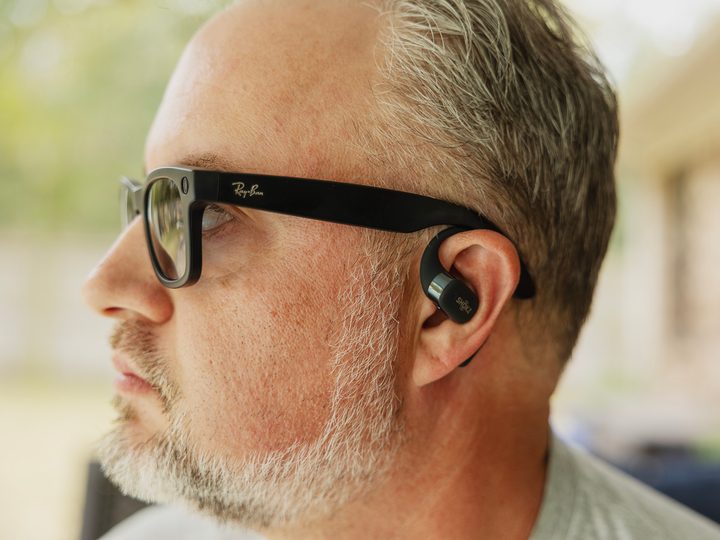
Phil Nickinson wearing both the Ray-Ban Meta smart lasses and the Shokz OpenFit earbuds.
You can wear smart glasses. Or you can wear earbuds. But you probably don’t need both. Phil Nickinson / Digital Trends

I’m a big fan of having the right tool for the right job — which is something I’ve definitely said before. If you’re a photographer, it means you probably have more than one lens. If you’re a chef, you have more than one knife or pan. You don’t take a sedan muddin’, as they say in my neck of the woods. And you don’t take a johnboat 100 miles offshore to go fishing.

Recommended Videos

The same can be true for headphones. There are real reasons to have more than one pair. I wouldn’t work out in full over-the-ears cans. (And can’t understand how the kids these days do.) But nor would I wear AirPods Pro when I’m cycling. That’s when open-ear earbuds, or bone-conduction headphones — something that doesn’t actually go inside your ear and block ambient sound — are required.

But lately I’ve found myself more often grabbing a multitasker. Headphones that — for me, anyway — are able to do the job in more than a single category. I still wouldn’t wear them to the gym, but I have worn them on a bike. I’ll wear them while driving, but won’t actually use them.

The “headphones” in question? The $299 Ray-Ban Meta sunglasses.

Smart glasses with decent-enough speakers mean you might not need proper earbuds with you.

Due to the nature of this job, I have a decent stable of current wireless earbuds and headphones from which to choose. And I’ve been leaving the house more often lately only with the Ray-Bans. Not because they’re the best headphones I have. But having the Ray-Bans on hand means I don’t have to carry sunglasses — a must here in Florida — as well as a separate pair of earbuds. That means one fewer thing in my pockets.

A lot of that decision comes down to the circumstances. My day starts at 4:45 a.m. when I leave for the gym. And I do so with my AirPods Pro in my pocket. It’s dark, so I don’t need sunglasses just yet. (Though now that we’re hitting daylight saving time again, the sun is well up by the time I’m headed home a couple hours later.)

Phil Nickinson wearing the Apple AirPods Pro and Ray-Ban Meta smart glasses.
There are times that only the AirPods Pro will do. But the Ray-Ban Meta often are the only “earbuds” in my bag. Phil Nickinson / Digital Trends
But on the weekends, when I’m traveling with one or both kids at soccer tournaments? The Ray-Bans — and their charging case — have been all I’ve had with me. The case part is important because these things don’t have the biggest batteries. But I’ve yet to use them so much that I’ve completely drained them before getting them some time back in their case. And if you’re going spend that much money on sunglasses, you really should keep them in a case they’re when not on your face.

And there’s something just more casual about taking a quick phone call — or surreptitiously listing to music or a podcast — while you’re outside doing other things. If I’m going to have thrash metal bouncing around my brain all day anyway, why not actually listen to something when I can?

Again, sunglasses don’t make for the best earbuds or headphones (or whatever we want to call this category) you can buy. If you want something open-eared, go for the Shokz OpenFit, which sound better than the Ray-Bans and cut through wind noise that much more. And I wouldn’t rely on the Ray-Bans on an airplane for any number of reasons. Battery. Noise cancellation. The possibility of sound being heard by my seatmates. For that, I’ll stick with the Beats Studio Pro, or my older-but-trusty Sonys.

But if I’m going to be somewhere that doesn’t require more specialized hardware? It might well just be me and the Ray-Bans. And I’m not alone in that idea.

Phil Nickinson
Former Section Editor, Audio/Video
Phil spent the 2000s making newspapers with the Pensacola (Fla.) News Journal, the 2010s with Android Central and then the…
Bowers & Wilkins introduces redesigned 800 Series Diamond D5 lineup at HIGH END Vienna
Your wallet is about to hear sounds it never asked for
Bowers & Wilkins

Bowers & Wilkins has unveiled the new 800 Series Diamond D5 loudspeaker range, marking the British audio company’s 60th anniversary with what it calls its most advanced speaker lineup yet. The flagship series, announced at HIGH END Vienna 2026, introduces major acoustic, mechanical, and aesthetic upgrades aimed at audiophiles and studio professionals seeking reference-grade sound reproduction.

The new D5 lineup succeeds the outgoing D4 range and represents the fifth generation of Bowers & Wilkins speakers to feature the company’s signature Diamond Dome tweeter technology. The range includes seven models, from the compact 805 D5 stand-mount speaker to the flagship 801 D5 floorstanding speaker, alongside dedicated home theatre centre-channel options. Prices start at £10,000 for the 805 D5 and climb to £43,000 for the top-tier 801 D5.

Read more
Sony’s True RGB technology is aiming for the best of OLED and Mini LED
Sony’s new display technology is designed to combine OLED level color with Mini LED brightness
Sony Bravia 9 II (

The battle for premium TV buyers has largely revolved around two technologies in recent years: OLED and Mini LED. OLED has earned a reputation for delivering exceptional contrast and viewing angles, while Mini LED has pushed brightness levels to new heights. The tradeoff has often been deciding which compromise makes more sense for your room and viewing habits.

Sony believes that conversation may be about to change. During a private media briefing in New York City, the company unveiled a new display technology called True RGB, which rethinks how a TV backlight works and aims to combine some of the biggest strengths of both OLED and Mini LED.

Read more
Alienware’s upgraded gaming monitors offer higher brightness and refresh rate starting at $300
Alienware’s four new 30-inch-plus screens bring higher brightness, faster refresh rates, and cheaper 240Hz options.
Computer Hardware, Electronics, Hardware

Alienware has four new screens coming out of Computex 2026, and the lineup cuts across almost every tier that serious PC gamers care about. Its latest Alienware gaming monitors put brighter OLED, faster ultrawide refresh rates, and $299.99 240Hz QHD gaming into one launch window.

The range includes a 39-inch 5K OLED flagship, a 34-inch 280Hz QD-OLED ultrawide, and two 240Hz QHD LCD options at 32 inches and 34 inches. That spread gives Alienware a high-end halo product while pushing fast QHD screens closer to mainstream upgrade territory.

Read more