Today, Sony has pulled the wraps off two new Dolby Atmos-capable home theater sound systems. And though they’re both designed to offer folks highly immersive sound and a simple installation, the way they approach that challenge couldn’t be more different. The $1,300 HT-A7000 looks like a traditional soundbar, right down to the optional wireless subwoofer and surround speakers. But the $1,800 HT-A9 uses a set of four bookshelf-sized independent wireless speakers that can be placed anywhere in a room and use their onboard microphones to sense and respond to furniture, walls, and other acoustic features. Both will be available in September/October from major retailers. Here’s a deeper look at each system.
Sony HT-A9: $1,800
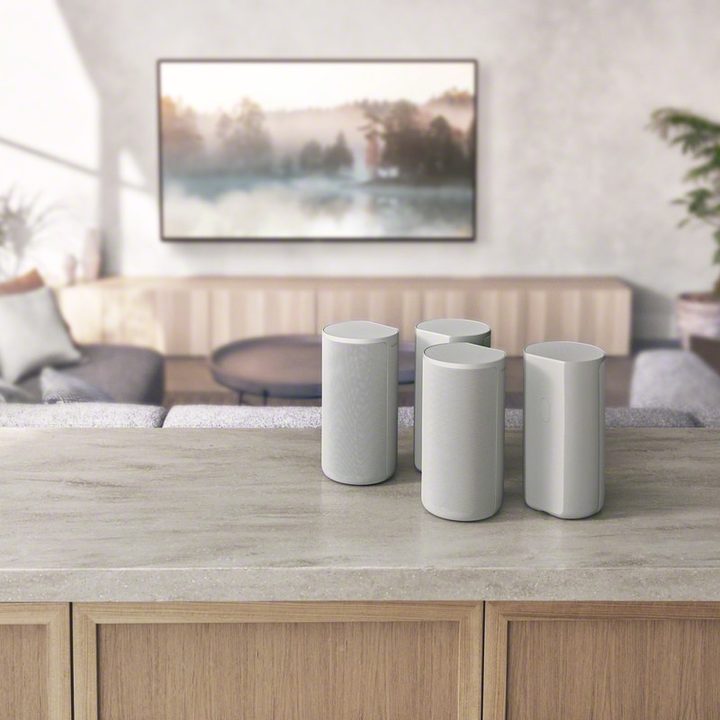
The HT-A9 is a totally new concept in home theater sound, although it’s clear that Sony took its inspiration from both Sonos and WiSA. It’s comprised of four identical wireless speakers that are equipped with a tweeter, a midrange driver, a bass duct, and an up-firing driver. They communicate with a control box that is no bigger than the size of an Apple TV. The control box acts as a simplified A/V receiver, with one HDMI input, one HDMI ARC/eARC output, an Ethernet jack, and a center channel output (more on that in a moment). The control box connects the system to Wi-Fi, and it’s compatible with Google Assistant and Amazon Alexa, plus Chromecast and AirPlay 2 are built-in.
Once installed, the system uses Sony’s Sound Field Optimization to detect room features like ceiling height and adjusts its settings accordingly. The HT-A9 also uses Spatial Sound Mapping technology, which Sony claims can create up to 12 “phantom” speakers, broadening the soundstage and creating a 360-degree dome of sound. Apparently, you will feel as though the sound is “coming from beyond your walls.”
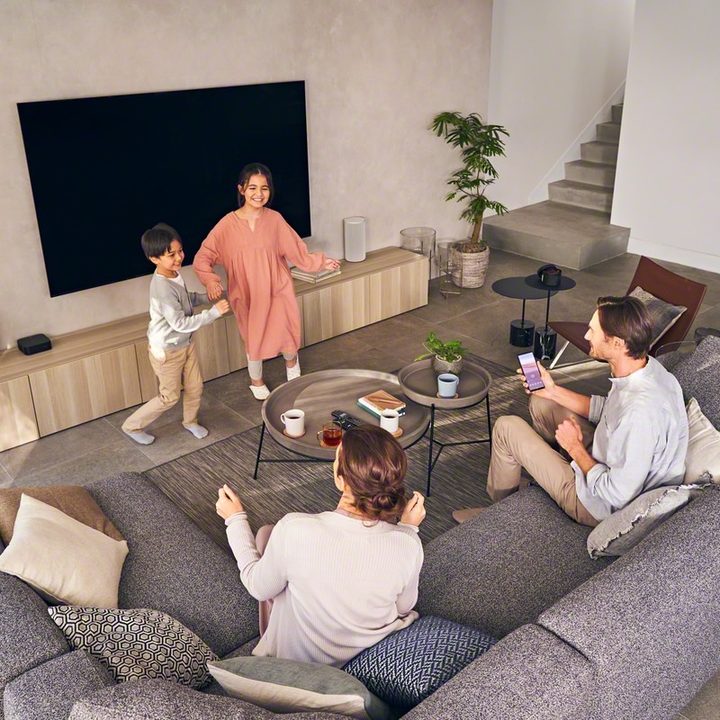
Having four speakers you place anywhere frees people from the traditional “big bar in front of the TV” look of typical soundbars, but it comes with some caveats. Despite the nearly $2,000 price, the HT-A9 does not come with a wireless subwoofer, so that really low rumble, which has become one of the hallmarks of immersive home theater sound, may be lacking. As you may have observed, there’s also no discrete center channel speaker.
Sony has designed the HT-A9 to work with its 2021 TVs, some of which possess the ability to act as a massive center channel speaker — that center channel output on the back of the control box provides this connection. For those without a compatible Sony TV, the HT-A9 creates a virtual center channel.
We’re also a bit surprised that Sony hasn’t included more connectivity options, like additional HDMI inputs, and optical input or wired subwoofer output. Sony hasn’t said whether or not the HT-A9 will support Bluetooth when it goes on sale.
If you want more low-end power, you can equip the HT-A9 with an optional wireless subwoofer. Sony provides two options: The $700 SA-SW5 and the $400 SA-SW3.
The system supports Dolby Atmos, DTS:X, Sony’s 360 Reality Audio (360 RA) format, and hi-res audio.
Sony HT-A7000: $1,300
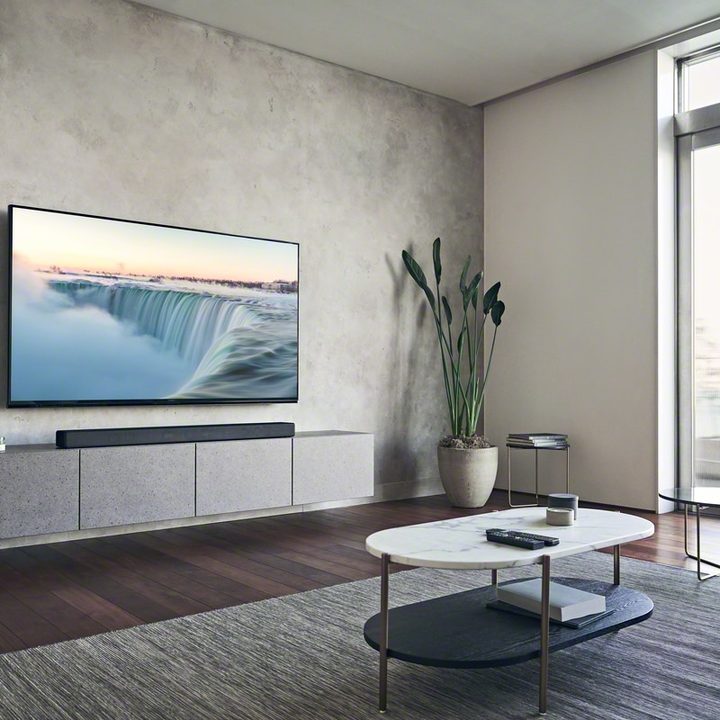
Sony’s HT-A7000 is far more conventional. It’s a 7.1.2 channel soundbar that uses built-in subwoofers and side-beam tweeters to create an immersive sound field from just a single enclosure. Like the HT-A9, you can supplement the A7000 with either the $700 SA-SW5 or $400 SA-SW3 wireless subs, plus there’s also the option of adding the $350 SA-RS3S wireless surround speakers to bring even greater immersion, but it should be noted that these surrounds do not have their up-firing drivers for improved Dolby Atmos or DTS:X performance.
Sony uses Sound Field Optimization to once again detect room features like ceiling height and adjust its settings accordingly. The A7000 comes with two HDMI inputs and an HDMI ARC/eARC output, as well as an optical input, a USB port for accessing music, and an analog input. Despite having its own center channel drivers, you can also connect the A7000 to a compatible Sony Bravia TV to take advantage of the TV’s center channel output capabilities.
The HT-A7000 has Chromecast and AirPlay 2 built-in, it’s compatible with both Google Assistant and Amazon Alexa, and it supports Dolby Atmos, DTS:X, Sony 360 Reality Audio, Spotify Connect, and hi-res audio.