Apple announced two new iPad tablets at a special October event in Brooklyn, both in the iPad Pro family. After focusing on the new iPhone XR, iPhone XS, and iPhone XS Max, along with the Apple Watch for its September launch event, the October event has concentrated on other devices in Apple’s range, including the Apple Mac computer. We’re talking about the iPad here, and key technology and design aspects from the new iPhone models that have finally arrived on the iPad.
Excited? Here’s everything about the new Apple iPad Pro tablets, which come in 11-inch or 12.9-inch screen sizes.
Updates
Apple confirms that some iPad Pros ship slightly bent
Did you open your shiny new iPad Pro to find that it was slightly bent? You’re not alone. According to The Verge, Apple confirmed that some iPad Pros may ship with a very slight bend in the chassis. According to the report, Apple does not consider it a defect and says that the bend should not get worse over time, nor should it affect the performance of the device.
The bend is apparently the result of a cooling process used to make the iPad’s metal and plastic components in manufacturing and can show up on both the 11-inch and 12.9-inch 2018 iPad Pro models. While Apple considers the issue normal, if you don’t like the bend, you shouldn’t have any issue returning it, according to The Verge. After all, Apple VP of hardware engineering Dan Riccio says it’s no big deal.
Slimmer design, bigger screen
Apple is very sure of the iPad’s popularity. Apple CEO Tim Cook described it as a “magical piece of glass that transforms into whatever you want it to be,” and said 400 million have been sold worldwide. The new iPad Pro pushes what you can do on a tablet even further than ever before, he added. For the new models the bezels around the screen have been shrunk down, and the sides of the device have been flattened for a new look. A new Apple Pencil even magnetically attaches to the body for convenience.
The slimmer bezels allow more room for the screen, and Apple offers two sizes for the new iPad Pro — 11-inches and 12.9-inches. It’s a Liquid Retina screen, just like on the iPhone XR, and even has rounded corners for a cleaner more modern look. The iPad’s footprint remains the same as the older, smaller iPad models, but both are slimmer than before, measuring just 5.9mm. The screen supports the same True Tone feature we’ve enjoyed on recent iPhone models. The 11-inch iPad Pro has a 2,388 × 1,668 pixel resolution, while the 12.9-inch version has 2,732 × 2,048 pixel. Both return a 264ppi pixel density.
In the top bezel of the screen is a 7-megapixel camera and Apple’s 3D TrueDepth face scanning sensors to give the iPad Pro’s Face ID. Just like the iPhone, Face ID provides secure face unlock and support for Apple Pay. The good news is Apple has engineered the face sensing tech to operate regardless of screen orientation, and if the iPad is connected to a keyboard case. Now Face ID has been added, the Home button has been removed, which means you’ll have to use gesture controls to get around iOS. Any iPhone X, or iPhone XS owners will already be familiar with this.
Face ID, more storage
Power comes from an A12X Bionic processor, built using a 7nm process, and from the Neural Engine. Around the edge of the body are four speakers — containing both woofers and tweeters — for an improved wider stereo sound. Wi-Fi models will be joined by cellular versions with Gigabit-class LTE from an eSIM. Bluetooth 5.0 is also standard. A USB Type-C connection has been introduced on the iPad Pro, to make connecting to other devices easier.
In addition to the Face ID camera, the back of the iPad Pro has a 12-megapixel camera with an f/1.8 aperture, and can record video at up to 4K resolution. It has a single lens, so you won’t find the iPhone XS’s portrait modes, but it does have the new Smart HDR technology. Internal storage ranges from 64GB to 1TB, and the battery is set to last for 10 hours before needing a recharge.
The body itself has changed shape slightly, with flatter sides, for example. Inside the iPad Pro are 102 purposefully placed magnets, and it’s these, combined with the redesigned body, that will allow accessories to safely and securely attach to the tablet. A new second generation Apple Pencil is one of them, which magnetically attaches to the iPad Pro, automatically pairs, and then charges. The new Apple Pencil also works with a tap, where two taps switch modes, and a tap of the Pencil on the screen opens the Notes app after waking the iPad. Joining the Apple Pencil is a new Smart Keyboard Folio case.
Prices and availability
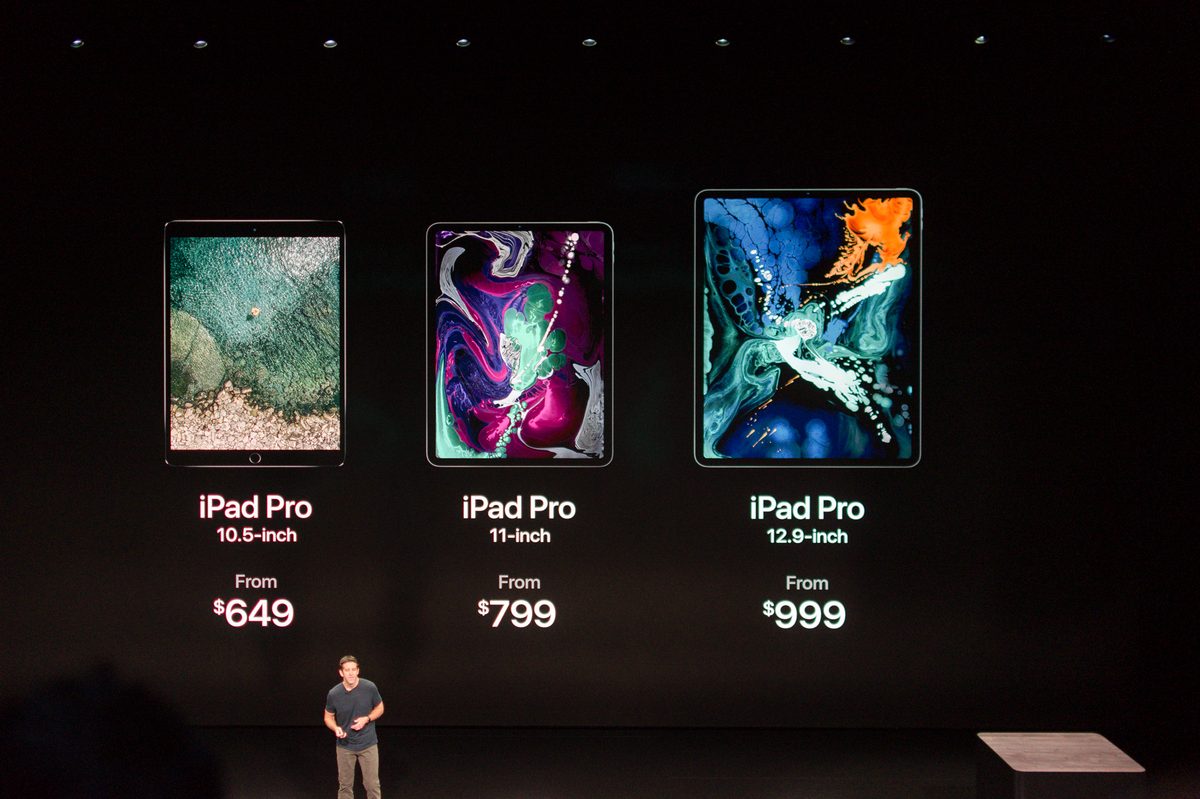
You can now order the new 11-inch and 12.9-inch iPad Pro tablets, and the device is available both in-store and online. Prices vary depending on the amount of memory and whether you choose a Wi-Fi or cellular model. The 64GB 11-inch Wi-Fi iPad Pro is $800, or $950 for the cellular version, The 12.9-inch 64GB model is $1,000, or $1,150 of the cellular model. If you want a new Apple Pencil, that’ll cost you $130, and the keyboard case is $180 for the 11-inch model, or $200 for the 12.9-inch model.
Updated on December 19, 2018: Apple confirms that some iPad Pro models ship with a slight bend.