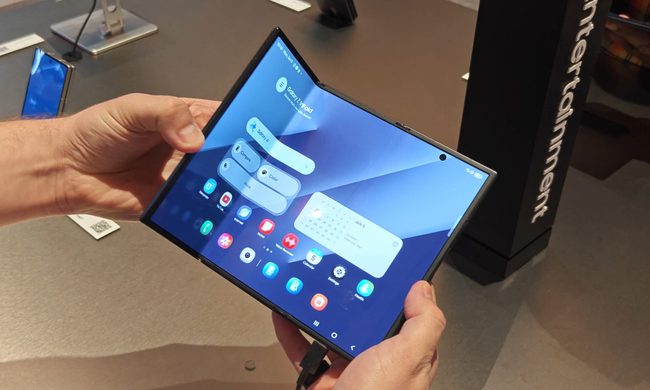
Samsung has just given us a demo of what the future is going to look like, if you’re willing to pay a fittingly high amount. The new Galaxy Z TriFold takes the concept of foldable phones, adds an extra fold to it, and changes the device into a proper tablet.
It’s surreal to see a device like that come to life. At least on the global stage. Huawei has already done it a couple of times with the dual-folding Mate XT pair, but that device leaves an exposed screen edge, runs a non-Android experience, and remains far away from the Western markets, including the US.
Samsung took a different engineering approach, solved a few critical usability problems with a dual-folding device, and most importantly, gave a glimpse of what the Android computing experience is going to look like.

Mind you, it’s a first-generation device, and still pretty thick at 12.9 mm. That’s like holding two mainstream phones like a triple-deck sandwich. Plus, the weight profile of 309 grams is not going to do any favors to your hands. Or your pocket – figuratively and literally.
I was expecting a price tag that would make it instantly budget-hostile. In Korea, the device has been priced at a converted rate of roughly $2,400, nearly the same asking price as the 1TB storage variant of the Galaxy Z Fold 7. But it’s an extremely exciting device for more reasons than one.
A peek into the future, with a twist
A few weeks ago, Google confirmed that it is replacing ChromeOS with a new foundation stack based on Android. “We’re building the ChromeOS experience on top of Android underlying technology,” a senior Google executive said back then. Recently, we heard murmurs that the new OS will be called AluminumOS.
Separately, the company also confirmed that it’s working on Android-based PCs, and that Qualcomm will be the key partner on the project. Lenovo inadvertently spilled the beans that it could be one of the early adopters. This Android-based operating system for PCs will mostly focus on seamless phone-PC connectivity and software-level familiarity, somewhat like iPadOS and macOS.

The Galaxy Z TriFold is a spicy teaser of that hybrid future. Just take a look at the silicon situation. Qualcomm’s Snapdragon X series processors for Windows-on-Arm laptops shared the same fundamental Oryon core and Adreno GPU architecture as the Snapdragon 8 series chips for mobile devices.
And given the history of ChromeOS machines running mostly on low-end processors to keep the costs in check, there is little doubt that a top-tier silicon – like the Snapdragon 8 Elite processor inside the Galaxy Z TriFold— will be technically able to handle Aluminum OS.
There’s another way of looking at it. The Galaxy Z TriFold is a sign that the replacement of ChromeOS with an Android-based alternative (or just shifting of those foundations) would be feasible on more form factors than just regular laptops.
These could be ultra-thin and portable machines, as well. We could see more tablets. And, of course, super-thin foldable devices, as well. Look no further than the Huawei Matebook Fold, which runs a HarmonyOS desktop experience based on the same Kirin family of processors as Huawei’s smartphones, which incidentally is a flavor of HarmonyOS.

I am not sure if dual-booting is on the horizon, but the Galaxy Z TriFold is almost certainly a peek into the different (read: exciting) form factors that Google’s upcoming OS could technically run on.
Setting the stage for new hardware innovations
Alright, at the cost of sounding like a tardy adult who lived his prime in the aughts, I’ll say this out loud. Smartphones became boring in the touchscreen era. The wild experiments we got from Nokia and LG are gone. Foldables – at the cost of fragility and expensive maintenance – injected some much-needed energy.
And no, foldables are not a gimmick. I spent weeks using nothing but the Galaxy Z Flip 7’s squarish-cover screen, while retaining its clamshell charm. The Galaxy Z Fold 7 is an altogether different productivity beast, and once you get used to the convenience of split-screen multitasking on the inner display, or perched atop a table in Flex mode like a laptop, there’s no going back.

The Galaxy Z TriFold, however, takes the idea even further, but with a deeper focus on the hardware innovations. And down the road, they are going to trickle down and make your average foldable phone even better. Let’s start with the display.
Samsung says it deployed a “reinforced overcoat” on the inner panel that adds shock absorption capability. The flexible display and the underlying hinge system are the most fragile portions of any foldable screen device, and it’s reassuring to see Samsung pushing the envelope of engineering in a meaningful direction.
Talking about the hinge, it has a dual-rail design that helps reduce the thickness, while the titanium housing makes it more resilient to natural wear and tear over extended usage. There’s also a ceramic-glass fiber-reinforced polymer back panel to keep cracks at bay.

At its thinnest point, the device is just 3.9mm across, making it the thinnest phone of its kind out there. There’s also a unique magnetic-lift system between the inward folding portions. Overall, the Galaxy Z TriFold is not merely the first mainstream device of its kind, but also a template of exciting innovations coming to the regular (and more affordable) phones down the road.
The software experience
Let’s face it. Tablets are not quite the “computer” replacement. At least not at this point. Google kicked off a whole momentum with Android 12L to make the OS more large-screen-friendly, and Android brands have continued to push out tablets as big as the 15-inch format, but the OS hasn’t quite reached a point where I can confidently ditch my laptop, even for fully web-based work.

The iPad is getting pretty close, but despite the macOS-like features that have landed with the iPadOS 26 update, it’s not fully up to the job. Samsung has deviated productively by offering DeX. This is a desktop-like environment that veers pretty close to the ChromeOS experience.
On the Galaxy Z TriFold, Samsung is pushing it even further natively on the device, instead of triggering it when the device is connected to a larger screen. This is actually the first device that can enter DeX mode on its own. Users will be able to run up to four workspaces simultaneously, each with up to five apps in split-view in the foreground.
It would still serve as a computing hub of its own when connected to another screen in Extended Mode, complete with support for drag-and-drop gestures. Once the device is unfolded, it can run three full-screen instances of mobile apps side by side, somewhat like the Open Canvas system that you will find on OnePlus’ foldables and tablets.

But the Galaxy Z TriFold comes at a rather opportune time, and with a handful of innovations to boot. Samsung has already shown features like seamless drag-and-drop across different app windows. The bigger inner screen also opens a wider and more natural aspect ratio of desktop-style productivity, at least for web-based software.
I can imagine using software such as Adobe Express and vibe-coding tools on this one. I quite like the side-by-side image editing that the company has demoed on the Galaxy Z TriFold. It’s also the perfect display format to use AI as a dedicated side panel, thanks to the deep Gemini integration and on-screen awareness.
The software on the Galaxy Z TriFold, especially with the in-house DeX innovations, could very well set the stage for improving Android tablets. And even if they don’t quite get the full Aluminum OS experience, there’s a lot that Google can take inspiration from.