1. Home
  2. Phones
  3. Mobile
  4. News

This Android phone charges from 0 to 100% in under 10 minutes — and you can’t have it

Add as a preferred source on Google

The charging benchmarks set by Android phones are quite astounding — with some phones being able to charge at 200 watts. If that wasn’t enough, a new Android phone takes it up a notch.

Xiaomi’s newly launched smartphone, the Redmi Note 12 Explorer, brings 210W charging, which is the fastest on any smartphone we’ve seen to date. The proprietary charging tech charges the phone to 66 percent in five minutes and up to 100 percent in about nine minutes. This is extremely impressive considering that the flagship offerings from the likes of Apple and Google take close to two hours for a complete charge.
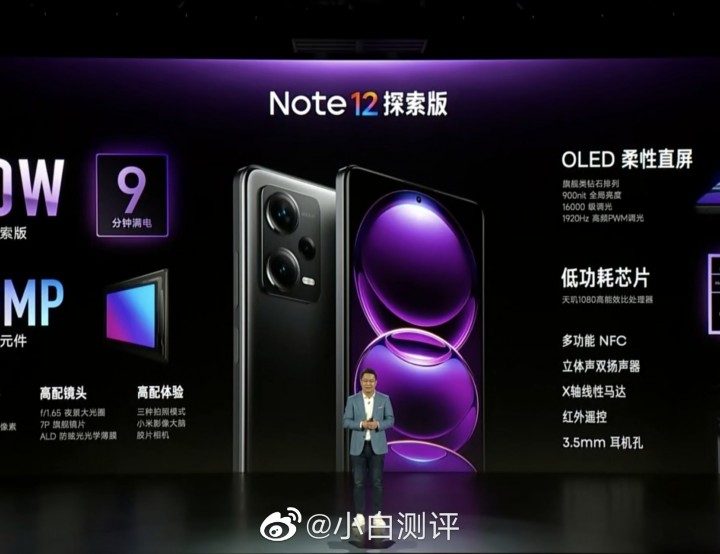
Xiaomi phone poster
Xiaomi

Power Delivery (PD), which is a common charging standard across USB devices, supports up to 240W of power to charge various gadgets. The standard prescribes 50V at 5A. However, Xiaomi’s charging tech keeps the voltage low at 20W and divides the electricity into three channels of 70W each (20V at 3.5A each). For safety measures, the channels are built to sustain up to 100W of power.

Recommended Videos

If you’re guessing that Xiaomi uses a massive charger for the same, that’s actually wrong. Thanks to GaN technology, the charger is fairly small in size; it measures 67.3 x 64.3 x 30mm. For those unaware, Gallium Nitride (or GaN) is a material that produces less heat while charging — thus allowing chargers to be more compact, lightweight, and energy-efficient than regular silicon-based chargers.

The supplied USB cable has an E-mark chip, without which the charger cannot attain its full potential. In the case of the Redmi Note 12 Explorer, the charger can spit out 210W power, however, with other devices, it can only do 65W via USB-PD.
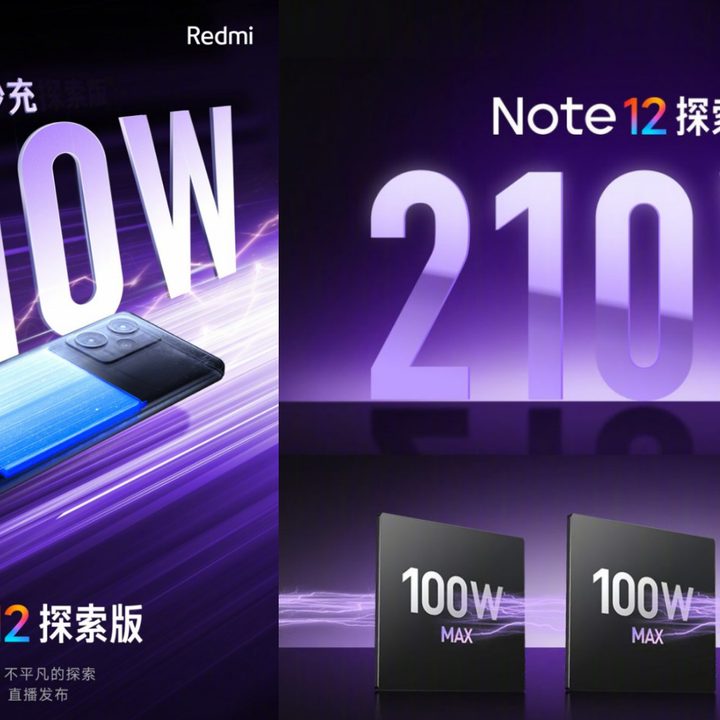
210W charging tech poster.
210W charging tech on Redmi Note 12 Explorer Xiaomi

While this charging tech is undeniably impressive, it’s unlikely that we will see it in the U.S. anytime soon. We say that because Chinese smartphone brands like Xiaomi do not operate in the U.S. The best we’ve seen for U.S. handsets is the OnePlus 10T, which tops out at 125W charging. That’s still impressive, but it’s a far cry from Xiaomi’s 210W.

The state of other flagship phones — such as the Galaxy S22 Ultra, Pixel 7 Pro, and iPhone 14 Pro Max — is even worse. There isn’t a lot of expectation from U.S. smartphone giants for charging speed, even as brands outside of the U.S. keep pushing the envelope further.

Ayush Chourasia
Ayush works as an independent tech journalist. He has been writing since 2018 and has worked with publications like India…
Gemini Intelligence has strict requirements, and your phone may not qualify
Gemini Intelligence

Google’s new Gemini Intelligence platform is quickly becoming one of the biggest talking points in the Android world right now. After being highlighted during this week’s Android Show, the feature is already being tied to several upcoming premium foldables and flagship phones. But there’s a catch: not every high-end Android device will be able to run it. And surprisingly, even some of Google and Samsung’s latest foldables may miss out.

According to Google’s requirements, Gemini Intelligence isn’t just another software update you can casually push to older devices. The company appears to be building this around a much stricter hardware and long-term software support system. To qualify, a phone needs a flagship-grade chipset, at least 12GB RAM, support for AI Core, and Gemini Nano v3 or newer. That immediately creates a problem for several current-generation phones.

Read more
Meta’s Ray-Ban Display now types messages from your finger movements
Neural Handwriting is a really cool feature, but Meta opening the Ray-Ban Display to developers is the quiet announcement that turns a clever wearable into a platform with immense possibilities.
Meta Ray-Ban Display and EMG Band.

Six months into its life, the Meta Ray-Ban Display is starting to look less like an experiment, thanks to what is arguably the most significant update Meta has ever pushed for the device. 

The headline feature is Neural Handwriting, which is now available to every Ray-Ban Display owner, having spent its early months in limited access for Messenger and WhatsApp users. 

Read more
WhatsApp is testing disappearing messages that wait for you to actually read them before vanishing
WhatsApp's new After Reading timer deletes messages only after the recipient reads them.
whatsapp-disappearing-messages-after-reading-timer

WhatsApp has always let you send messages that vanish on a timer, but the clock starts the moment you hit send, not when the other person actually read it. That means a message could sit unread for hours and still disappear before anyone sees it.

This is why WhatsApp is testing a new feature called 'After Reading' timer for disappearing messages, spotted in the latest iOS beta update by WABetaInfo.

Read more