  1. Home
  2. Space
  3. News

It’s exactly 20 years since a Mars rover took this historic image

Add as a preferred source on Google

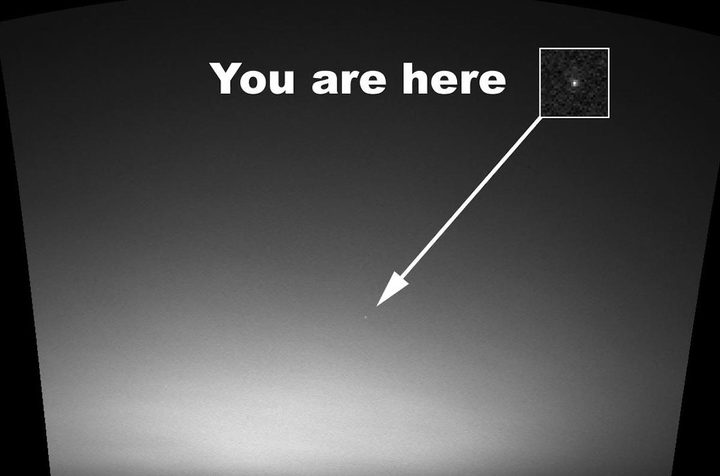
The first photo of Earth taken from the surface of another planet.
This is the first image taken of Earth from the surface of another planet. It was captured by NASA’s Mars rover, Spirit, one hour before sunrise on the 63rd martian day, or sol, of its mission in 2004. NASA/JPL/Cornell/Texas AM

Twenty years ago, on March 8, a NASA Mars rover made history when it captured the first image of Earth from the surface of another planet.

Recommended Videos

The rover, Spirit, landed on the Martian surface in January 2004. Soon after landing in Mars’ Gusev Crater, Spirit wasted little time beaming back images of its new surroundings. A couple of months later, it snapped a mind-blowing image (above) offering a view of Earth that was as fresh as it was astonishing.

“Shortly before sunrise [on March 8], Spirit’s camera managed to capture Earth as a bright star, appearing much as Venus does to terrestrial observers. This marked the first photograph of Earth from another planetary surface,” NASA said in an article on its website this week.

It was nearly another 10 years before another NASA rover, Curiosity, came along and captured its own image (below) of Earth, this one from inside Mars’ Gale Crater. Curiosity’s picture is remarkable because it also shows Earth’s moon despite being taken from 99 million miles (159 million kilometers) away.
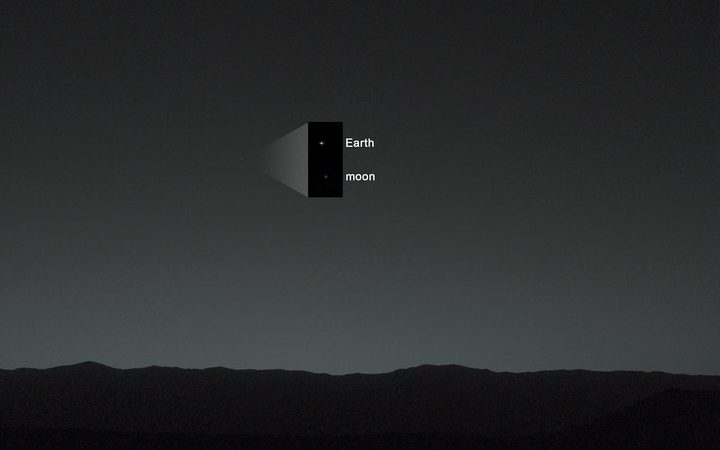
Earth captured from Mars by NASA's Curiosity rover.
NASA/JPL-Caltech/MSSS/TAMU

“These images — and others taken of Earth from ever-more distant vantage points over the past eight decades — provided a new perspective of our home planet’s place in our solar system,” NASA said.

Spirit explored the Martian surface for almost another six years, with the last contact from the rover coming on March 22, 2010. Curiosity, meanwhile, continues its work in Gale Crater until this day, and another rover, Perseverance — NASA’s most advanced to date — has been exploring Jezero Crater since arriving there in spectacular style in February 2021.

In December 1968, another iconic Earth image was captured not by a rover but by retired astronaut Bill Anders during the Apollo 8 lunar mission in December 1968. In recent years, astronauts aboard the International Space Station have also been snapping sublime images of our planet from 250 miles up.

Trevor Mogg
Contributing Editor
Not so many moons ago, Trevor moved from one tea-loving island nation that drives on the left (Britain) to another (Japan)…
Scientists have found a hidden galaxy inside the Milky Way, and they’re calling it Loki
A lost dwarf galaxy may be hiding inside the Milky Way.
milky-way-hidden-galaxy-loki

Our home galaxy has a secret buried inside. A new study published in the Monthly Notices of the Royal Astronomical Society suggests that the Milky Way swallowed an ancient dwarf galaxy billions of years ago, and its stellar remains are still embedded within ours.

Researchers have named this lost galaxy Loki, after the Norse trickster god, and the name is quite fitting because it remained hidden in plain sight for a very long time.

Read more
NASA aims September launch for Roman space telescope and it’s going to be a huge shift
An earlier target for Roman means one of NASA’s most ambitious observatories is getting close, with the potential to open a huge new era in space discovery
Machine, Wheel, Astronomy

NASA is now aiming to launch the Nancy Grace Roman Space Telescope as soon as early September 2026, a faster timeline than its earlier commitment to fly no later than May 2027. That alone makes this one of the agency’s most important missions to watch over the next few months.

The reason is simple, Roman is built to scan vast parts of the sky with sharp infrared vision.

Read more
Blue Origin successfully re-uses a New Glenn rocket for the first time ever
Blue Origin achieves first New Glenn reflight despite payload setback
Blue Origin

Blue Origin has achieved a major milestone in its spaceflight ambitions by successfully reusing a booster from its heavy-lift New Glenn rocket for the first time. The historic launch, conducted on April 19, marks a significant step forward for Jeff Bezos’ space company as it seeks to compete with rivals like SpaceX in the rapidly evolving commercial launch market.

A Milestone With A Mixed Outcome

Read more