  1. Home
  2. Space
  3. Photography
  4. News

Astronaut’s stunning snapshot shows Earth in a whole new way

Add as a preferred source on Google
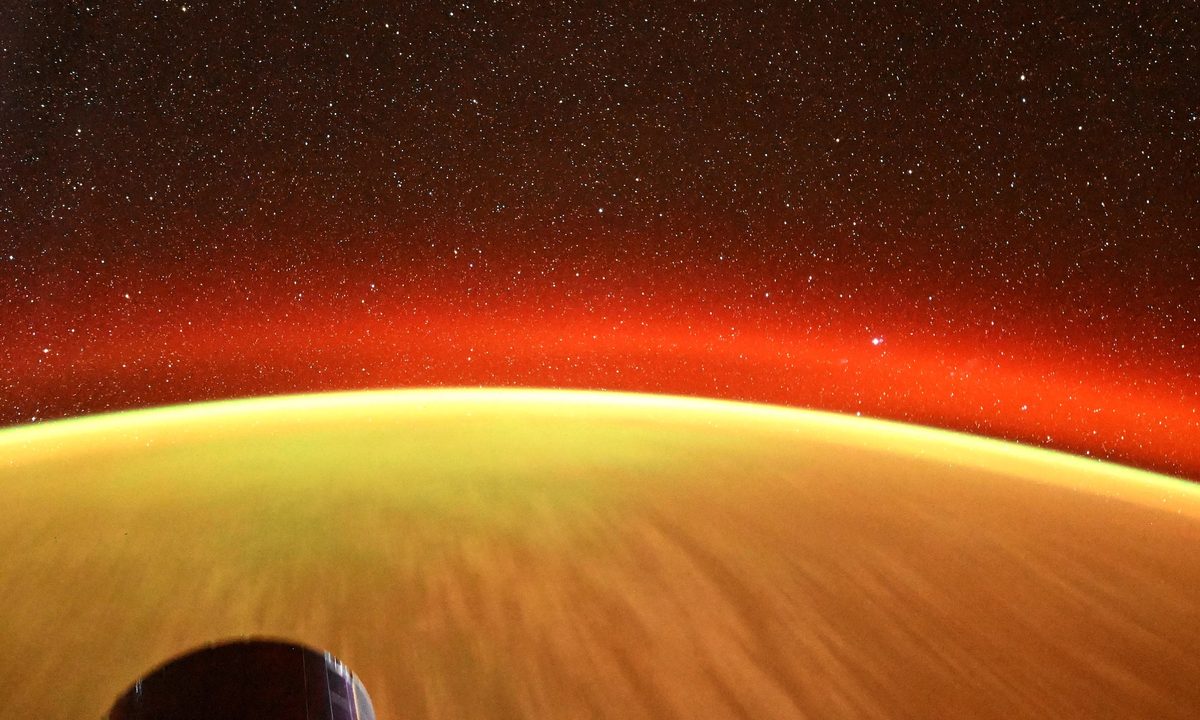
An image showing the stars of deep space and a sea of clouds lit by the red upper atmospheric airglow.
Don Pettit / NASA

Earth has rarely looked as remarkable as it does in this stunning shot (above) captured by NASA astronaut Don Pettit from the International Space Station (ISS).

Taken during his recent seven-month mission aboard the orbital outpost, the astonishing image shows an airglow over the planet we call home, together with distant stars and a part of a SpaceX Dragon spacecraft docked at the station.

Recommended Videos

“SpaceX Dragon flies between the stars of deep space, and a sea of clouds lit by the red upper atmospheric airglow,” Pettit wrote alongside the photo in a social media post that he shared on Sunday. “This is a 20-second exposure taken with my orbital sidereal drive that tracks the stars thus allowing long exposures.”

SpaceX Dragon flies between the stars of deep space, and a sea of clouds lit by the red upper atmospheric airglow.

This is a 20 second exposure taken with my orbital sidereal drive that tracks the stars thus allowing long exposures. pic.twitter.com/Kk7KwHSQql

— Don Pettit (@astro_Pettit) July 12, 2025

An airglow is a faint, natural light that occurs as sunlight interacts with atoms and molecules within the atmosphere. It’s seen from space as a thin, colorful glowing band close to the edge of our planet, usually green in color but sometimes red or blue. Unlike auroras, which are driven by solar storms, airglows are always present although they’re only visible at night.

The orbital sidereal drive that Pettit speaks of is an innovative device created by Pettit himself to keep stars sharp in long-exposure photos captured from the space station. The tool moves the camera to compensate for the movement of the ISS, thereby keeping the stars in the same spot on the camera sensor, preventing them from streaking across the frame.

Pettit has earned a reputation for taking breathtaking shots of Earth and beyond from orbit. He shared many of his efforts during his most recent space mission, which ended in April, but since then he’s been sharing new images captured during the same expedition. 

Just last week, for example, Pettit posted this incredible near-infrared shot of the Grand Canyon, which he described as “reminiscent of the surface of Mars.” 

Trevor Mogg
Contributing Editor
Not so many moons ago, Trevor moved from one tea-loving island nation that drives on the left (Britain) to another (Japan)…
Astronauts reportedly took shelter after work on Russia’s leaky ISS module triggered concerns
The ISS really picked a stressful time to start leaking again
The International Space Station.

Astronauts aboard the International Space Station reportedly took precautionary shelter measures after maintenance work on a long-troubled Russian module raised fresh safety concerns about air leaks aboard the orbiting laboratory.

According to reports, the incident involved Russia’s Zvezda service module, which has experienced recurring air leak problems for several years. During repair work and pressure tests connected to the leak investigation, astronauts were instructed to isolate themselves in safer sections of the ISS as engineers monitored the station’s integrity and pressure stability.

Read more
Blue Origin’s massive New Glenn rocket explodes in a fiery blaze during tests
The incident leaves NASA's Moon Base ambitions and Amazon's Kuiper constellation without their primary launch vehicle at the worst possible moment.
Explosion, Fire, Nuclear Explosion

Blue Origin's New Glenn rocket exploded during a static fire test at Launch Complex 36 in Cape Canaveral, Florida. The incident took place on the night of May 28, 2026. 

The explosion was captured on a live stream by NASASpaceflight.com and footage of the explosion spread rapidly across X. The Space Launch Complex 45 has confirmed in an official statement (shared by Spaceflight Now on X) that all personnel have been accounted for and there have been no injuries or fatalities.

Read more
Orbot Robotics’ space robot has four arms, but its Goro physique has a purpose
This four-armed robot could make routine space-station work easier for astronauts
Robot with four arms

Helios is a new four-armed robot from Zurich-based Orbit Robotics, and at first glance, it reminded me of Goro from Mortal Kombat. But unlike the prince from Outworld, Helios is not built for combat. It is designed to help astronauts on space stations with the repetitive, time-consuming work that keeps life in space running.

Orbit Robotics says that in microgravity, legs are not much help. Instead of walking or standing, Helios needs to move through tight station interiors, hold itself steady, and handle cargo, tools, or equipment. Its four-arm design turns extra limbs into both mobility aids and working hands.

Read more