  1. Home
  2. Space
  3. News

Blue Origin shows off 3-story Blue Moon lunar lander mock-up

Add as a preferred source on Google

Blue Origin, owned by Amazon founder Jeff Bezos, has unveiled a full-scale mock-up of the Blue Moon Mark 1 lander destined for a lunar touchdown.

Recommended Videos

A gathering attended by Bezos and NASA chief Bill Nelson took place recently at Blue Origin’s engine manufacturing facility in Huntsville, Alabama.

Images from the event were shared on social media by both Blue Origin and Nelson.

“We unveiled our nearly 3-story Blue Moon MK1 cargo lander demonstrator,” Blue Origin said in its post, adding that as well as transporting cargo to the lunar surface, the Mark 1’s early uncrewed missions will also serve to confirm the capability of the vehicle’s technologies.

“MK1 will be capable of delivering three metric tons to any location on the moon’s surface,” Blue Origin said. “That capacity makes it ideal for a variety of logistics, infrastructure, and science payloads.”
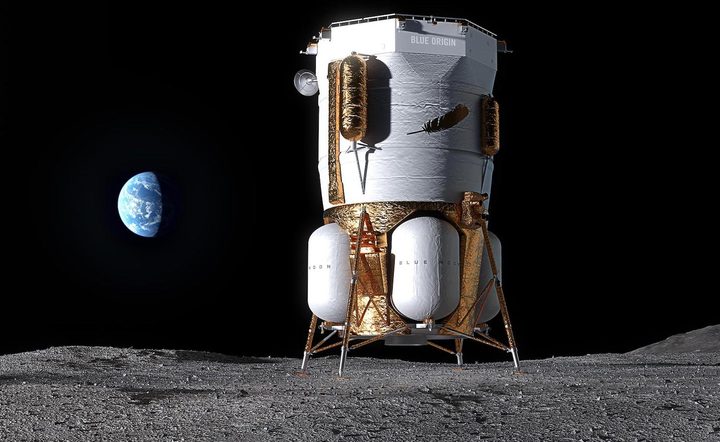
How Blue Origin's lander might look on the moon.
How Blue Origin’s lander might look on the moon. Blue Origin

Later flights will use Blue Origin’s Mark 2 lander to put astronauts onto the moon. A date for the first Mark 1 mission has yet to be announced, while the first Mark 2 flight carrying astronauts to the lunar surface is currently set for 2029 as part of the Artemis V mission.

The lander will travel to the moon inside the 23-foot-wide (7-meter) fairing atop Blue Origin’s New Glenn rocket, which is currently under development. Astronauts will transfer to the lander from the moon-orbiting Lunar Gateway facility, which is also under development.

Commenting on his first viewing of Blue Origin’s lander — or at least a mock-up of it — NASA boss Bill Nelson described it as “impressive” and said Blue Origin’s landing system will “help ensure a steady cadence of astronauts on the moon to live and work before we venture to Mars.”

Before Blue Origin’s first astronaut mission, SpaceX will use a modified version of its Starship spacecraft to put the first humans on the moon since the final Apollo flight in 1972. The mission, Artemis III, is currently set for 2025.

As part of the Artemis program, NASA also plans to build a permanent lunar base for long-duration stays by astronauts, while the moon could also one day be used to launch crewed missions to Mars and beyond.

Trevor Mogg
Contributing Editor
Not so many moons ago, Trevor moved from one tea-loving island nation that drives on the left (Britain) to another (Japan)…
Scientists have found a hidden galaxy inside the Milky Way, and they’re calling it Loki
A lost dwarf galaxy may be hiding inside the Milky Way.
milky-way-hidden-galaxy-loki

Our home galaxy has a secret buried inside. A new study published in the Monthly Notices of the Royal Astronomical Society suggests that the Milky Way swallowed an ancient dwarf galaxy billions of years ago, and its stellar remains are still embedded within ours.

Researchers have named this lost galaxy Loki, after the Norse trickster god, and the name is quite fitting because it remained hidden in plain sight for a very long time.

Read more
NASA aims September launch for Roman space telescope and it’s going to be a huge shift
An earlier target for Roman means one of NASA’s most ambitious observatories is getting close, with the potential to open a huge new era in space discovery
Machine, Wheel, Astronomy

NASA is now aiming to launch the Nancy Grace Roman Space Telescope as soon as early September 2026, a faster timeline than its earlier commitment to fly no later than May 2027. That alone makes this one of the agency’s most important missions to watch over the next few months.

The reason is simple, Roman is built to scan vast parts of the sky with sharp infrared vision.

Read more
Blue Origin successfully re-uses a New Glenn rocket for the first time ever
Blue Origin achieves first New Glenn reflight despite payload setback
Blue Origin

Blue Origin has achieved a major milestone in its spaceflight ambitions by successfully reusing a booster from its heavy-lift New Glenn rocket for the first time. The historic launch, conducted on April 19, marks a significant step forward for Jeff Bezos’ space company as it seeks to compete with rivals like SpaceX in the rapidly evolving commercial launch market.

A Milestone With A Mixed Outcome

Read more