  1. Home
  2. Space
  3. Emerging Tech
  4. News

Remains of shallow, briny pools provide further evidence of liquid water on Mars

Add as a preferred source on Google
A Guide to Gale Crater

As the Curiosity rover explores Mars’ Gale Crater, the data it collects tells us more about the history of the planet and in particular about whether liquid water once existed there. Using data collected by Curiosity, a new study has examined the geology of the crater to learn more about the briny ponds which may once have dotted the planet’s surface.

Recommended Videos

“We went to Gale Crater because it preserves this unique record of a changing Mars,” William Rapin, Caltech researcher and lead author of the study, explained in a statement. “Understanding when and how the planet’s climate started evolving is a piece of another puzzle: When and how long was Mars capable of supporting microbial life at the surface?”

By looking at the salts present in rocks in an area of the crater called Sutton Island, the scientists could build up a picture of the environment through time. They already knew that the area went through drier periods, as the mud in a region called Old Soaker was cracked. The cracks form as the mud dries out.

The new evidence shows there were wet periods too though. The presence of minerals salts mixed with sediment suggests that shallow ponds once formed there, before drying to leave the salts behind. The ponds would have been briny due to the concentrated salts.
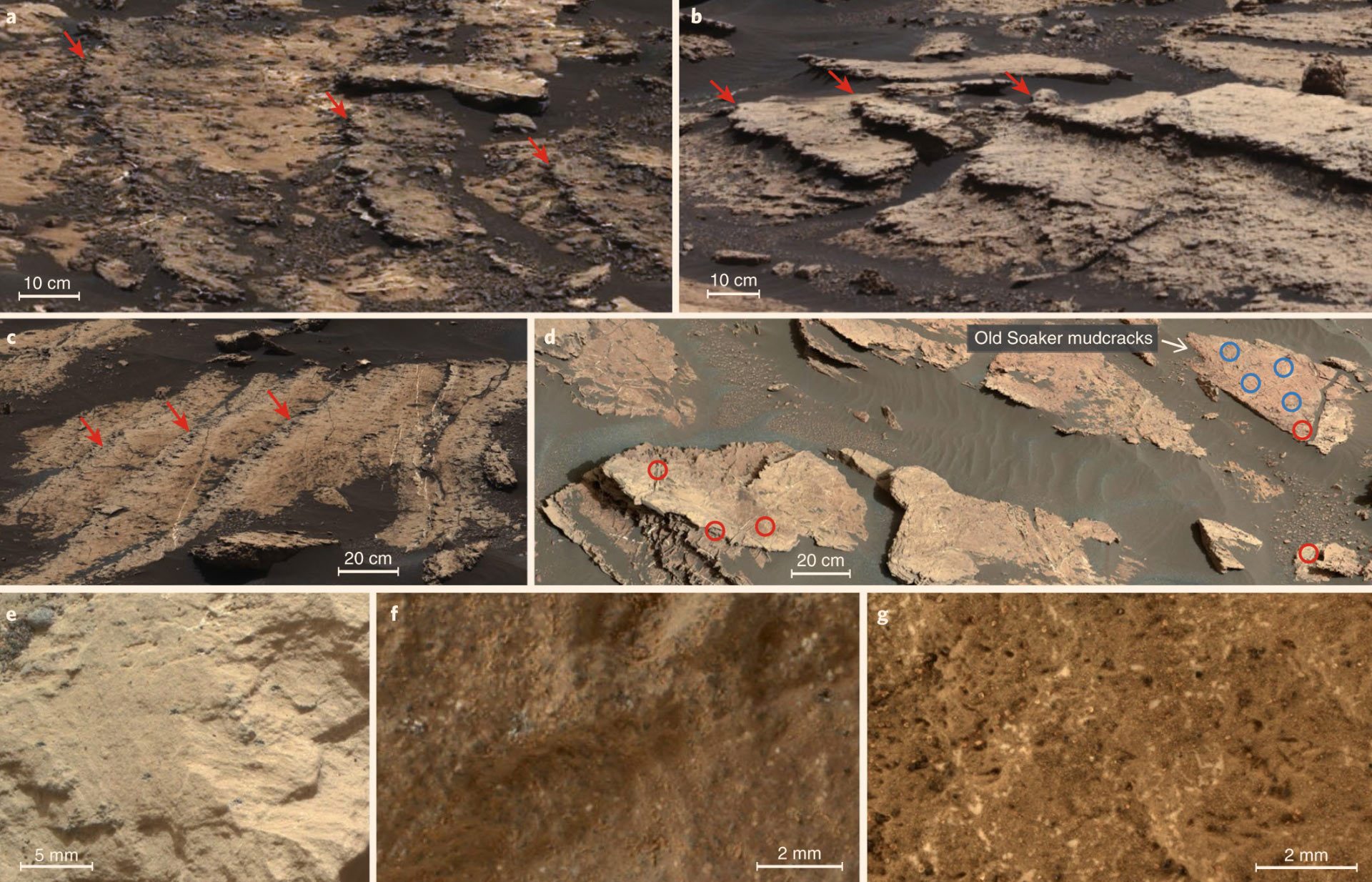
Different sulfate elements found in Mars’ Gale Crater: (a) magnesium sulfate-enriched lithology; (b) calcium sulfate enrichments; (c) euhedral white crystals and heterogeneous calcium sulfate and magnesium sulfate enrichments; (d) areas with calcium sulfate enrichments (red) and without (blue); (e, f) close-up images of a mudstone and a sandstone enriched in calcium sulfate; (g) close-up image of bedrock. Rapin et al, doi: 10.1038/s41561-019-0458-8.

To understand more about the formation of these briny lakes, scientists turned to an environment closer to home: “Given that Earth and Mars were similar in their early days, Sutton Island might have resembled saline lakes on South America’s Altiplano,” Dr. Rapin said.

“Streams and rivers flowing from mountain ranges into this arid, high-altitude plateau lead to closed basins similar to Mars’ ancient Gale Crater… During drier periods, the Altiplano lakes become shallower, and some can dry out completely. The fact that they’re vegetation-free even makes them look a little like Mars.”

The research is published in the journal Nature Geoscience.

Georgina Torbet
Georgina has been the space writer at Digital Trends space writer for six years, covering human space exploration, planetary…
Stunning close-up footage shows NASA’s moon rocket roaring to space
On its first crewed flight, NASA's lunar rocket displays its awesome power.
NASA's SLS rocket roars skyward at the start of the Artemis II mission on April 1, 2026.

As NASA’s Artemis II astronauts journey back to Earth following their breathtaking close encounter with the moon earlier this week, the space agency has just shared some stunning footage (below) of the rocket launch that sent the crew on its way on April 1.

The close-up tracking shot shows the awesome power of the Space Launch System (SLS) rocket’s four core RS-25 engines together and its two solid rocket boosters as the 98-meter-tall vehicle roars away from the launchpad at the Kennedy Space Center in Florida.

Read more
How to watch NASA’s moon crew splash down at end of historic mission
The Orion spacecraft's final moments before splashdown will be the most perilous of the entire mission.
Earth and the moon as seen from the Orion spacecraft during the Artemis II mission in April 2026.

The Artemis II astronauts have looped around the moon, captured some extraordinary imagery (above), set a slew of records, and are now on their way back to Earth.

The 10-day mission will reach its climax on Friday, April 10, during a dramatic homecoming that will see the Orion spacecraft enter our planet’s atmosphere at a speed of nearly 25,000 miles per hour.

Read more
Notable firsts of the Artemis II moon mission … so far
The Artemis II crew are now on their way home, so let's take a look at the mission's achievements so far.
The moon as seen from the Orion spacecraft during the Artemis II mission.

Having just looped around the moon in a historic flyby of our nearest neighbor, the Artemis II crew are now on their way back to Earth.

NASA’s Victor Glover, Reid Wiseman, and Christina Koch, along with the Canadian Space Agency’s Jeremy Hansen, launched aboard the Orion spacecraft from the Kennedy Space Center on April 1, lifted to space by the mighty SLS rocket.

Read more