Despite its freezing temperatures, thin atmosphere, and lack of surface water today, scientists believe that Mars could once have been capable of supporting life. No one knows whether life ever did develop there (though there is almost certainly nothing alive there now), but finding out if our neighboring planet ever did host microbial life is one of the great questions in astronomy today. Now, scientists are one step closer to answering that question.
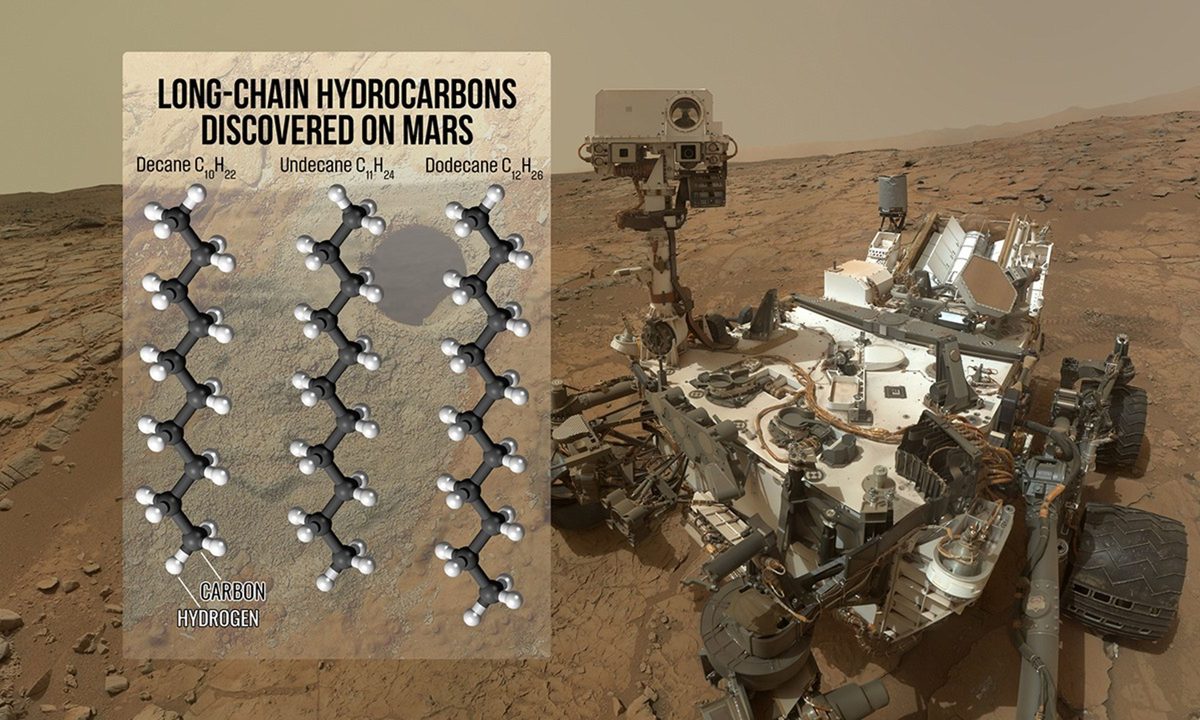
The NASA Curiosity rover has discovered the largest organic compounds ever found on Mars, suggesting that the conditions for life to develop could have been present on the planet billions of years ago. Organic compounds aren’t necessarily indicators of life, but they are its building blocks, so finding these compounds in such a large and well-developed state supports the idea that it may have been possible for life to develop there.
The compounds identified are called decane, undecane, and dodecane, and are made up of carbon atoms and hydrogen atoms. They are thought to be fragments of fatty acids, which are a building block for life on Earth.
Curiosity has previously discovered small organic molecules on Mars, but these recently found compounds are larger and would have require chemistry to reach a more advanced state to be produced. The finding is also good news for potential life hunters, as it shows that the indicators of life could still be around even after billions of years.
“Our study proves that, even today, by analyzing Mars samples we could detect chemical signatures of past life, if it ever existed on Mars,” explained lead researcher Caroline Freissinet of the French National Centre for Scientific Research.
Curiosity has also found evidence that liquid water was once present in the same region where the compounds were found, called Yellowknife Bay. Samples taken from the area, which appeared to be an ancient lakebed, showed the presence of clay minerals which form in water, meaning that there likely was plentiful water there once. There are also signs of sulfur which helps to preserve organic molecules and nitrates and methane, which on Earth can be associated with living things (though which can come from other sources too).
“There is evidence that liquid water existed in Gale Crater for millions of years and probably much longer, which means there was enough time for life-forming chemistry to happen in these crater-lake environments on Mars,” said fellow researcher Daniel Glavin of NASA’s Goddard Space Flight Center.
The research is published in the Proceedings of the National Academy of Sciences.