  1. Home
  2. Space
  3. News

How this supercomputer will use A.I. to map the universe’s dark energy

Add as a preferred source on Google

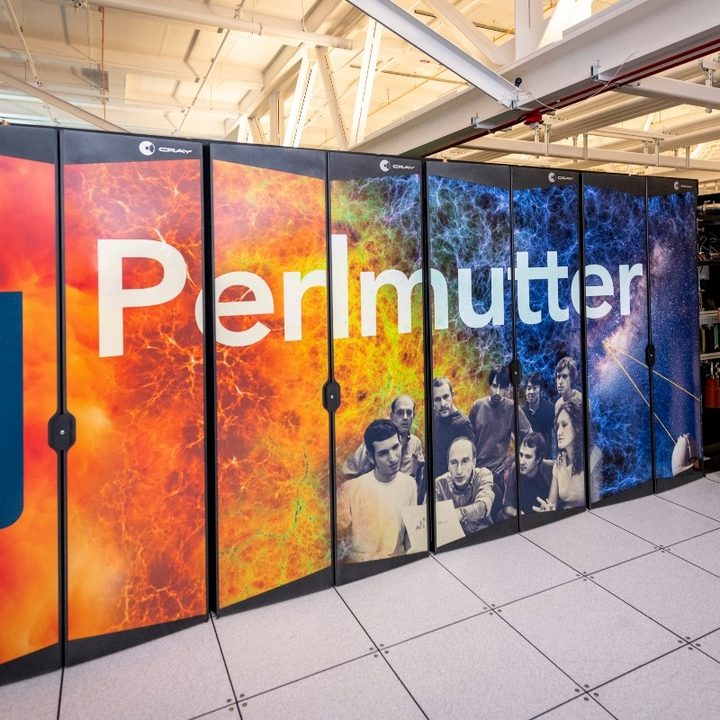
The Perlmutter supercomputer at the National Energy Research Scientific Computing Center (NERSC) at Lawrence Berkeley National Laboratory
The Perlmutter supercomputer at the National Energy Research Scientific Computing Center (NERSC) at Lawrence Berkeley National Laboratory Berkeley Lab

To hunt for one of the most mysterious forces in the universe, you need a powerful computer. Soon the hunt for dark energy will get a boost from a next-generation supercomputer, which will help in a project to create the most detailed 3D map yet of the universe.

Recommended Videos

The Wall Street Journal reports that the new Perlmutter supercomputer, recently installed at the National Energy Research Scientific Computing Center in Berkeley, California, will begin working on the Dark Energy Spectroscopic Instrument (DESI) survey project this summer. The project aims to learn more about dark energy, a hypothesized type of energy that accounts for a whopping 68% of the universe. To do this, the DESI instrument at the Kitt Peak National Observatory in Arizona will observe the night sky with 5,000 spectroscopic “eyes” which will record the light from 35 million galaxies.

To analyze all of that data, researchers will use the Perlmutter supercomputer. Named after Nobel Prize-winning astrophysicist Saul Perlmutter, the computer is a significant upgrade over the lab’s previous supercomputer, Cori, and is predicted to reach 100 petaFLOPS of processing power.

Perlmutter will use artificial intelligence to identify significant objects in the DESI data, then other applications can calculate the distance between these objects. By observing how gravity operates on a very large scale, researchers can pick up clues about the expansion of the universe, and from this, learn about dark energy.

That’s because dark energy is something we know exists due to the way the universe expands. Scientists have known for a long time that the universe is expanding, but research using the Hubble Space Telescope in the 1990s showed that the rate of this expansion was not slowing down, as would be expected due to gravity, but was actually accelerating. That’s the puzzle: There’s some unknown force pushing galaxies outward, and that force is what we call dark energy. To understand it more, we need to track distant objects like galaxies or quasars and map their distance.

To this end, the DESI project aims to produce a 3D map of the sky, far more detailed than any other 3D map made to date. “That allows us to look further back into the history of the universe and to a time period that’s never been probed [at high precision] for dark energy studies,” Aaron Meisner, a staff scientist at the National Science Foundation’s NOIRLab, told the WSJ.

DESI is expected to begin its five-year survey later this year.

Georgina Torbet
Georgina has been the space writer at Digital Trends space writer for six years, covering human space exploration, planetary…
Astronauts reportedly took shelter after work on Russia’s leaky ISS module triggered concerns
The ISS really picked a stressful time to start leaking again
The International Space Station.

Astronauts aboard the International Space Station reportedly took precautionary shelter measures after maintenance work on a long-troubled Russian module raised fresh safety concerns about air leaks aboard the orbiting laboratory.

According to reports, the incident involved Russia’s Zvezda service module, which has experienced recurring air leak problems for several years. During repair work and pressure tests connected to the leak investigation, astronauts were instructed to isolate themselves in safer sections of the ISS as engineers monitored the station’s integrity and pressure stability.

Read more
Blue Origin’s massive New Glenn rocket explodes in a fiery blaze during tests
The incident leaves NASA's Moon Base ambitions and Amazon's Kuiper constellation without their primary launch vehicle at the worst possible moment.
Explosion, Fire, Nuclear Explosion

Blue Origin's New Glenn rocket exploded during a static fire test at Launch Complex 36 in Cape Canaveral, Florida. The incident took place on the night of May 28, 2026. 

The explosion was captured on a live stream by NASASpaceflight.com and footage of the explosion spread rapidly across X. The Space Launch Complex 45 has confirmed in an official statement (shared by Spaceflight Now on X) that all personnel have been accounted for and there have been no injuries or fatalities.

Read more
Orbot Robotics’ space robot has four arms, but its Goro physique has a purpose
This four-armed robot could make routine space-station work easier for astronauts
Robot with four arms

Helios is a new four-armed robot from Zurich-based Orbit Robotics, and at first glance, it reminded me of Goro from Mortal Kombat. But unlike the prince from Outworld, Helios is not built for combat. It is designed to help astronauts on space stations with the repetitive, time-consuming work that keeps life in space running.

Orbit Robotics says that in microgravity, legs are not much help. Instead of walking or standing, Helios needs to move through tight station interiors, hold itself steady, and handle cargo, tools, or equipment. Its four-arm design turns extra limbs into both mobility aids and working hands.

Read more